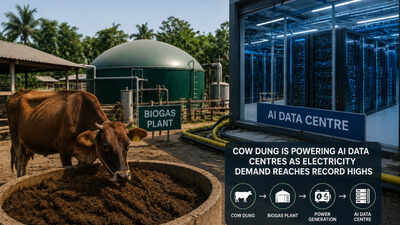
Artificial intelligence has created an unexpected problem. Training and running increasingly sophisticated AI models requires enormous computing power, and the data centres housing those systems are consuming electricity at an unprecedented rate. As grids struggle to keep up, technology companies and energy developers are searching for reliable power sources beyond conventional renewables. One of the most surprising contenders comes not from a power station, but from dairy farms.The answer lies in renewable natural gas (RNG), according to the US Department of Energy, a fuel produced by capturing methane released from decomposing cow manure. Instead of allowing this potent greenhouse gas to escape into the atmosphere, specialised facilities convert it into pipeline-quality gas that can generate electricity for homes, businesses and, increasingly, AI data centres. It may sound unconventional, but the technology is already well established, and supporters argue it could simultaneously reduce agricultural methane emissions while helping meet the surging electricity demand of the AI era.According to the International Energy Agency (IEA), global electricity consumption by data centres is projected to more than double by 2030, reaching around 945 terawatt-hours (TWh) annually, more than Japan’s current total electricity consumption. AI is expected to be the single largest driver behind that increase.“AI is the most important driver of the growth in electricity demand from data centres.” said the International Energy Agency, Energy and AI (2025)
Why renewable natural gas is attracting the AI industry
The idea is not to burn raw manure. The real opportunity lies in converting livestock waste into renewable natural gas (RNG), also known as biomethane.When cow manure decomposes naturally, it releases methane, a greenhouse gas far more effective at trapping heat than carbon dioxide. According to the Intergovernmental Panel on Climate Change (IPCC), methane has a global warming potential around 28 times greater than carbon dioxide over a 100-year period, and around 84 times greater over 20 years.Rather than allowing those emissions to escape, anaerobic digesters capture the methane inside sealed tanks where microorganisms break down organic waste in the absence of oxygen. The resulting biogas is then purified, removing carbon dioxide, hydrogen sulphide, water vapour and other impurities until it contains 90% or more methane. At that point, it becomes renewable natural gas.The U.S. Environmental Protection Agency (EPA) explains that upgraded RNG is chemically almost identical to conventional natural gas, meaning it can travel through existing gas pipelines and fuel standard gas-fired power stations without requiring entirely new infrastructure.That compatibility makes RNG particularly attractive to data centre operators. Unlike solar and wind, which depend on weather conditions, gas-fired generators fuelled by RNG can provide continuous, dispatchable electricity, an essential requirement for AI facilities that operate 24 hours a day and cannot tolerate unexpected power interruptions.
How cow manure could help ease the data centre power crunch
Interest in manure-derived energy has grown rapidly because it addresses two problems at once: reducing methane emissions from agriculture while producing reliable electricity.The EPA estimates that hundreds of livestock operations across the United States already use anaerobic digesters to recover methane, while the number of operational renewable natural gas projects has expanded dramatically over the past decade. According to the agency’s Renewable Natural Gas Database, the United States had 102 operational RNG projects in 2023, compared with just 41 in 2015, with agricultural manure representing one of the fastest-growing feedstocks.Once upgraded, renewable natural gas can either be injected directly into the natural gas grid or transported to nearby generating facilities that supply electricity to industrial users, including large-scale data centres.This flexibility is becoming increasingly valuable. Constructing entirely new power stations and transmission infrastructure often takes years, whereas RNG can utilise much of the existing gas network. That allows operators to increase available generation more quickly while reducing dependence on fossil-derived natural gas.Anaerobic digestion also produces nutrient-rich fertiliser as a by-product while reducing odours, pathogens and waste volumes on farms, creating additional environmental benefits beyond electricity generation.
Can renewable natural gas solve AI’s growing energy problem?
Probably not on its own.The scale of electricity required by artificial intelligence is simply too large for any single renewable energy source to meet. The IEA expects data centres worldwide to consume approximately 945 TWh of electricity annually by 2030, more than double today’s levels. In advanced economies, data centres are expected to account for more than one-fifth of all growth in electricity demand between now and the end of the decade.Renewable natural gas therefore represents one piece of a much broader energy strategy that increasingly includes nuclear power, geothermal energy, solar, wind, battery storage and conventional grid electricity.There is also an ongoing environmental debate. Some researchers argue that expanding demand for manure-derived RNG could unintentionally encourage larger industrial livestock operations by creating an additional revenue stream for factory farms. Others maintain that as long as livestock farming continues, capturing methane before it escapes into the atmosphere is substantially better than allowing it to enter the atmosphere untreated.What is becoming increasingly clear is that the AI revolution is reshaping the global energy landscape in unexpected ways. Just a few years ago, few would have imagined that the future of high-performance computing might depend, in part, on the waste produced by dairy cows. Today, renewable natural gas is emerging as one of several unconventional energy sources being considered as the world races to power the next generation of artificial intelligence.