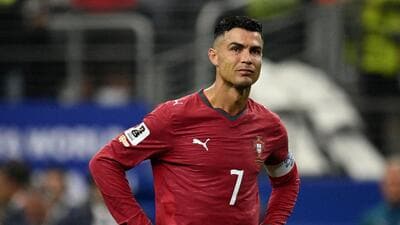
New Delhi: Cristiano Ronaldo has always defined himself by numbers. So, after he played his 27th and final World Cup game for Portugal, it feels apt to celebrate the legend in the same way.
He was the first player to score in six different FIFA men’s World Cup tournaments. Also, he was the first player to score 25+ goals across the Men’s World Cup and European Championships. His longevity – he is 41 years old – saw him become the oldest player to score in the knockout rounds of the competition and Portugal’s all-time top goal-scorer (with 11 goals) in the competition.
But in light of Portugal’s exit, another set of statistics stands out. In 10 knockout matches at the World Cup, over 741 minutes of play, Ronaldo scored just one goal (a penalty) and had zero assists.
The biggest players are expected to deliver when their country needs them most but Ronaldo went missing at exactly that point in World Cup after World Cup. Perhaps that tells us something about him or maybe it’s on the rest of the team.
While speaking on Portugal’s elimination from the World Cup on Fox Sports, former France striker Thierry Henry came out in Ronaldo’s defence.
“People will blame him because that’s the easy thing to do,” said Henry. “I won’t. Because if you decide to start Cristiano, then you have to build situations that suit him. Instead, Portugal kept circulating possession without purpose. They had one of the greatest penalty-box finishers football has ever seen, yet they hardly gave him the service he lives on. That’s not on Ronaldo. That’s on the team around him.”
Many, though, will wonder why Ronaldo was part of the starting eleven at all. In his final World Cup match, Ronaldo managed only 19 touches: 12 in the first half — the fewest he has ever had in the first half of a World Cup match — and only seven in the second.
Portugal coach Rogerto Martinez defended his decision to leave Ronaldo on the pitch throughout the match.
“When you’re a team and you need a goal, you can’t take Cristiano Ronaldo off,” he said. “He can play 90 minutes, no problem.
“He’s a presence, he opens space, with a deadball situation, anything in the box, it would make no sense (to substitute him). In extra time it probably would have made sense to use Goncalo Ramos. But we had to keep the structure, it wasn’t the case to take your top scorer off during the 90 minutes.”
But it was clear to everyone watching (including England skipper Harry Kane) that Ronaldo was a step slower than he was at his peak, his first touch on the ball is generally poor and those step overs that made him famous now look forced. Good enough against Uzbekistan or in the Saudi League, not so much against top-quality opposition.
It is hard not to admire what Ronaldo has achieved over the course of a career and the manner in which he has done it. However, watching him on the field was also hard, as he appeared a shadow of his former self. The tears he shed while walking off the field after the Spain game indicated how much this had meant to him.
“I’m sad to be leaving the World Cup like this,” Ronaldo said. “I gave it my all. I did my best and I’m leaving with a clear conscience. It was my last World Cup, yes, but I’ll now have time to reflect and be with my family. I won’t be making any rash decisions.”
He added: “I’ve won three titles for Portugal; before Cristiano, Portugal hadn’t won a single title. The biggest title the national team has ever won was in 2016, the European Championship, which, to be honest, is just as significant to me as a World Cup.”
To Ronaldo, at a personal level, it was but to the rest of the world, the comparison won’t add up. Perhaps the words were meant to soothe a bruised ego; perhaps it is what he ardently believes. Either way, the records will remain but they will always be accompanied by the sadness of a dream that was shattered by reality.