For decades, astronomers have searched for the birthplace of globular clusters, the dense spherical collections of stars that orbit galaxies today. These ancient systems are among the oldest visible structures in the Universe, yet their earliest history remains surprisingly difficult to reconstruct. Most theories have focused on crowded regions inside young galaxies, where gas was abundant and star formation intense.A new study published in Astrophysics of Galaxies, titled “Too shy to spin? Cosmic wallflowers as proto-globular clusters”, however, points attention elsewhere. Instead of forming deep within galactic discs, some of the earliest compact star clusters may have emerged in comparatively quiet territory surrounding young galaxies. These overlooked environments, sometimes described as circumgalactic regions, contain streams of gas feeding growing galaxies. According to simulations of conditions more than 13 billion years ago, these outskirts may have provided the right ingredients to form extremely dense star clusters that bear a striking resemblance to objects recently observed by the James Webb Space Telescope (JWST).
How gas filaments in the early universe created compact star clusters
The study used high-resolution cosmological simulations to explore how star clusters emerged when the universe was still very young. The team examined galaxies spanning a wide range of masses at redshifts greater than seven, corresponding to a period less than a billion years after the Big Bang.Within the simulations, they identified dozens of compact stellar systems forming beyond the main galactic discs but still inside the gravitational reach of their host dark matter haloes. These clusters were not associated with the crowded central regions often linked to vigorous star formation. Instead, they appeared along dense gas filaments surrounding the galaxies.Gas flowing through these filaments sometimes became unstable. Under the right conditions, sections of the stream fragmented and collapsed rapidly, producing compact concentrations of stars. What emerged were isolated clusters with remarkably high stellar densities, despite their distance from the central galaxy.
Compact star clusters detected by JWST mirror simulation results
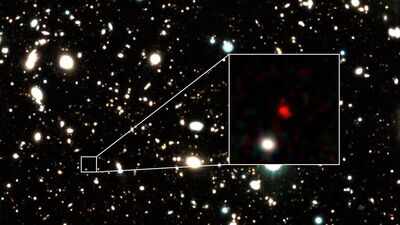
Interest in these objects has grown partly because of the James Webb Space Telescope (JWST) has begun detecting extremely compact star-forming systems in the distant Universe. Some of the most intriguing examples were identified through gravitational lensing, where the gravity of foreground galaxies magnifies far more distant objects.According to Harvard University, the simulated clusters reached stellar surface densities comparable to those inferred for compact clusters observed in the lensed Cosmic Gems Arc, a system seen at a redshift of roughly 9.6. Although simulations cannot prove that the observed clusters formed through the same process, the similarities suggest that circumgalactic environments deserve closer attention.The finding broadens the picture of where early star formation could occur. Young galaxies were not isolated islands. They sat within networks of gas filaments stretching across the cosmic web, and those structures may have hosted star formation in their own right.
How isolated star clusters may have become globular clusters
Globular clusters are found around many galaxies today, including the Milky Way. They contain hundreds of thousands, and sometimes millions, of stars packed into relatively small volumes. Many formed so early that they preserve clues about conditions in the infant Universe.The new work raises the possibility that at least some globular clusters did not originate inside galactic discs at all. Instead, they may have begun life as isolated compact systems in the outskirts of forming galaxies before surviving for billions of years.If that picture proves correct, it could help explain several long-standing puzzles. Clusters forming outside crowded galactic environments may have followed different evolutionary paths, experienced fewer disruptive encounters and retained distinct chemical signatures. Their unusual birthplace could still be reflected in the properties astronomers observe today.The idea does not replace existing formation scenarios, but it adds another route through which ancient globular clusters may have emerged.