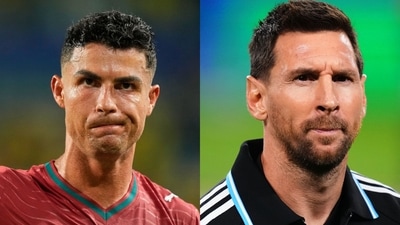
For more than two decades, Cristiano Ronaldo and Lionel Messi have existed almost inseparably in football’s biggest individual debate. Now, for perhaps the first time, the end of both their international careers appears close enough to allow their national-team legacies to be assessed almost in full.
Ronaldo, 41, has already confirmed that the 2026 World Cup was his last. After Portugal were eliminated 1-0 by Spain in the round of 16, he stopped short of immediately retiring from international football, saying he would take time before making a final decision. The latest reports suggest Portugal’s Nations League meeting with Wales on September 24 at Sporting’s Estádio José Alvalade could become his farewell appearance, although neither Ronaldo nor the Portuguese federation has officially confirmed it.
Messi’s situation is similarly unresolved but increasingly points towards the end. The 39-year-old has not officially retired after Argentina’s 1-0 defeat to Spain in the World Cup final, but teammate Leandro Paredes revealed that Messi appeared to have already decided the final could be his last international match. Reports in Argentina have also suggested that he may remain available briefly before receiving a formal farewell.
If those goodbyes are indeed approaching, their international careers leave behind two extraordinary but distinctly different arguments for greatness.
Ronaldo owns international football’s record book
The easiest part of the comparison belongs to Ronaldo. He has played 233 matches for Portugal and scored 146 goals, both men’s international world records. His international career began against Kazakhstan in August 2003 and has stretched across six World Cups and six European Championships.
Messi stands at 207 appearances and 125 goals for Argentina. The gap is therefore substantial but not overwhelming: Ronaldo has 21 more goals from 26 additional matches.
Ronaldo’s longevity is even more remarkable when his World Cup career is considered. His three goals in 2026 took him to 11 across 27 matches, and he became the first male footballer to score at six different World Cups. He is also the European Championship’s all-time leading scorer with 14 goals and became the defining figure of Portugal’s greatest period of international success.
Before Ronaldo, Portugal had produced great generations and reached the 1966 World Cup semi-finals, but had never won a senior major international trophy. Ronaldo captained them to Euro 2016 before adding Nations League titles in 2019 and 2025.
That distinction is central to his legacy. Ronaldo did not simply accumulate records for Portugal; his era changed what success looked like for the country.
Messi’s World Cup legacy creates the biggest separation
Where the comparison changes dramatically is the World Cup. Messi leaves the 2026 tournament with 21 World Cup goals from 34 appearances, second only to Kylian Mbappe’s 22. Ronaldo finishes with 11 from 27.
The difference becomes greater when their deepest tournament runs are examined. Ronaldo’s best World Cup finish came in his first appearance in 2006, when Portugal reached the semi-finals and eventually finished fourth. He never reached a World Cup final.
Messi has played in three. Argentina lost the 2014 final to Germany, beat France to become world champions in 2022 and returned to the final in 2026 before Spain ended their title defence.
Messi also won the World Cup Golden Ball in both 2014 and 2022, making him the only player to win the award twice. His 2026 performance added another extraordinary late-career chapter: eight goals and four assists as Argentina reached another final. His World Cup influence extends beyond scoring. Messi holds the tournament record for 23 victories and has produced 10 knockout-stage assists, another record.
Ronaldo’s World Cup longevity is historic. Messi’s World Cup resume, however, combines longevity with elite knockout influence, individual awards and ultimately the trophy itself.
That is the largest gap between them.
Euro Ronaldo vs Copa America Messi
Their continental careers produce a much tighter comparison. Ronaldo’s European Championship numbers are unparalleled. His 14 goals make him the competition’s record scorer, while his six tournament appearances stretch from the heartbreak of losing the 2004 final at home to finally lifting the trophy in 2016.
Messi has scored 14 Copa America goals and holds the competition’s appearance record with 39 matches across seven editions. More importantly, after losing Copa finals in 2007, 2015 and 2016, he finally won the competition in 2021 before Argentina successfully defended their title in 2024.
Ronaldo, therefore, possesses the stronger individual record within his continental championship. Messi has the stronger title record, with two Copas compared to Ronaldo’s one European Championship.
Their additional trophies add another layer. Ronaldo’s two Nations League victories give him three senior international titles. Messi has four: two Copas, the 2022 World Cup and the 2022 Finalissima.
Two different relationships with their countries
There is also an important historical distinction.
Messi played for Argentina, a nation that had already won two World Cups before his senior debut and carried the enormous cultural legacy of Diego Maradona. His challenge was not creating an international powerhouse but restoring one.
Argentina had gone 28 years without a senior title before the 2021 Copa America and 36 years without a World Cup before Qatar. Messi’s late-career transformation turned years of international frustration into arguably Argentina’s greatest sustained modern period: Copa America in 2021, Finalissima and World Cup in 2022, another Copa in 2024 and another World Cup final in 2026.
Ronaldo’s legacy is different. Portugal were respected before him, but his generation crossed a line none before it had crossed by actually winning major trophies. That gives Ronaldo perhaps the stronger case when measuring impact relative to his country’s previous achievements.
So whose international legacy is greater?
Ronaldo’s international career is arguably the greatest exercise in longevity and goalscoring that men’s national-team football has seen. The most appearances. The most goals. Six World Cups. Six European Championships. Portugal’s first European title and two Nations Leagues.
But overall, Messi’s international legacy is stronger. The reason is not simply that he won a World Cup. It is the combination around it: three World Cup finals, 21 World Cup goals, two Golden Balls, another extraordinary eight-goal campaign at 39, two Copa America titles and an influence on Argentina that went far beyond finishing chances.
Ronaldo owns more of international football’s record book. Messi owns the greater body of achievement at international football’s biggest tournament. As their final goodbyes approach, that is perhaps the clearest distinction between two international careers that shaped an entire era.