
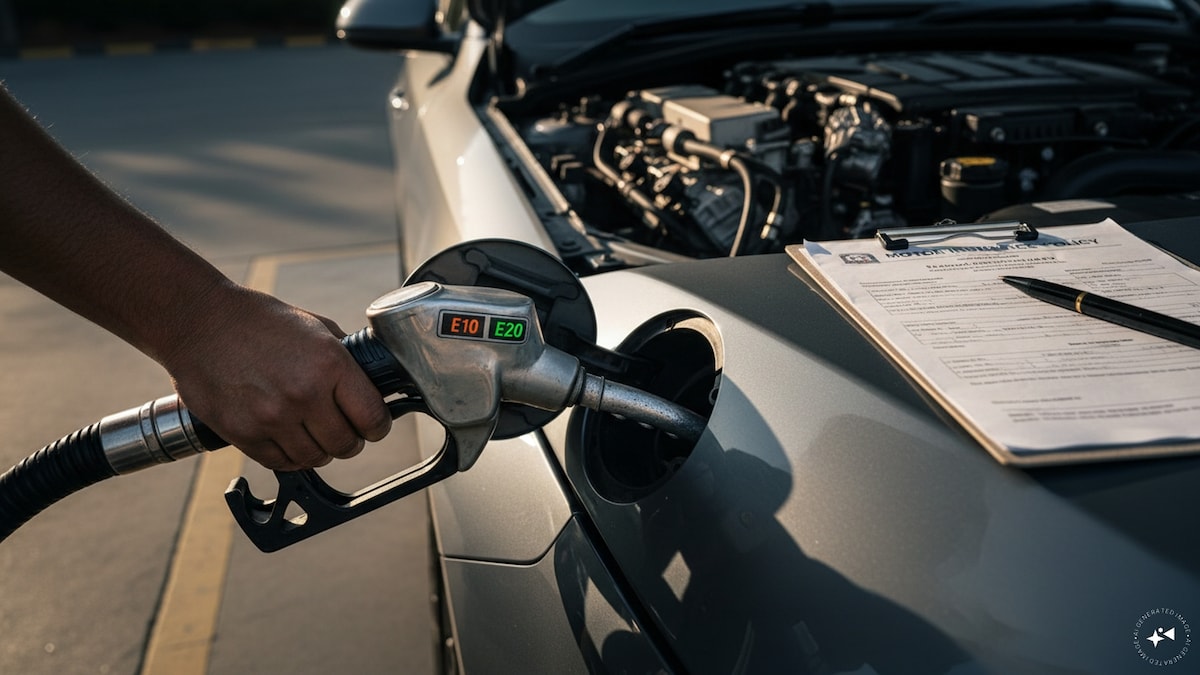
The issue gained attention in June 2026 after wording on an ICICI Lombard webpage led to concerns that damage linked to the use of E20 fuel in vehicles not designed for it could affect claim eligibility.
The insurer later clarified that using E20 petrol does not invalidate a motor insurance policy and that claims are assessed based on the insured event and policy terms, not on the fuel type alone.’
Here’s a detailed look at what using E10 or E20 petrol means from a motor insurance perspective.
Insurers and industry experts say the fuel type alone does not determine whether a motor insurance claim will be accepted or rejected. Claim assessment continues to depend on the policy coverage, the nature of damage and the cause of loss.
Explaining this, Saurabh Vijayvergia, Founder and CEO of CoverSure, an AI-first, IRDAI-licensed insurance management platform, said that if a vehicle suffers an insured event such as an accident or theft, the claim would be assessed based on the policy terms and the cause of loss, not simply on whether the vehicle was using E10 or E20 petrol.
What if a vehicle develops a mechanical issue?
A key distinction for policyholders is between accidental damage and mechanical failure.
Experts said a mechanical breakdown does not automatically become an insurance claim merely because the vehicle was running on E10 or E20 petrol.
“Standard motor policies have always treated mechanical or electrical breakdown and normal wear and tear differently from accidental damage,” Vijayvergia said.
If a vehicle develops an engine or fuel system issue, the insurer may examine the cause of the damage and determine whether it falls within the policy coverage.
Atrey Bhardwaj, Chief Growth Officer at Probus, a digital insurance broker and InsurTech platform, also said insurers cannot reject a claim solely because E20 fuel was used.
However, if an investigation establishes that damage occurred because the vehicle was not compatible with E20, or because the owner ignored manufacturer recommendations, the circumstances leading to the loss may be evaluated.
What about vehicles designed for E10 petrol?
Vijayvergia said E10 vehicle owners do not have a separate motor insurance framework.
“There is no separate motor-insurance regime for E10-designed vehicles as things stand, and an E10 vehicle doesn’t become uninsurable simply because E20 is now the standard fuel at the pump,” he said.
For such vehicles, insurers will continue to assess claims based on the same parameters, the policy coverage and the cause of damage.
A reduction in mileage or fuel efficiency, by itself, is generally not treated as an insured loss under a standard motor insurance policy.
What records should vehicle owners maintain?
Experts say vehicle owners do not need additional documentation only because they use ethanol-blended fuel.
The usual insurance records remain important, including:
- Motor insurance policy documents
- Registration certificate (RC)
- Driving licence
- Claim form
- Repair estimates
- Workshop diagnosis or job card, especially in case of disputes over the cause of damage
- Vehicle servicing records
Bhardwaj said owners should keep service records updated and ensure maintenance is carried out as per the manufacturer’s recommended schedule.
Vijayvergia added that if a vehicle owner suspects a fuel-quality issue, they should preserve the fuel bill, if available, and approach the fuel retailer or oil marketing company for resolution.