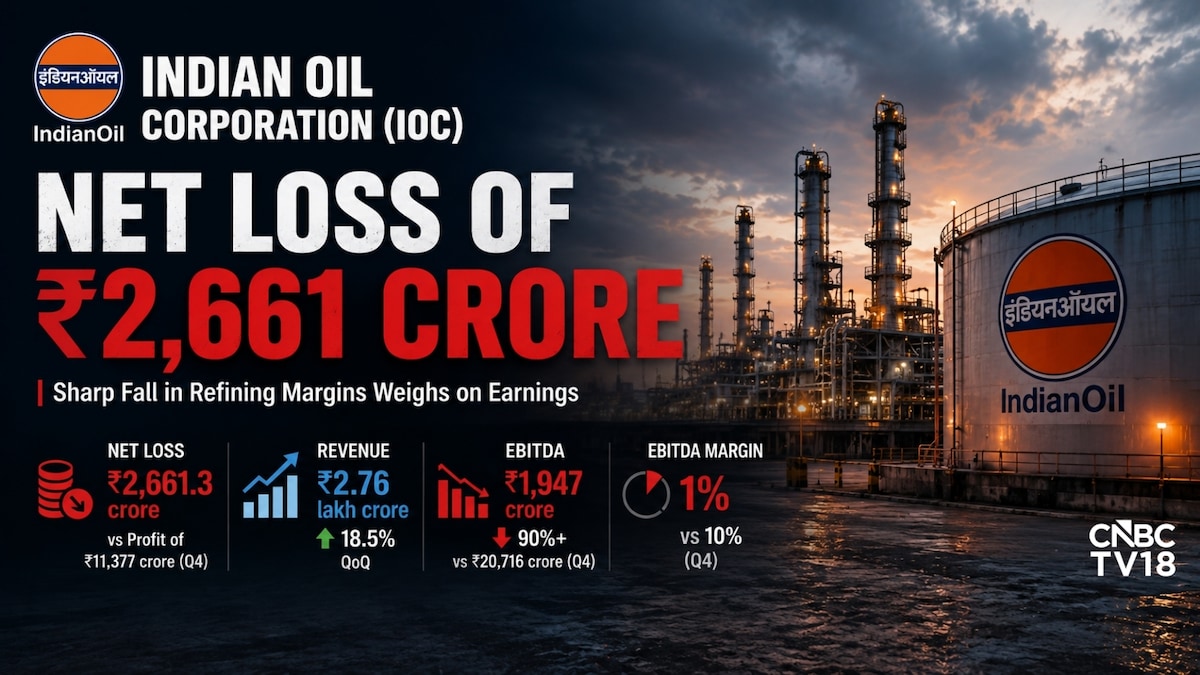
The company had reported a profit of ₹11,377 crore in the March quarter, highlighting the sharp deterioration in earnings over just one quarter.
The June quarter was widely expected to be difficult for oil marketing companies (OMCs), as lower refining margins and weak marketing profitability weighed on earnings across the sector.
Revenue rises, but profitability collapses
Revenue increased to ₹2.76 lakh crore, beating the CNBC-TV18 poll estimate of ₹2.59 lakh crore and rising from ₹2.33 lakh crore in the March quarter.
However, higher revenue failed to translate into profits.
EBITDA fell sharply to ₹1,947 crore from ₹20,716 crore in the previous quarter.
EBITDA margin shrank to just 1%, down from 10% sequentially.
The company also reported a pre-tax loss of ₹3,274.3 crore, compared with a profit of ₹15,322.4 crore in the March quarter.
The sharp decline in margins shows that higher sales alone were not enough to offset the collapse in refining profitability. For refiners like IOC, refining margins often have a much bigger impact on earnings than revenue growth.
What hurt IOC this quarter?
Refining margins, also known as Gross Refining Margins (GRMs), measure the difference between the cost of crude oil and the value of petroleum products such as petrol, diesel and aviation fuel.
When these margins decline, refiners earn less on every barrel of crude they process, directly affecting profitability.
The June quarter saw a sharp fall in refining margins across the industry, making it one of the weakest quarters for state-owned oil marketing companies.
LPG compensation cushions the blow
IOC’s financials continued to receive support from the government’s LPG compensation mechanism.
The company recognised ₹3,621.5 crore as revenue during the quarter as compensation for losses incurred on supplying subsidised domestic LPG cylinders.
This helped reduce IOC’s cumulative net negative LPG buffer, although the outstanding balance remained substantial at ₹29,729.95 crore as of June 30.
Without this compensation, the company’s quarterly loss would have been even larger, underscoring the financial burden of selling domestic cooking gas below market prices.
Governance issue continues
IOC said its financial results were approved directly by the Board, as the Audit Committee has remained non-functional since March 28, 2026, owing to the absence of the required number of independent directors.
An audit committee is a key governance mechanism responsible for overseeing financial reporting and internal controls. While the board can approve results in such circumstances, prolonged vacancies in independent director positions are generally viewed as a governance concern.
Shares of Indian Oil Corporation ended almost unchanged at ₹139.99 ahead of the earnings announcement on Friday. The stock has fallen nearly 16% so far in 2026.
Also read: ITC Q1 profit slides 27% as lower revenue, margin pressure hurt growth; misses estimates