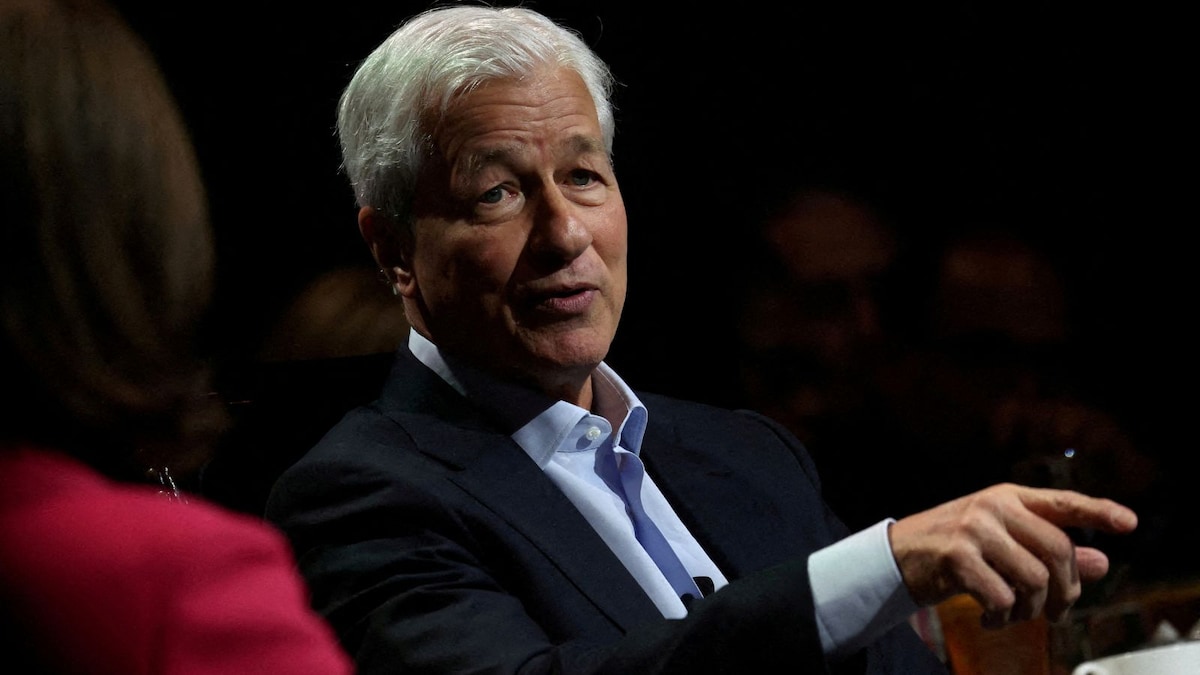
Dimon was speaking to CNBC on JPMorgan’s Olympic partnership, which underscores changing economics of sports.
-JPMorgan recently inked a partnership with the Olympics, which cost the firm hundreds of millions of dollars, a person with knowledge of the matter said. The sponsorship – not too dissimilar to one BofA did with FIFA – underscores how the International Olympic Committee is looking to cash in directly from multinationals. And for companies like JPMorgan, they get more direct brand exposure with integrated marketing (i.e. the torchbearer running by a Chase branch). Jamie Dimon shared his take on the economy, the outlook for investment banking & dealmaking, AI, and more.
Here is the full transcript of the interview:
CNBC: Jamie, thank you for taking the time. We are obviously here at the lovely LA Coliseum ahead of the partnership that you have struck with the LA Olympics in 28, the other French Ops Olympics in 2030, and you’re expanding your presence here in Los Angeles as well, particularly with small businesses. What’s the impetus for these investments here in LA,
Jamie Dimon
So we showed way back on this. Well, first of all, welcome everybody. We bought WaMu like literally a week after Leo went bankrupt, and that formed the platform. I think three or 400 branches. We now have 700. You know, we’re the number one deposit share here, and the whole time we built on top of that private banking, investment banking, the innovation economy, and our services. So we’re totally vested, and obviously L.A. is like 35% or so of California in total and still a hotbed of technology, manufacturing, obviously Hollywood; and then L.A. Olympics. You know, we’re all in L.A., so we decided to, you know, be a sponsor of that, which we’re pretty proud of doing, and a big push in small business because the Olympics is going to make sure that a lot of the contracts that serve the Olympics for you know, that multi-week period is going to go to small business. So you want to help a lot of these small businesses get the procurements, get the contract, and get the finance they need to expand their business now and in the future.
CNBC: And I believe you were the first bank branch to reopen after the Palisades fire, and you had this big housing initiative as well that you launched this week as part of your bus tour throughout California as part of the American Dream Initiative that the firm is also doing. You’re allocating 750 billion dollars through 2035 to support home ownership in the US, and that announcement actually was about six weeks after the US housing bill was passed. And I’m curious how this access to capital, as well as the you know, removing some restrictions to build, do you think that really moves the needle?
Jamie Dimon
Yeah, it’ll start moving the needle. Pacific Palisades. I mean, I went there a year ago with Rick Caruso, who’s just a fabulous human being. He’s opening literally next week the Pacific Village and Palisades Village. We’ve our branch was totally burnt down there, and that’s been rebuilt. And he’s doing it early because he wants to help accelerate and catalyse growth in that area. If they’re there, homes will come back and other businesses will come back. And so, great example of collaboration between business and government, trying to get things done the right way. Housing, you have two issues. One is affordable. One is affordable. So we’re doing a lot of affordable housing and more lending, cheaper mortgages. The other one is supply. Supply is mostly around permitting approvals and local zoning requirements. So the bill the House passes is very good, and then we have to do complements to it locally. A lot of local stuff is stuff that holds it back. So if you do both, you’re going to get a lot more supply.
CNBC: And of course, a key part of housing affordability is mortgage rates, and I want to get your thoughts on the bond market with the recent reset, particularly on the long end. How concerned are you about this signalling a credibility test at the Fed and their willingness to actually fight inflation?
Jamie Dimon
Yeah, well, I think the more important question is ‘Is there inflation?’ If there’s inflation, they will have to fight it. It hasn’t changed very much lately, and it’s been over 3% now for five years. I think the world of Kevin Warsh. I think it makes tremendous sense for any new leader of the Fed. And if you give anyone a job, take a step back; look at it, think about what you did and how it should be done. That’s the job of a leader, and I think he’s doing the right thing. I think he’s raising the right issue with the task force. I’m not greatly in favour of the task force, but it’s the right idea to look at how we measure inflation, what the issues are, and the balance sheet. So I wish them the best. They will, you know, over time do the right thing.
CNBC: So I don’t think
Jamie Dimon
it makes that much of a difference about signalling to the Fed. I think the people are, you know, squealing like stuck pigs in that one.
CNBC: Sticking with the animal analogy, you recently called inflation a skunk at a party.
Jamie Dimon
Yeah.
CNBC: And so going back to your early earlier point about whether inflation still exists, do you still sense that otters are still out there?
Jamie Dimon
Yeah, so I didn’t say it is. I said it could be. By that I mean, what are the inflationary forces that are taking place? It’s at 3%. So obviously we all want to get it down, but forces are pushing up: some of the geopolitical situations, huge global deficits, and government deficits. You know, ours is 2 trillion, almost 2 trillion. The rest of the world, you know, is almost 4 or 5% of their GDPs. Huge infrastructure requirements. So inflation is both, you know, what people expect, but it’s also capital demand, and it seems to be there’s a lot of demand for capital. The remilitarisation, the world would be inflationary. I don’t know if these things will push the rate up, but if they do, that could be the skunk of the party. That people want to be paid more money for long-term bonds, and so you just got to keep your eye on it. Hopefully, none of those things will materialise in a bad way.
CNBC: And you recently told our former colleague Wilfred Frost in a podcast that you wouldn’t be a buyer of treasuries; you wouldn’t be a buyer of equities at these levels. Why is that?
Jamie Dimon
Well, Treasuries, as I just said, are like already embedded in the marketplace; there are people’s assumptions about inflation. I guess that there are higher odds for that than the other ones. Equities, I should have said it that way. There are always equities you can buy, but asset prices are high. So stock prices, however you measure them, you know? In the top five or 10% of all-time measurements, but at any point in time, a stock could be a good buy. Now that’s true globally. So you know, you look around the world. No, you shouldn’t speak generically about stock prices. So,
CNBC: a lot of people have criticised market structure right now, levered ETFs, positioning, and so forth. How concerned are you about the proliferation of levered ETFs on single stocks?
Jamie Dimon
Well, leveraged ETFs on their own are quite small, so I’d say not really. But there is what I call market leverage: prime broker leverage, hedge fund leverage, ETF leverage, treasury arbitrage leverage. I’m double-counting some of that, so the market leverage is pretty high. Now, of course, we manage it, client by client, you know, and so you’ve seen disasters that you know, people lose a lot of money and nothing really happens. They just unwind it. But when you have that, you do have a higher chance that some people will disrupt the market in a quick way, and people get rattled over it. And so it is a little high. And I just saw the Fed today is going to be looking at private credit again. I’m not worried about that systemically, but there may be some issues that the Fed should be looking at.
CNBC: Going back to the leverage that that you’re talking about, obviously, a big high-profile example of that was Situational Awareness last week. J.P. Morgan was one of the bigger prime brokers to Situational Awareness, which was a now-collapsed AI-focused hedge fund. How much more stress do you see out there? It’s
Jamie Dimon
Still there, by the way. Right, they unwound all that
CNBC: Smaller, smaller form.
Jamie Dimon
No, I think that market handles that very well. But when I talk about leverage, margin debt is the highest ever. There’s a lot of margin debt you don’t see because it’s not called margin debt; it’s called other things. So it’s that kind of leverage, some hidden, some public. We see a lot of it, and it’s high. You know, it’s not. I’m not going to say it’s systemically high. It’s going to cause a disaster, but it’s high. You know, the worst thing is if you have actual losses in the marketplace, which would happen in ’08. It wasn’t the leverage; it was the amount of losses that were going to be realised on mortgages.
CNBC: So, as a result of that, have you been asking clients to hold more collateral because of you know what you’re seeing in the system?
Jamie Dimon
We always adjust that. I mean, again, that’s client by client. It’s always adjusted. You know, when volatility goes up, clearing houses and banks generally ask for more collateral. So you’ll probably see a little bit of that.
CNBC: I want to ask you about AI. There was a Reuters report out this morning, which says you’ve been personally reaching out to other CEOs to join an industry group known as the Alliance for Critical Infrastructure to address risks posed by AI. There’s a lot of complexity and conflicting opinions about regulating AI, open source versus closed, and China versus the U.S. specifically. Based on what you’ve, you know, those conversations that you’ve been having and what you’re seeing internally, what do you think is the best way to regulate?
Jamie Dimon
Yeah. So the first thing is Tom Fanning, who had great foresight, set this thing up a long time ago. I’m like a support cast member here to try to get more members and try to get if we are doing the right stuff and ask the questions. It’s critical. This thing is called the Alliance for Critical Infrastructure. People are already members. You know, we’re just trying to strengthen it. But obviously, with mythos and risk to physical assets, you know, it’s incumbent upon industry to do its job both within an industry – so a lot of industries already do it, but also across industries; we’re all reliant on each other. You know, if telecom has a problem, it could affect us. If utilities or water has a problem, it could be a huge effect on banks but also on the economy. So most people say yes. Let’s roll up our sleeves and get to work and figure out how to protect the infrastructure. And remember, this is beyond us. So it’s not just big companies. You know, we want to help all banks. We want to, you know, every if you’re in the utility business, you want to make sure all utilities are protected, and, you know, their government things are not protected. So this is just re-upping the effort to make a very serious effort to make sure we’re doing all the right things about patching, understanding the risks, doing tabletop exercises, looking across industries, and sharing best practices, and everyone should be. And you can start doing some of that stuff now. You don’t have to wait for this to come out. So this thing is just being strengthened and informed and hopefully will be a real positive element. And then obviously work with the government. The government has its own role in this, and so this group will help interface with that, and both give advice and take advice from the government.
CNBC: One thing that your CFO Jeremy Barnum said on your recent earnings call about J.P. Morgan’s token expense was that it’s a trivial number for the first half of the year, but you’re forecasting some meaningful acceleration in the second half. How concerned are you about this trend toward token maxing and costs, and and how do you control them?
Jamie Dimon
Yeah, well, they will be controlled. I mean, right? You can write. There’s a company I met. I met them a while ago. That’s the cocktail party I had last night. That that has it’s going to have an orchestration layer that sends your work to the best for you. So it could be cheapest to deliver. Could be the most expensive. It could be the fastest. It could be all different things. And so people will manage the cost of tokens, and it’s like you’re not going to take your Ferrari to get gas, you know. So right now, you know, some of these things are very expensive. Some of the other things are 1% of that, and a lot of queries that people set into the expensive stuff could have gone to a low-cost, even no-cost query. So it’s just that. Just imagine the process, and then. Will be managed over time. I mean, everyone knows that there’ll be different ways to do it. I can do it by budgeting it differently, by only giving you so many expensive tokens and a lot more cheap tokens, and we’ll figure it out. I’m really not that worried about it. But again, you know, for enterprise, it’s got to make sense. People aren’t just going to spend more and more money where they’re not getting value for it. So people will be measuring the value multiple different ways, and I think it does bring value. So we, you know, we’ve been doing this now for 12, 13 years, and we have over maybe 1000 use cases, but some are just critical or ready to our operations at risk: fraud, marketing, design, customer errors, and it’s literally just starting. I mean, these new models are so good and so powerful; they also create the risk, which is why we’re doing the critical infrastructure investment.
CNBC: Right. It all it all pulls together. Also on that call, Jeremy mentioned that the firm passed on some data centre financing, and I’m just wondering, kind of given that element of the business model with regard to kind of trafficking, not taking your Ferrari. I mean, I’m assuming you take it by gas, but maybe maybe not something Less expensive, you know how how much excess do you think is out there in light of kind of this rethink around expense in the business model?
Jamie Dimon
You know about hyperscale spending or excess spending on corporations? Which one are you referring to?
CNBC: Oh, excess spending by the hyperscalers and the data build-out and all the financing. Right. So,
Jamie Dimon
In my own view, and I maybe won’t. It’ll ultimately play out and pay out. And these people are doing real calculations. What’s needed? They see what it costs to do the frontier models. They see what it costs to do inferencing. The need is going up dramatically. People are going to be offering more, but it’s a big build. So I don’t know. But if you look at specific data centres. That’s different. Who’s the takeout? When’s the takeout? Who’s responsible if the power doesn’t get turned on? Who’s responsible if the GPUs don’t work at full function? That’s projects, and we have to analyse them one by one. But we’ll see. It’s also driving the American economy because the increase alone is 1% of GDP, and next year it’s going to be another 1% of GDP increase, and so you know that’s right now going to be higher. You’ve got to get steel and cement and all these things to build the data centres, and hopefully there’ll be more productivity after they’re built. It takes a while to get them up and running.
CNBC: If that boom fizzles, though, I mean, is that a threat to the U.S. economy?
Jamie Dimon
Well, there are two things. If they have to spend less money, that will reduce the GDP. The value from the existing data centres will probably be real, so there’s two different elements. So,
CNBC: So you’re not too concerned about that reversing and having a more systemic impact on the lot of
Jamie Dimon
Things to worry about, and that’s not high on the list. Yeah, I haven’t
CNBC: Heard you mention it high on the list. That’s why I figured it was worth asking. You know, we’re here in LA, obviously, and you are leading a $10 billion loan package to support the Paramount SkyDance acquisition of Warner Brothers Discovery, also advising on that deal. You know, David Ellison recently penned an op-ed in the New York Times in defence of the deal, and I’m just curious what you think the whole thing means for the media industry.
Jamie Dimon
Yeah. So first, I like David quite a bit, and what I’m about to say is not self-serving because I know people say that and say whatever you want. That industry is very competitive. Some people are really struggling. Some are doing well. Huge sums of money are going into it from various sources, major companies. What’s happened? The consumers have more and more and more content from all these various distribution sources. That’s what’s happening. Boards have to decide how they want to position themselves for the future. So this is a very competitive market. All the people who actually know antitrust really well have already proved all this, and they looked at the broader market, the narrow market, and stuff like this. So this is going to be tough competition for David or anybody else in the business, whether or not they do this acquisition. So that’s one point. You know, to act like it’s not a competitive business and that something’s wrong with this. That’s not great. The second thing is far more important for the future of American business, which is states overriding national policy on mergers and acquisitions that are often done by, you know, regulators or the DOJ trusts. Of course, things should be reviewed, but the notion that state’s going to get the vote in every one of these things-I mean, you you actually have a small pockets, our our dynamic system, and and all these various things, and you know, for the folks who don’t know, I mean, this country is so dynamic because we have these huge markets that people compete in, and boy, do they compete. There may be examples of monopolistic behaviour, but I’ve seen very little of that in my life. You know, if you go to Europe and states, they can’t compete, and because you can’t sell goods, you know, basically can’t sell goods across borders because of all this, all this to think of states. It’s crippling the European economy, and if you if we want to cripple ours, that’s a good idea to start there. So I would urge people: this is not a state-by-state matter, and I know they have they may have a legitimate interest in it. They should be thinking about the country’s interests on this one.
CNBC: The Capitol Bar. Its pipeline is a key, you know, moment for large banks such as yours. SpaceX reported its first earnings report as a public company, trading about you know more than 10% below its issue price. Obviously, lockup expiring and so forth. Do you think that the performance of SpaceX and some of the other broader concerns about the AI ecosystem, you know, poses any risk to the the pipelines that everyone has been so excited about this year.
Jamie Dimon
I don’t know. We talk about pipelines. First of all, the IPOs opened and closed in 2021. I think there were 400 in the United States in 2022. There were 40. And then where people will take public might be quite different in one environment than in another environment. But when we talk about an IPO, you might specific companies that are specific to a company. That may not be the market in general. So, so I don’t think it really does. I think if you have really bad markets, it does. You know, really bad markets. You know, IPOs can drop dramatically. So that to me would be more important. And then you have to evaluate company by company what you think.
CNBC: Well, some of the bigger ones that people were expecting this year: Anthropic, maybe OpenAI next year. Any issues you think? Given
Jamie Dimon
I can’t talk about them specifically, but there are a lot of companies that want to go public. Some that don’t have to. So we talk to a lot of them, and you know, and then the people who ultimately decide are the big investors, and there are very smart investors out there. It’s not decided by the company selling or even by the investment bank. It’s by huge investors or global investors, sovereign wealth funds, the big money managers. They will say, “I want to buy this. I don’t want to buy it. And remember, they’re also doing it privately, so there’s a lot of private market activity, which is pretty close to what I would consider public at this point, where people are buying and selling pieces of these companies at the values you hear about.
CNBC: Right? I’m sure you’ve had those discussions this week here in California. On the most recent earnings call, you described the broader banking environment as quote getting as close to as good as it gets. We just don’t know how long it’s going to last. What do you see as the biggest risks to the banking environment?
Jamie Dimon
Stand by that statement. It’s pretty good. It is. I mean, anyone in our business, I mean, enjoys it, but don’t think it’s just because of our own genius. You know, markets are up, and volumes are up and things- IPOs are up, high yields are up, hyperscale is funny money- and it’s kind of a global phenomenon. But the biggest, I think – I’ve already talked a little about rates and inflation. I’d put that there, but geopolitics. I mean, I think there’s more about the free world at this point. How you know, Ukraine terrorism, Iran’s sorting out, how our relations with China sort out. That is probably the most important. Now, whether it affects the economy is that’s a different issue. I’m much more concerned about doing things that protect the free and Western world. You know our military alliances and our economic alliances are critical. How we manage through that, you know, how we manage through the end, hopefully the proper end of these wars, is more important.
CNBC: And the security and resiliency initiative turned almost turned one year old. I guess it’s October that you launched that. What has been your experience so far?
Jamie Dimon
It’s been extraordinary, and you know it’s opened our eyes. We’re learning the process. We hire people. We have Jay Hirwine doing a great job. Todd Combs is doing a great job. You know we we’ve seen hundreds of companies, hundreds of ideas. We’ve written research around this shipbuilding ecosystem, the pharmaceutical ecosystem, and the rare earth ecosystem. More are coming. We’re talking about what’s the right kind of industrial policy. All countries do industrial policy, but what’s the right way to do it to get back to what we need? It’s certain advanced manufacturing and semiconductors, and these are really complex ecosystems. We’ve also rolled this out to allies. Let’s just think of the UK, France, Germany, Poland, Italy, Australia, Japan, and South Korea; they also have this issue, and they also do a lot of things with America. You know, a lot of ships come out of South Korea. So one of the things I did in Philadelphia, I went to the Navy Yard. It was Hanwha bringing technology in to restart the shipping business, the shipbuilding business in the old Philadelphia Navy Yard, which built a lot of ships in World War II. And I read about one this morning, which I can’t tell you about, to start a port which built a lot of the ships in World War II in another city, and so this thing is working. It’s not just us, by the way. We were a teeny part of it, but when you travel around here, like last night, I had a company at my table. It’s amazing what these entrepreneurs do. That is, you know, building satellites to move satellites in space, quite successful at putting them in different positions. You need to get them there. You know, I saw a company called Zipline, a fabulous guy running it called Keller. You know, that started by drones, but delivery wasn’t allowed here for a while. Delivering medical pharmaceuticals in Rwanda, you know, to remote areas, and 17,000 lives have been saved, and now he’s doing it here in certain metropolitan areas. Not all of them, and just think of this: the drone costs I don’t know three; it’s $5 to get there. Here is delivering medical supplies or food to elderly people, and compare that to delivering it by car. You have to get a person in the car, get them started. It’s 4000 pounds of steel. Drive 30 miles. The food is called anyway. Drive 30 miles back. This is cheap, free, safe, no traffic, no traffic accidents, far less energy supply, so no CO2. So these technologies, they’re unbelievable. And of course, you’ve seen the new technology in drone warfare, and we’re just doing our part to make sure we get here. We need to do here, and we do need to do it. This is we made I don’t like fine over spilt milk, but we made a huge mistake not recognising the problem 10 or 15 years ago. You know, outsourcing to potential adversaries, not to their adversaries, supplies that we need for our F-35s, our nuclear subs, our tanks, etc. So we didn’t have production capability to build more missiles. We need more production capability. It needs to sit there idle sometimes so you can push a button and turn it back on when you need it for a war. And so, all of these can be fixed. You know, the governments make a lot of changes now in how they do procurement, budgeting, and ordering supplies ahead of time. A lot of companies could build stuff, but they need an order from the Department of War. So we’re working on this stuff to make some great policies. More to come in this one, but it’s been fabulous. Yeah,
CNBC: Yeah, it’s been quite the year. I’ve read the research; it’s really good. You know, a month ago, you elevated Troy Roba and Doug Petno to co-presidents, which kind of reignited the parlour games about what J.P. Morgan looks like in a post-Jamie Diamond world. Any updates or what the market should start thinking about in terms of timing? It’s
Jamie Dimon
Not a parlour game. It’s the most serious thing that a company can do. It’s what do you put in leadership, and we’ve got great leaders throughout the company. Obviously, there are two to replace me tomorrow. They’re quality people, right heart, right mind, curiosity, grit, courage. That which is what I care about. But people say, “What are you looking for? Technology? Or I said, “Absolutely not. I want a package of a person who’s a leader, who’s trusted, who’s respected, who’s curious, who’s honest. His day is long. Who you know meets flaws. Like we make a lot of mistakes. The only way you fix them is you acknowledge them. And so we’ve got that. And you know nothing’s changed other than the names.
CNBC: So no update on timing or anything on that. It’s
Jamie Dimon
exactly what I said before, so I’m not going to repeat on the show.
CNBC: Great, Jamie Dimon, thank you so much. Thank you. Appreciate your time.
Also Read: DeepSeek plans ‘significant’ price increase for its AI services