India’s men and women begin their FIH Hockey World Cup campaigns this weekend at the Wagener Stadium in Amstelveen, the Netherlands. Both teams have been drawn into Pool D of their respective draw, and, catastrophe forbidding, should make it out of the first stage. The bigger question is what happens next; not since the 1970s have the Indian teams finished in the top four. But, with both units showing great promise and improvement in the last eighteen months, 2026 may yet reshape that narrative and bring an end to that drought.
Converting Olympic form will be key amidst midfield questions
India’s men have not stood on a World Cup podium since they won the whole thing in 1975. That is fifty-one years of trying, and mostly failing — since 2000, their best World Cup finish is sixth, back in 2018. The infamous 2023 edition, played on home turf in Odisha with every possible advantage, ended in a ninth-place finish that got coach Graham Reid the sack.
This time feels different, and it has nothing to do with sentiment. India have won back-to-back Olympic bronze medals in Tokyo and Paris under Craig Fulton, who has quietly rebuilt the side’s tactical identity. The team that used to attack in waves and leak goals now defends in a compact, disciplined block and looks to hurt teams on the counter-attack — the same approach that got them through the Paris Olympics playing over an hour with ten men after a red card, and still winning on a shootout. It is a less glamorous way to play, but it has been effective.
Also Read: Olympic royalty but World Cup outsiders: Indian Hockey’s long climb back to the top
The results in 2026 have been mixed, and that needs an honest look rather than a rosy one. Across 16 matches in the FIH Pro League this year, India won just four, drew five, and lost seven, including an 0-8 hammering by Argentina in Rourkela. But split that Pro League season in two, and the picture changes. The Indian leg was poor; the European leg, played soon after, was much better. India beat both the Netherlands and Germany, thrashed Pakistan twice, and split two shootout contests with England. Fulton has a vocal history of treating results as secondary to preparation — India were unconvincing before Paris 2024 too, and still came home with a medal. The European form suggests the team is peaking at roughly the right time again.
The group itself is kind. Wales are the weakest side in the pool and should not trouble India. Pakistan have been beaten in seven of the last eight meetings since 2020, including a 7-1 win earlier this year, so despite the emotional charge of the August 19 fixture, that should be a routine win in the bank. England are the genuine test — the head-to-head since 2020 reads two wins, one loss and six draws, which tells you how tightly matched these sides are. That match will likely decide who tops the pool, but getting through to the championship pool as one of the top two sides should be well within reach. From there, India’s likely opponents are the Netherlands and Argentina from Pool A— two of the best sides in the world, and a level up from anything Pool D offers — and that is where the jeopardy really comes to life.
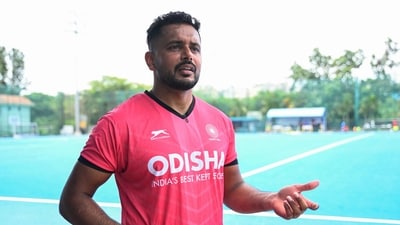
Captain Harmanpreet Singh is one of the best drag-flickers in the world and is a real goal threat from penalty corners, but the onus will fall on forwards Sukhjeet Singh and Abhishek Nain to also step up as game-changers. What could prove the biggest hindrance to their title hopes is their midfield — Hardik Singh, Manpreet Singh, Vivek Sagar Prasad and Nilakanta Sharma are elite individuals, but have struggled as a unit to dictate the tempo of matches. India are a dogged defensive side, but crucially, they no longer have PR Sreejesh in goal. The new generation of Mohith HS and Suraj Karkera are far from incapable, but this will be a trial by fire for them.
A semi-final berth is a realistic target, not a fantasy. But even a second-phase exit, while short of the ambition, would still represent a step forward from 2023.
Old foes and set-piece dependence make for a tough draw
For the women’s team, there is cause for cautious optimism. Their story has largely been one of missed qualifications and lower-half finishes since their only World Cup semi-final came at the very first edition, back in 1974, when they finished fourth. But coach Sjoerd Marijne, who guided India to their historic Tokyo Olympics semi-final in 2020, is back for his second stint in charge of the national team, and form is firmly in their favour.
Earlier this year, India won the FIH Nations Cup in New Zealand, and that too in some style — going unbeaten across five games, beating New Zealand 2-0 in the final, and securing promotion back to the top-tier FIH Pro League. But the qualification path also came with warning signs — India lost the Asia Cup final to China, then needed the qualifying tournament in Hyderabad to book their spot, where they were beaten by England in the final. Those faces will prove familiar in the Netherlands. Pool D will pit India against China, England and South Africa. India should collect maximum points against the latter, having won five of the last six meetings. But England and China will be tough contests.
Second place, and a passage to the championship pool, is achievable but not guaranteed — it likely hinges entirely on the England match on August 20. Experienced forwards Navneet Kaur and Deepika Sehrawat have led the attack with aplomb, with Sehrawat’s drag-flicks from penalty corners especially dangerous. The risk comes from India’s underwhelming open-play chance creation. 19 of their 27 goals in 2026 have come from set-pieces, and while that bodes well for their lethality at penalty corners, it leaves them one-dimensional and easier to tactically outmanoeuvre. The knockouts are likely to be a step too far, especially with two of the Netherlands, Australia, Chile, and Japan in store in the second pool stage. Going deep into the tournament from that point is a tough ask. Realistically, a finish in the five-to-eight range would mark a positive result. But group-stage elimination, and a repeat of the ninth-place finishes from 2010 and 2022, would be a real step backwards given the momentum built over the past year.
The bottom line
Both teams have the tools to progress from the first round. For the men, Pool D is generous enough that anything short of the second crossover pool should be considered a disappointment, and a semi-final is a genuine possibility if the midfield holds up against European opposition. For the women’s team, reaching the second phase would be a big step forward itself, and a top-eight finish should be the minimum ambition.
India’s hockey story has long been one of Olympic success but World Cup disappointment. The contingent in Amstelveen has shown it is quite capable of rewriting that narrative.