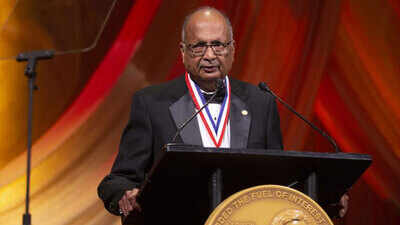
In 1971, a naval officer was asked to solve a problem that India could not simply buy its way out of. The Indian Navy needed better anti-submarine sonar, but access to advanced foreign systems was restricted. The officer tasked with finding an indigenous solution was Arogyaswami Paulraj.Decades later, the technology he pioneered would have a very different application. Paulraj’s work on MIMO — multiple-input, multiple-output wireless communication — became a foundation of modern high-speed wireless networks, including 4G, 5G and Wi-Fi. Stanford University describes his MIMO work as laying the foundation for today’s high-speed wireless connectivity.
From the Indian Navy to IIT Delhi
Born in Pollachi, Tamil Nadu, in 1944, Paulraj joined the Indian Navy as a teenager. The Navy recognised his academic ability and sent him to IIT Delhi for advanced studies. He eventually completed a PhD in electrical engineering there in 1973.The loss of an Indian naval ship to submarine action during the 1971 India-Pakistan war exposed shortcomings in the Navy’s sonar capabilities. Paulraj was brought into the effort to improve India’s underwater detection technology.His subsequent work led to the development of APSOH, or Advanced Panoramic Sonar Hull Mounted. The project began in the 1970s and involved a large team of engineers and several Indian organisations. After years of development and testing, APSOH entered fleet service in 1983.The achievement was significant because India had developed a sophisticated naval sonar system largely through indigenous research and engineering. The National Inventors Hall of Fame notes that Paulraj’s APSOH work helped usher in India’s leadership in this area of technology.
Three national laboratories and a move to Stanford
Paulraj’s work in India extended beyond sonar. During his government service, he helped establish national research centres covering artificial intelligence and robotics, advanced computing and military electronics. Stanford lists his roles in organisations including the Centre for Development of Advanced Computing, the Centre for Artificial Intelligence and Robotics and Bharat Electronics.In the 1980s, Paulraj also spent time at Stanford as a visiting scientist. He eventually joined the university as a postdoctoral researcher and later became a professor.It was there that his career took another unexpected turn.
The idea that changed wireless communication
While working on wireless communication and antenna-array research, Paulraj noticed that signals arriving through different paths could potentially be separated and used rather than treated simply as interference.The idea became MIMO technology.MIMO uses multiple antennas at both the transmitting and receiving ends of a wireless connection. Instead of relying on a single stream of information, different data streams can be transmitted simultaneously and separated at the receiving end.The result is dramatically greater capacity and faster data transmission without requiring a proportional increase in wireless spectrum.Paulraj first developed the MIMO concept in 1992 and received a patent for it in 1994. His Stanford biography says his work showed how spatial multiplexing could send independent data streams from multiple transmit antennas and separate them at the receiving antennas.
From an idea to the technology behind modern networks
The technology initially faced scepticism from parts of the wireless industry and funding community. Paulraj persisted and founded Iospan Wireless in 1998, which developed commercial MIMO-based wireless systems. Intel later acquired Iospan’s technology.He subsequently co-founded Beceem Communications, which became a major player in wireless semiconductor technology and was acquired by Broadcom.The significance of MIMO was recognised internationally. The Marconi Society awarded Paulraj the 2014 Marconi Prize for his pioneering contributions to MIMO antennas, noting that the technology was at the heart of high-speed Wi-Fi and 4G mobile systems.Paulraj later received the IEEE Alexander Graham Bell Medal, the IET Faraday Medal and the Royal Academy of Engineering’s Prince Philip Medal. He was also inducted into the US National Inventors Hall of Fame.
An Indian researcher’s impact on everyday technology
Paulraj’s journey is unusual because his most influential work did not begin with smartphones or home internet.It began with a naval problem in India.The same researcher who helped develop an indigenous sonar system for the Indian Navy later developed a technology that transformed wireless communications. Today, MIMO is incorporated into broadband wireless systems, including 4G, 5G and Wi-Fi.His career also offers a lesson for students interested in engineering and research: major technological breakthroughs can emerge when researchers follow an unexpected result, persist through scepticism and apply ideas across seemingly unrelated fields.From underwater sonar to wireless networks, Arogyaswami Paulraj’s work demonstrates how fundamental engineering research can travel far beyond the problem it was originally designed to solve.Disclaimer: This article is based on publicly available information from institutional websites, published records and other sources cited in the story. While every effort has been made to ensure accuracy, the information presented does not necessarily reflect the views of TOI Education.