The trigger wasn’t a harvest failure, fraud or a stock market crash. It was
President Xi Jinping’s tax collectors serving the listed arm of China’s third-largest farming conglomerate with a bill totalling 120% of its net income in 2025, as they demanded back payment for previously enjoyed perks that they said it wasn’t eligible to claim. Over just three days in June, hundreds of millions of dollars were erased from the company’s share price — a fifth of its market cap — as investors digested the bad news.
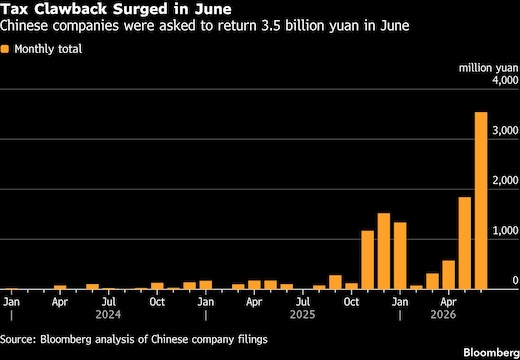
Far from an aberration, cases like this are playing out across China. More than 100 listed companies were hit with tax clawbacks and charges for delayed tax payments totalling around 7.7 billion yuan ($1.1 billion) in the first six months of 2026, according to a Bloomberg News analysis of filings. That tally exceeded the entire amount reclaimed in the 14 years since Xi came to power in 2012.
Proceeds of the campaign amount to a fraction of roughly 400 billion yuan in industrial policy support that Gavekal Dragonomics estimates largely went to lowering the financial burden for companies last year. But the damage is undeniable, with clawbacks wiping out a large portion of first‑half earnings for many firms, according to Bloomberg’s analysis. And they could be a preview of what’s to come.
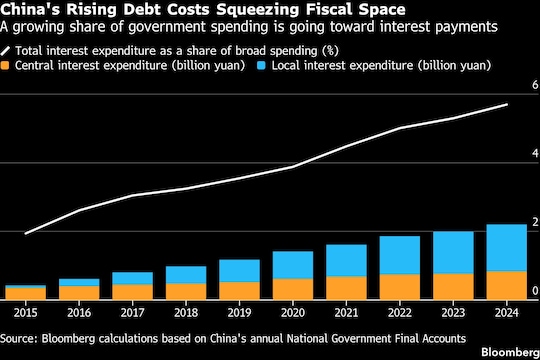
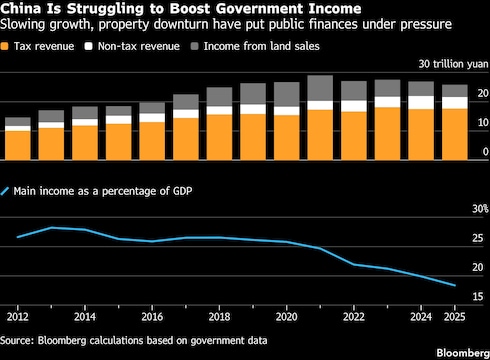
Xi is embarking on his biggest push to recover corporate taxes as local provinces hunt for new revenue sources. Tax receipts are down from a 2023 peak amid dwindling domestic demand, while income from selling land — once a reliable cash cow — is shrinking at a double-digit pace. The crackdown signals a break from a decades-old growth model built on provinces using generous subsidies to hit economic targets.
“The GDP tournament model is being dialled down,” said Alicia Garcia-Herrero, chief economist for Asia Pacific at Natixis. “Expect more cautious, less entrepreneurial behaviour on the ground.”
One tax official in a western Chinese city, who asked not to be identified, said authorities were deliberately targeting public companies or big firms flush with money. Pressure from tax bosses in Beijing to issue such bills was meeting resistance from local officials, according to another administrator, who asked for anonymity to discuss sensitive matters.
Provincial chiefs have long jostled to lure investment with rebates, subsidies and bespoke tax deals — a process that helped drive decades of breakneck growth from the late 1970s and foster emerging industries such as electric cars and solar panels. Even as some cash-strapped cities struggled to pay officials’ salaries and maintain bus routes, they still relied on offering perks to entice companies and meet growth goals.
Payment demands being made now range from the misapplication of tax relief and over-claimed VAT deductions to the revocation of designations that enabled qualified companies to pay a favourable rate.
Most public firms have benefited from some tax breaks over the past decade. An analysis by Citic Securities Co. earlier this year found that about 64% of A-share listed companies enjoy a preferential corporate-tax rate.
Companies with the biggest back-tax bills this year include state-owned mineral, energy and tech giants such as Yunnan Copper Co. and Wuxi Taiji Industry Co., as well as privately-owned Aier Eye Hospital Group Co. and electronics wholesaler Shenzhen Aisidi Co. Most had been racking up profits for multiple years running.
Now many companies are being hit with clawback bills that far exceed their first-half earnings. Shenzhen Aisidi absorbed a cost equivalent to more than six times its half-year profit. Taken together, the 10 worst-hit companies contributed more than 70% of all the back taxes reported by listed firms this year as of June.
In Heilongjiang Agriculture’s case, it had to settle a charge linked to corporate income tax breaks for leased land stretching back to 2021. That resulted in an expected loss of nearly 537 million yuan in the first half. Disclosure of the bill in June sent its stock price plunging by the 10% daily limit for two straight days — something that hadn’t happened since a market crash over a decade ago.
Several companies provided details about their settlements in stock exchange filings, saying the focus was on corporate income taxes or the value-added levy. Most said problems were uncovered during “self-reviews” requested by tax authorities, with many emphasising no administrative penalties were imposed.
Implications for profits were stark among some of the largest payers that guided net income in the first half of 2026 and the impact from their tax expenses. Heilongjiang Agriculture expected a loss while Hunan Valin Steel Co. and Shenzhen Aisidi reported a year-on-year profit drop of at least 79%.
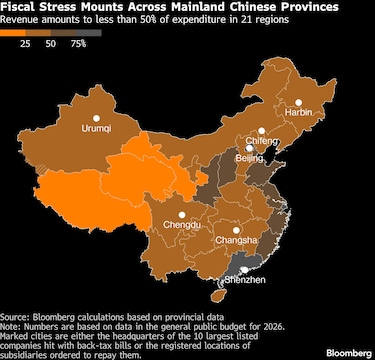
The official in western China said smaller firms have been mostly spared so far because authorities prefer not to overdo the campaign. Framing the approach as pragmatic, the official said companies are being shown leniency — provided they pay a reasonable portion of what they owe even if it’s less than the amount due under the law.
As local officials move away from using tax subsidies to spur growth, they’re embracing Beijing’s push to steer capital toward critical sectors and investing heavily in tech startups. Blockbuster listings such as that of memory-chip maker CXMT Corp. have raised hopes these long-term bets could generate returns and help relieve debt burdens.
Anhui in central China has proved to be a success story thanks to its stake of about 40% in CXMT through a network of entities. That’s an investment worth around 1.5 trillion yuan as of Tuesday and more than three times as large as the province’s expected general public revenue this year.
The shift comes as China’s is turning the page on a decade of supporting businesses through tax cuts championed by late Premier Li Keqiang. The change was formalised earlier this year when China vowed for the first time to maintain taxes at a “reasonable” level relative to gross domestic product when the government unveiled its five-year blueprint for development.
The government will “systematically review” any outdated tax breaks, phasing out those deemed unnecessary and refining others, Vice Finance Minister Liao Min said at a briefing on Friday, adding the goal is to reduce what he described as fragmented policies.
Central to enforcing the shift is Golden Tax IV — an administrative system China began rolling out in 2021 that fuses tax data with databases maintained by banks, customs authorities, market watchdogs, public security and payment platforms. With nationwide e‑invoicing largely completed in 2025, Beijing now has near real‑time visibility into most business transactions, leaving under-payments harder to hide.
The official in western China said the system flags problems, prompting authorities to ask companies to carry out self-reviews before conducting inspections. Enforcement has noticeably tightened since the end of last year, the official added.
Addressing the problem of reckless local competition for investment, authorities also pushed provinces to abolish or revise some 830 documents and contractual items involving unlawful tax policies, according to the State Taxation Administration.
“Government revenue is falling short, yet new tax sources are hard to come by,” said Kevin Gao, who owns a home appliance maker in central China. “So the authorities have no choice but to squeeze more out of existing ones.”
Gao said officials in his city strengthened tax enforcement from the middle of last year, subjecting almost every business to full reviews. Audits will deliver lasting growth to the total tax base, he said, rather than just a one-time revenue boost, because companies now “face higher bills under revised compliance standards.”
More broadly, China is scaling back tax breaks on a range of industries officials used to offer, effectively adding costs to some firms and individuals while reaping more government income. Facing a backlash abroad against the flood of Chinese goods, Beijing removed or cut export rebates on hundreds of products from April, including solar cells and battery-related goods, and this year slashed tax breaks for new energy car purchases by half.
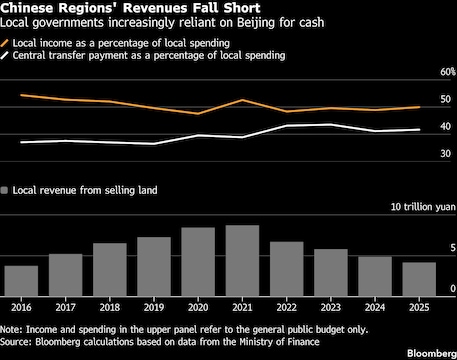
Provinces are having to rely more on the national government to meet their day-to-day spending needs. Payments transferred from the center now account for 42% of their expenditure under the budget covering matters such as education, healthcare and social spending, up from 37% a decade ago, according to Bloomberg calculations based on official data.
Local governments are “in a difficult bind” as they search for what’s going to be their new source of revenue, said Jean Oi, a professor of China studies at the National University of Singapore. While Beijing understands fiscal reforms are needed to beef up their revenue-earning potential, little progress has been made, she added.
“Both the central and local governments have an interest in getting more taxes,” said Oi, who’s on academic leave from Stanford University, where she directs the China Program. “They’re trying to get everybody to pay up and follow the rules, but is it enough? I really worry.”
Also Read: Lake America? Trump mulls renaming Lake Ontario, expresses love for French Canadians amid trade war