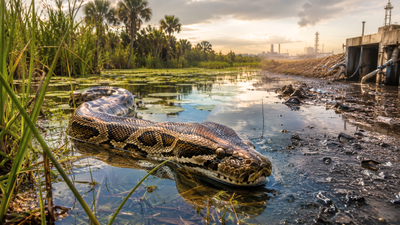
Florida’s Burmese pythons are notorious for swallowing native wildlife, but scientists are finding another use for these invasive snakes. Their bodies can function as biological sensors, carrying chemical traces that reveal what is happening inside the wetlands they inhabit. Researchers are examining python tissues for pollutants including mercury and a class of persistent chemicals known as PFAS, using the snakes to understand contamination across the Greater Everglades ecosystem. A 2026 study led by University of Florida researchers found PFAS in the livers of 67 Burmese pythons, while earlier research has documented mercury accumulation in the species. Because the snakes are already being captured as part of invasive-species removal programmes, scientists can collect samples without deliberately taking additional animals from vulnerable native populations.
Why Burmese pythons can act as biological sensors
The idea rests on the way Burmese pythons live and feed. The species is a long-lived apex predator with a broad diet, meaning an individual snake can consume prey from different parts of the ecosystem and accumulate contaminants that have already moved through the food web. Researchers describe them as holophagous consumers because they swallow their prey whole, potentially taking in the contaminants contained throughout that prey. Their position high in the food chain also means chemicals that accumulate in smaller organisms can become concentrated in their tissues over time. The 2026 PFAS study, led by Lauren E Blackman and colleagues at the University of Florida and partner organisations, argues that these characteristics make Burmese pythons particularly useful as environmental sentinels.
Scientists found PFAS inside python livers
The latest evidence comes from the study Invasive Burmese pythons (Python bivittatus) as sentinels for PFAS biomonitoring in the Greater Everglades Ecosystem, published in Science of the Total Environment in May 2026. Researchers examined liver samples from 67 Burmese pythons collected within or near the Greater Everglades ecosystem. The researchers screened the samples for 30 PFAS compounds using high-performance liquid chromatography-tandem mass spectrometry. Nine PFAS were quantified above the laboratory limit of quantification. Linear PFOS was particularly widespread, being detected in 93% of the python livers, with a median concentration of 89 nanograms per gram of dry tissue. The median concentration for the combined PFAS measured in the study was 111 nanograms per gram of dry tissue.
The snakes carried more PFAS than a native apex predator
The findings also provided a striking comparison with a native predator. The median total PFAS concentration measured in the Burmese python livers exceeded concentrations reported in livers of American alligators living in the same broader ecosystem. The researchers did not find a statistically significant difference in PFAS concentrations between snakes sampled from eastern and western areas surrounding the Everglades. They did, however, find a strong difference between the sexes. Male pythons had significantly higher combined PFAS concentrations than females, with the reported statistical test producing a p-value below 0.0001. Among females, PFAS concentrations tended to decline as body length and mass increased, which the researchers said could be consistent with maternal transfer of contaminants.
Why the findings matter for the Everglades
PFAS, short for per- and polyfluoroalkyl substances, are a large family of human-made chemicals known for their persistence in the environment. Their presence in wildlife can provide evidence that contaminants are moving through food webs rather than remaining confined to water or sediment. The python study is therefore not simply a survey of chemicals inside individual snakes. It offers a way of examining the broader contaminant burden of the Greater Everglades ecosystem. The researchers argue that using an invasive predator already targeted for removal creates an unusual monitoring opportunity. Instead of capturing additional native wildlife specifically for pollution studies, scientists can make use of animals already being removed as part of management programmes.
Mercury tells another pollution story
PFAS are not the first contaminants scientists have tracked through Burmese pythons. Mercury has already established the species as a useful biomonitor in southern Florida. In a 2019 study published in the Bulletin of Environmental Contamination and Toxicology, Darren G Rumbold of Florida Gulf Coast University and Ian A Bartoszek examined tissues from 227 Burmese pythons captured in southwest Florida between 2012 and 2018. Mercury concentrations reached 4.86 milligrams per kilogram in the liver of one 4.7-metre snake. Across 123 tail-tip samples, the average concentration was 0.12 ± 0.19 milligrams per kilogram. The researchers concluded that snakes could provide an opportunity to monitor mercury at the aquatic-terrestrial interface, particularly because their capture could be combined with invasive-python control efforts.
A USGS dataset stretches the picture across two decades
The evidence has since expanded beyond individual studies. The US Geological Survey released a dataset in 2025 titled Mercury Concentrations in Burmese Pythons Across the Greater Everglades Region in Florida from 2001 to 2022. Scientists examined mercury concentrations in python tail muscle across two major periods, 2001 to 2011 and 2014 to 2019, with snakes sampled across wetland, forested and urban habitats. The work also included tissues from offspring of six female pythons collected in 2022. Kidney, liver and muscle samples from the young snakes were examined to investigate mercury cycling within their bodies, while mercury in maternal blood was assessed to investigate transfer from mothers to offspring.
Scientists can read pollution through the food web
The value of using pythons is that their bodies can integrate information that would otherwise require extensive environmental sampling. A water sample provides a snapshot of contamination at one location and one moment. A predator that has travelled through the landscape and consumed multiple prey species can carry a longer biological record of exposure. Scientists can then compare contaminant concentrations with the snake’s location, size, sex and other characteristics to investigate how pollutants are distributed and accumulated. The USGS specifically notes that Burmese pythons accumulate mercury through their consumption of smaller prey containing the metal, making them potentially useful for understanding mercury patterns across the Greater Everglades ecosystem.
Invasive snakes offer an unusual research advantage
There is an important practical advantage behind the approach. Burmese pythons are an invasive species in southern Florida and are already the subject of extensive removal programmes because of their impact on native wildlife. Researchers can therefore obtain tissues from captured snakes without creating an additional sampling pressure on threatened or protected native predators. The 2019 mercury study highlighted this point, noting that incorporating contaminant monitoring into python-control work could be cost effective and could reduce concerns about removing native snakes for research. The 2026 PFAS study similarly presents the invasive species as an opportunity to study environmental contamination while supporting existing management efforts.
The research could reveal more than one pollutant
The significance of the work extends beyond mercury and PFAS. The same basic principle could potentially be applied to other contaminants that accumulate in wildlife tissues. Researchers are particularly interested in chemicals that persist in ecosystems, move through food webs and accumulate in predators. Because Burmese pythons occupy both aquatic and terrestrial environments and consume a wide range of prey, their tissues can potentially provide information about contamination across ecological boundaries. The 2026 researchers described the species as a suitable sentinel for assessing the broader PFAS burden of the Everglades, building on earlier evidence that pythons can be used to investigate mercury contamination.
The snakes are not replacing conventional pollution monitoring
Calling Burmese pythons “moving sensors” is useful shorthand, but the scientific method has limits. The snakes do not measure pollution directly and their tissues cannot automatically identify where every contaminant came from. Their diets, movements, age, sex, body size and reproductive status can all influence the concentrations found in their bodies. The PFAS researchers themselves found sex-related differences and possible evidence of maternal transfer, showing why biological measurements have to be interpreted carefully. Python samples are therefore best viewed as one layer of environmental monitoring that can complement measurements of water, sediment, prey and native wildlife.
An invasive predator becomes an environmental record
The research creates an unusual reversal in the story of Florida’s Burmese pythons. The snakes arrived as an invasive species and have become a major ecological problem, but the same characteristics that make them formidable predators also make them valuable scientific subjects. Their long lives, broad diets, position near the top of the food chain and ongoing removal from the Everglades give researchers access to biological evidence of contamination. With PFAS now detected in python livers and decades of mercury data available, scientists are turning an invasive animal into a source of information about the health of the wetland it has invaded. In that sense, each captured python can provide more than evidence of an invasive species problem. Its tissues can also contain a chemical record of the ecosystem through which it has moved.