Kotak Institutional Equities’ reverse valuation exercise suggests the market is significantly more optimistic about BHEL’s future thermal equipment opportunity than the thermal capacity addition outlook would indicate. While NTPC’s current valuation implies around 40 GW of incremental thermal capacity, BHEL’s valuation implies a much larger level of future thermal equipment execution.
What BHEL’s valuation is pricing in
BHEL’s current market capitalisation of around ₹1.5 lakh crore, implies a 150 GW of lifetime thermal equipment sales at a 10% PAT margin, Kotak’s note said. At a 7.5% PAT margin, that ask will increase further to 200 GW.
Kotak arrives at this ask after assigning 25% of BHEL’s value to its non-thermal businesses, implying a value of around ₹1.13 lakh crore for its thermal equipment business.
The brokerage notes that this calculation does not account for the time value of future revenues and profits, which could increase the required level of execution further.
Kotak also estimates that India’s aggregate future thermal capacity addition could be around 100 GW. This is the key benchmark against which the brokerage assesses the opportunity implied by BHEL’s valuation.
Why BHEL outperformed NTPC?
Kotak said the sharp divergence began around the start of the West Asia conflict, with BHEL outperforming NTPC by 80 percentage points since April 1.
The brokerage attributed NTPC’s underperformance primarily to expectations of weaker near-term earnings growth because of the low pace of thermal capacity addition, along with uncertainty around the medium-term growth prospects of its thermal business as renewable generation and storage capacity expands.
Kotak also said the recent correction in NTPC Green Energy is unlikely to be a major reason for NTPC’s underperformance, given the relatively low contribution of the subsidiary to its sum-of-the-parts valuation.
Thermal additions remain subdued as renewables expand
India added only 2 GW of thermal capacity in the first five months of FY27, according to Kotak’s data. This follows additions of 7 GW in FY26, 4 GW in FY25 and 6 GW in FY24.At the same time, utility-scale and rooftop solar capacity reached 133 GW in FY26, compared with 103 GW in FY25 and 81 GW in FY24.
Kotak expects renewable capacity to rise from 187 GW in FY26 to 310 GW by FY30, while coal-based capacity is estimated to increase from 231 GW to 242 GW over the same period. The brokerage expects the increase in renewable capacity to cater to a significant part of incremental electricity demand.
It also points to increasingly competitive renewable tariffs. Recent auctions have seen competitive tariffs for standalone solar, wind and solar-plus-storage projects. Kotak estimates the current tariff for six hours of solar plus 12 hours of storage at ₹5.4 per kWh.
For NTPC, the lower pace of thermal capacity addition and expansion of renewable generation and storage add to uncertainty around the medium-term prospects of its thermal business, according to Kotak. For BHEL, the same backdrop is relevant to the size of the future thermal equipment opportunity.
What does NTPC’s valuation imply?
Kotak’s reverse valuation exercise suggests NTPC’s current market valuation implies 42 GW of incremental thermal capacity at a 1.5-times price-to-book multiple for regulated equity.The implied capacity varies significantly depending on the multiple used. At 1.25 times P/B, the implied new thermal capacity is 128 GW, while at 1.75 times it is 13 GW.
For context, the Central Electricity Authority projects 86 GW of cumulative thermal capacity addition during FY27-36, Kotak said. The brokerage also noted that some of this capacity could come from private-sector players, with Adani targeting roughly 4 GW of annual capacity additions during FY27-32.
How large is the thermal equipment opportunity?
Kotak estimates that even with around 100 GW of future thermal capacity addition, the aggregate undiscounted profit pool for thermal equipment manufacturing would be around ₹50,000 crore–₹1 lakh crore, assuming a realisation of ₹10 crore per MW and a 10% net profit margin.
In its detailed calculations, Kotak assumes a 75% market share for BHEL. At 100 GW of total thermal capacity addition, this would give BHEL a revenue opportunity of ₹75,000 crore. Its cumulative PAT would be ₹37,500 crore at a 5% margin, ₹56,300 crore at 7.5% and ₹75,000 crore at 10%.
Kotak’s assessment therefore puts the ₹1.5 lakh crore BHEL market capitalisation against a likely thermal equipment profit pool of ₹50,000 crore–₹1 lakh crore based on 100 GW of new thermal capacity.
The brokerage also highlighted BHEL’s historical cash generation. The company generated aggregate free cash flow of ₹20,100 crore during FY2007-26, while FY26 free cash flow stood at ₹5,300 crore.
BHEL, NTPC stock performance
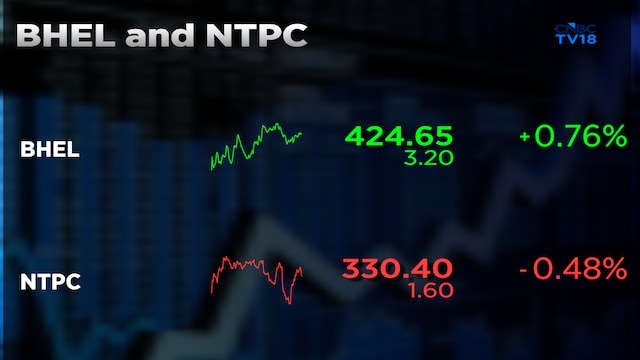
Shares of BHEL are trading 0.9% higher on Tuesday at ₹425.2. The stock has gained 46% so far in 2026.
On the flip side, shares of NTPC are trading 0.6% lower on Tuesday at ₹330. The stock is trading close to its 52-week low of ₹315.
Also read: GE Vernova T&D FY29 earnings estimates could rise 15% after Power Grid order: PL Capital