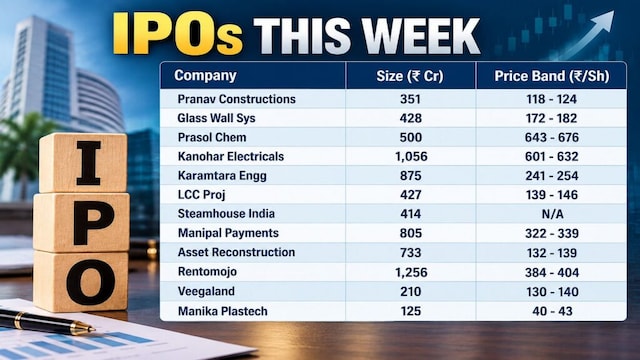
The IPO comprises a fresh issue of around ₹80 crore and an offer for sale worth ₹420 crore. Nishith Rajnikant Shah, Chairman & Whole-time Director, and Dhaval Nalin Parikh, Joint Managing Director, said the company has enough room to scale operations using its existing assets before undertaking another round of expansion.
CNBC-TV18 estimated that Prasol could scale revenue potential to around ₹3,000-3,200 crore through higher utilisation and future capex. Responding to the calculation, Shah said, “It is more than fair. A fair assumption.”
Capacity expansion to support future growth
Prasol is currently operating at around 44% capacity utilisation, leaving room to increase production without significant new investments.
Shah said the company typically begins expansion once plants reach 80% utilisation, instead of waiting until they are fully occupied.
“Normally, when we reach 80% of the plant capacity, we look for expansion. We never go to 100%,” he said.
The company has already acquired 20-25 acres of adjoining land at both its Mahad and Khopoli manufacturing facilities for future expansion.
Shah added that the company has sufficient internal cash generation to fund expansion plans.
“We have good amount of money to take care of our expansions… without taking a single dollar from anyone,” he said.
Margins expected to improve
Shah said Prasol expects profitability to improve as it manufactures a larger share of products instead of distributing them.
The company converts acetone into higher-value speciality chemical derivatives, which carry better margins.
“As you go up, your margin increases, and also with time, your utilisation goes up,” Shah said.
He added that the company is replacing part of its distribution business with manufacturing, which should further support margins through operating leverage.
Focus remains on speciality chemicals
Parikh said Prasol’s products are designed for specialised industrial applications rather than commodity markets.
The products are supplied to customers in agrochemicals, pharmaceuticals, home and personal care, mining and lubricant industries, where the company develops customised formulations with strict quality specifications.
Parikh said Prasol competes with global companies such as Arkema, Solvay, Lubrizol and Chevron, although no single player manufactures the company’s entire product portfolio.
Raw material sourcing to improve
The company currently imports about 70% of its acetone requirement, while phosphorus is fully imported.
Shah said India’s domestic acetone supply is expected to improve with additional production capacity coming on stream, which could strengthen raw material availability for the company in the coming months.
For the full interview, watch the accompanying video

Catch all the latest updates from the stock market here