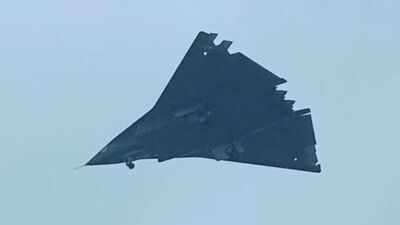
China may be exploring the use of high-energy laser weapons on its next-generation fighter aircraft to defend against incoming missiles, after a state-owned aviation institute showcased a fighter-specific laser tracking and aiming system at a defence exhibition in Beijing.The Aviation Industry Corporation of China (AVIC) Beijing Precision Engineering Institute for Aircraft Industry displayed details of a “fighter aircraft laser-weapon tracking and aiming system” at the 14th China International Defence Electronics Exhibition, held from September 15 to 17.Social media posts from the exhibition showed that the system was listed as weighing less than 380 kg, although several key performance specifications were obscured.The display listed transmission power as “00kW”, which could indicate a power level of at least 100kW if the obscured character represents a single digit. Its dynamic tracking accuracy was shown as “ μrad (RMS)”, with the actual figure redacted.
System displayed alongside J-36 image
The promotional material paired the tracking system with an image of a large tailless aircraft that Chinese military aviation researcher Andreas Rupprecht identified as the J-36.The J-36 is the unofficial designation for a three-engined aircraft first seen flying over Chengdu in December 2024. It is widely believed to be a sixth-generation fighter under development by Chengdu Aircraft Corporation, part of state-owned AVIC.Rupprecht said the AVIC display represented the strongest public indication so far that China is developing such an airborne laser system.Mark Cazalet, editor-in-chief of international defence news organisation Warsight, also said the illustration appeared to depict the J-36. He said the aircraft “likely has sufficient space, weight and power” to accommodate a high-energy laser.“Lasers are in many ways easier to implement on larger aircraft than smaller aircraft,” he said, with larger platforms more likely to have the space, weight and power available for the systems.The technology could also potentially be adapted for other large aircraft, including bombers, transport aircraft and airborne early-warning platforms.
What could an airborne laser do?
Airborne lasers could potentially provide aircraft with another layer of protection against incoming missiles. Cazalet said their limited range would make them more suitable for attacking incoming missiles or damaging and dazzling their seekers than for conventional air-to-air combat.Lasers could burn through physical targets only at relatively short ranges, typically several kilometres, while optical sensors could potentially be damaged or dazzled from greater distances, he said.Cazalet said the development of Chinese systems capable of countering long-range missiles was “not altogether surprising”, given US efforts to develop or field weapons such as the AIM-174B, AIM-260 and AIM-424.However, he said questions remain over how such laser systems would perform in operational conditions.
Key technical questions remain
The exhibition display does not establish that China has already integrated an operational laser weapon onto a fighter aircraft.One major uncertainty is what is included in the advertised 380 kg weight. Cazalet said the figure likely covered components such as the beam director, laser source and cooling system. However, the display did not clarify whether the figure applied only to the tracking and aiming system or to a complete laser weapon.It also did not disclose the system’s electrical power requirements.There is currently no public evidence that the system has been installed on or flight-tested aboard a Chinese fighter aircraft.Developing an airborne laser is considerably more difficult than deploying one on the ground because the system must generate and manage large amounts of power while maintaining extremely precise aim from a rapidly moving and vibrating aircraft.
China has pursued airborne laser technology before
China has previously shown interest in mounting laser systems on aircraft.PLA procurement notices in 2020 sought suppliers for an “airborne laser attack pod” and control software for a “laser attack platform”. A military programme affiliated with state broadcaster CCTV also said China had developed a prototype airborne laser, citing academic research into energy storage and power supply.In 2021, a Chinese study used flight data from a transport aircraft to simulate how an airborne laser could maintain accuracy despite aircraft movement and vibration.AVIC has also disclosed testing of other directed-energy tracking systems. A July report in China Aviation News, an AVIC publication, said researchers at the institute had built and field-tested one such system within a year.The report described a March 2024 trial in which the system maintained a lock on a drone despite clouds, birds and increasing distance. Later versions were reportedly tested on multiple platforms, although the report did not identify those platforms or establish a connection with the fighter-specific laser system displayed in Beijing.
US experience shows the challenge
The United States has faced similar technical challenges in attempting to develop airborne laser weapons.The US Air Force’s Self-protect High Energy Laser Demonstrator, or SHiELD, programme sought to demonstrate whether a pod-mounted laser could protect fighter aircraft from incoming air-to-air and surface-to-air missiles.In 2021, programme manager Jeff Heggemeier cited wind speeds, turbulence and rapid aircraft manoeuvres among the “hard problems” encountered during development.The programme concluded in 2024 without a laser pod being mounted on a fighter test bed.For China’s sixth-generation aircraft, therefore, the Beijing exhibition offers an indication of the direction of development rather than proof of an operational airborne laser weapon. The displayed system suggests progress in precision tracking, but its integration, power requirements, range and ability to defeat real missiles remain publicly unconfirmed.