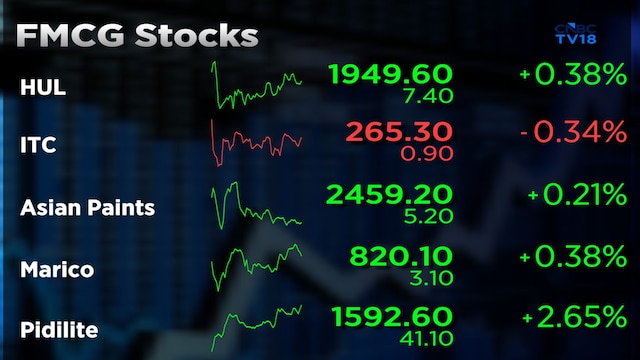
Roy said, “Most companies will see a double-digit kind of an inflation, say 10 to 15%. It’s not that everything has gone up and that’s why every company has taken ballpark 5% kind of price hike. Paint companies, Pidilite have taken double-digit price hike. Even HUL has taken almost 7% kind of price hike. In spite of all this, if I see on the EBITDA margin, the pressure will be 50 to 150 basis points because ad spends will be cut.”
Roy expects most staples companies, excluding ITC, to report double-digit sales growth in the second quarter. Companies have already started passing on higher costs to consumers, with price hikes varying across categories and products.
Hindustan Unilever (HUL) expects to maintain its near-term EBITDA margin guidance of 22.5-23.5%, although Roy expects the company to operate towards the lower end of this range in quarter two. Its longer-term margin guidance stands at 22-24%.
The current environment could also create an opportunity for larger FMCG companies to gain market share. Local and smaller players may find it harder to absorb sharp increases in commodity prices, giving larger companies more room to strengthen their position.
Crude oil remains a key factor for the sector. Roy said most companies have already factored in crude prices of around $100 per barrel. If crude rises towards $120, another round of price hikes could follow across staples and paints.
For Asian Paints, where crude-linked raw materials account for a significant portion of the cost base, Roy expects EBITDA margins to remain broadly within the company’s stated 18-20% range.
Marico could see a relatively better margin performance, helped by a sharp correction in copra prices from their peak. However, sugar and packaging costs remain areas of concern, with both seeing significant inflation.
On ITC, Roy expects the cigarette business to remain under pressure over the next couple of quarters, with both volumes and EBITDA likely to decline. He expects the business to start recovering in the fourth quarter.
“Near term, there will be a volume decline for ITC in cigarette business and there will be a double-digit EBITDA decline,” he said.
For full interview, watch accompanying video