
The lender initially projected a 20% expansion in advances for the current financial year, 2026-27 (FY27).
However, the April-June quarter of 2026 (Q1FY27) growth reached 28%, and the momentum has continued into the July-September quarter of 2026 (Q2FY27).
PN Vasudevan, Managing Director and Chief Executive Officer of Equitas Small Finance Bank, indicated that a formal upward revision will follow the upcoming quarterly results, with the second half of the year traditionally proving more robust for credit uptake.
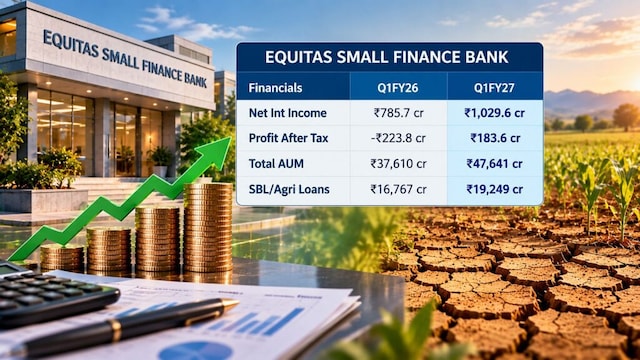
Asset quality metrics are also tracking ahead of initial estimates. The bank guided for a full-year credit cost of 1.5%, but recorded just 1.36% in the first quarter, typically the weakest period for collections. Full-year credit costs are now expected to fall below the 1.5% mark.
While net interest margins, which stood at 7.24% in the first quarter, face a projected 15 basis point compression due to higher deposit rates, this will be offset by lower credit costs and reduced operating expenses. Consequently, the bank expects to comfortably exceed its target of a 1.2% return on assets for the full year and a 1.5% exit rate in the fourth quarter.
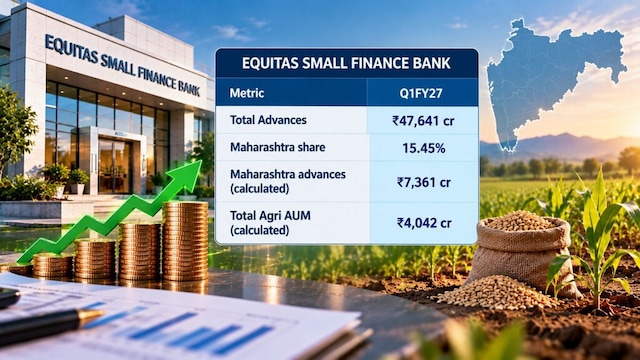
Addressing the recent declaration of drought across 74% of Maharashtra, affecting 265 of the state’s 358 talukas, the management sees limited risk to the loan book. Equitas does not issue direct agricultural loans, relying instead on its microfinance portfolio to meet priority sector lending requirements.
Microfinance constitutes roughly 10% to 11% of the bank’s total advances, with Maharashtra accounting for just 2% to 2.5% of the overall book.
Repayment patterns remain stable, and collection efficiency in the microfinance segment is holding steady between 99.7% and 99.75%. Even if the state government expands farm loan waivers, microfinance loans are not directly covered under such schemes.
Also Read: Another 3-4% price hike needed to protect margins; Equirus likes LG Electronics, Blue Star, Voltas
“Typically, when the governments announce any farm loan waivers in the past, what we have seen is that the portfolio of banks has not really been that affected because people who have not paid or are having overdues, the government ends up paying it even if there is a delay,” Vasudevan explained.
The only minor overhang occurs when capable borrowers temporarily halt payments in the hope of receiving a waiver despite being ineligible.
Watch the full conversation here

On the regulatory front, a proposal by the Insurance Regulatory and Development Authority of India (IRDAI) to reduce commissions on policies requiring minimal selling effort will have a marginal financial impact.
The bank generated nearly ₹95 crore to ₹100 crore in insurance distribution revenue last year, with credit shield policies accounting for about ₹50 crore. If commissions on these products are halved, the potential revenue hit would be ₹25 crore to ₹30 crore, representing roughly 2% to 2.5% of annual profits.
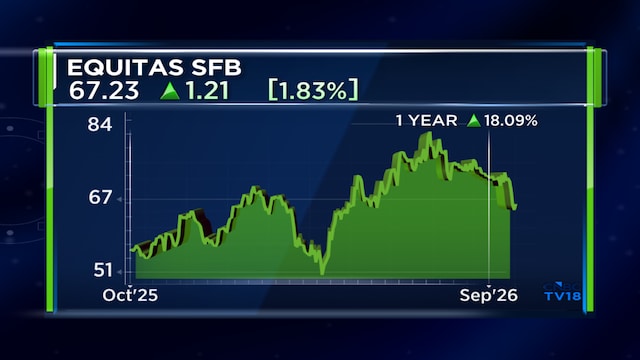
Chennai-based Equitas Small Finance Bank shares have gained nearly 19% over the past year, while the bank’s market capitalisation stands at around ₹7,697.69 crore.
Catch all the latest updates from the stock market here