
Shares of Tata Consultancy Services (TCS) gained nearly 3% on Thursday, October 8, ahead of the information technology major’s second-quarter results, due later in the day. The stock though, is off the highs of the day currently.
The stock rose to an intraday high of ₹2,141.50 and was trading 1.3% higher at ₹2,105.10 around 11:40 am, breaking a two-session losing streak.
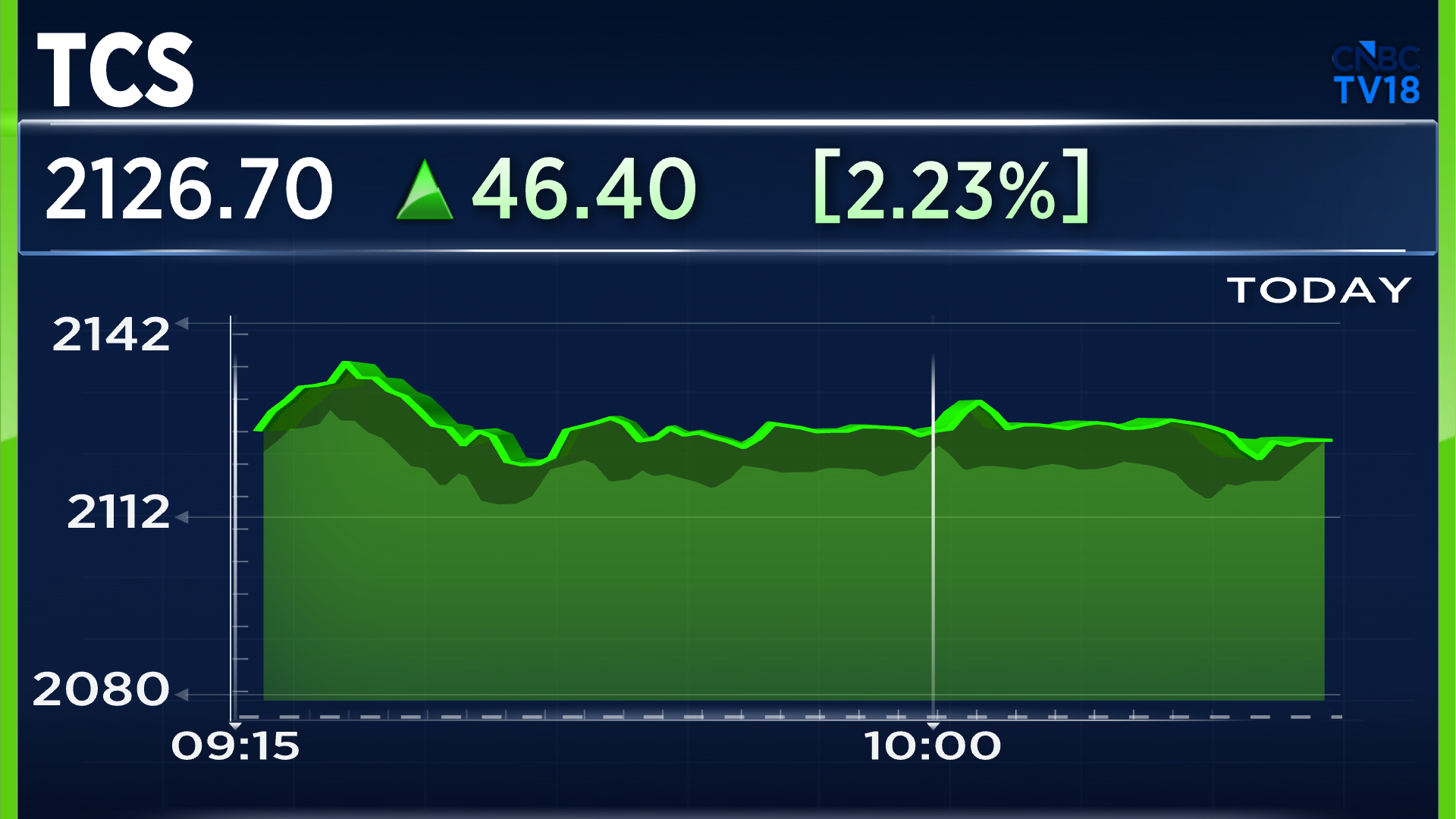
Despite Thursday’s recovery, TCS shares remain under pressure, down around 34% so far this year and nearly 30% over the last 12 months. The stock is also about 36% below its 52-week high of ₹3,350, touched on February 3, 2026. Its 52-week low stands at ₹1,976.80, hit on July 1, 2026.
TCS Q2 expectations
According to the CNBC-TV18 poll, TCS is expected to report a 0.4% quarter-on-quarter increase in dollar revenue to $7.657 billion from $7.624 billion in Q1FY27.
Revenue in rupee terms is seen rising 1.3% sequentially to ₹73,225 crore, while earnings before interest and tax (EBIT) are expected at ₹17,738 crore, up from ₹17,317 crore in the previous quarter. The EBIT margin is expected to improve marginally to 24.2% from 24%.
Also read: Muthoot Microfin Q2 update: AUM growth of 22%, cost of funds decline from June quarter
Profit after tax (PAT) is estimated to rise 2.4% quarter-on-quarter to ₹13,673 crore from ₹13,349 crore. The comparable Q1 PAT, excluding the ₹668 crore exceptional loss related to a legal claim settlement, was ₹13,849 crore.
In constant currency terms, revenue growth is expected at around 0.5-0.6%, pointing to another subdued quarter for the country’s largest IT services company.
Large-cap IT firms are expected to report a weak quarter despite Q2 traditionally being seasonally stronger. Clients continue to defer non-critical technology spending, with a focus on short-term return-on-investment programmes, vendor consolidation and cost take-out deals.
AI-led productivity gains are also emerging as a pressure point. Code assistants and artificial intelligence automation tools are driving productivity deflation across application management services and time-and-materials contracts, increasing pressure on vendors to offer price concessions during renewals.
What to watch
Deal wins and margins: TCS’ total contract value (TCV) is expected at around $9-10 billion, broadly in line with the $9.5 billion reported in Q1. The company had won an $800 million mega deal with SKF in the previous quarter, its sixth mega deal in the last five quarters. The Porsche deal is unlikely to be included in Q2 TCV as the associated MHP acquisition is expected to close after quarter-end.
On margins, TCS’ EBIT margin is expected to improve 20 basis points to 24.2%, helped by a partial reversal of the 170-basis-point impact of Q1 wage hikes. However, part of the benefit is expected to be reinvested in artificial intelligence and data-centre capabilities.
AI monetisation and pricing: Investors will track the pace of AI monetisation, with TCS’ annualised AI revenue run rate at $2.6 billion in Q1FY27, up 13.6% sequentially. The extent of AI-led productivity gains translating into pricing pressure will also be key, with gross productivity concessions estimated at 10-15%, partly offset through expanded scope.
Porsche-MHP integration: TCS is acquiring 100% of Porsche’s management and IT consulting subsidiary MHP for €320 million, alongside a five-year, €1.25 billion strategic partnership with Porsche. MHP generated €742 million in revenue in CY2025, with 30-40% coming from Porsche and the rest from external clients.
The deal is expected to strengthen TCS’ AI capabilities across mobility and software-defined vehicles, while MHP’s current ~10% margin could result in 50-60 basis points of initial margin dilution. TCS is targeting double-digit growth from synergies and sees MHP’s revenue potentially scaling to around $1 billion over time.
Margin trajectory: A key question will be whether TCS can achieve an exit EBIT margin of above 25%, particularly given the near-term impact of MHP integration costs.