
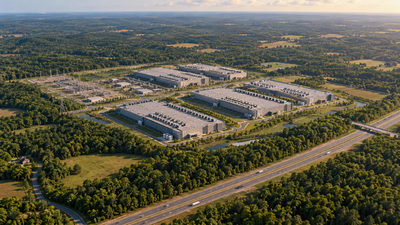
At a time when the artificial intelligence (AI) boom has sparked a surge in electricity demand, American AI data centre companies are finding new ways to power their infrastructure. While some are turning towards massive solar and wind farms, others are striking deals to use nuclear power to keep the servers running. Now, they are reportedly turning to Arizona’s Sonoran desert where thousands of retired airplanes with jet engines mounted sit in vast metal graveyards. Those turbines are being resurrected to keep the servers running. The New York Times reported that a growing roster of engineering firms is stripping engines from decommissioned aircraft and converting them into stationary electrical generators with data center operators snapping them up as fast as they can be built.
US Midterm Election Results 2026
“They’re getting creative. Just a few years ago, a traditional data center would have been like, ‘Are you kidding me? This is ridiculous’,” said Bill Kleyman, chief executive of AI platform and infrastructure provider Apolo. Today, attitudes have fundamentally shifted around project lead times. Data center developers are now singularly obsessed with “speed to power,” Kleyman explained, adding, “It’s like, ‘How fast can you get me energy?’”The rush to secure self-contained energy sources has also been accelerated by political pressure. With rapid data centre construction driving public backlash over rising household utility bills, President Donald Trump has pushed facilities to generate their own power rather than pulling from local grids.“It was my idea. Data centers now are mandated by me that they build their own electricity, so they’re not taking it from the grid,” Trump told reporters in August.
Tapping massive ‘power reserves’
Aircraft graveyards offer an enormous, untapped energy reserve, the report pointed out. In January, the federal Energy Information Administration estimated that the engines housed inside 4,000 retired military jets parked at a single desert base in Tucson could produce 40,000 megawatts of electricity, exceeding the generation capacity of the entire state of Arizona.Converted aircraft turbines, however, come with major engineering trade-offs. For example, repurposed jet engines are generally less fuel-efficient than turbines built specifically for modern gas-fired power plants. Moreover, because of their lower operational efficiency, data centers require a higher number of jet-powered units to produce the equivalent electrical output. Converted engines release significantly higher volumes of air pollutants into surrounding communities.Elon Musk’s AI venture, xAI, has already integrated eight converted jet turbines to power a major data center in Mississippi, according to state regulatory filings and satellite imagery reviewed by The New York Times. State permits granted to the facility allow the converted turbines to emit carbon monoxide at double the rate permitted for other on-site turbines, along with a 25% higher ceiling for volatile organic compounds (VOCs). Both substances present serious health hazards.Environmental organisations and community advocates argue that leaning on older, dirtier turbines undermines clean energy goals. The Southern Environmental Law Center has formally challenged Mississippi’s regulatory approval of xAI’s turbines, arguing that the equipment maker has failed to supply documentation proving compliance with standards for toxins like formaldehyde, while accusing xAI of undercounting its projected emissions.