
Nona Gaprindashvili became women’s world champion at 21. Sixty-four years later, at 85, she is still sitting across a chessboard, competing for another world title.
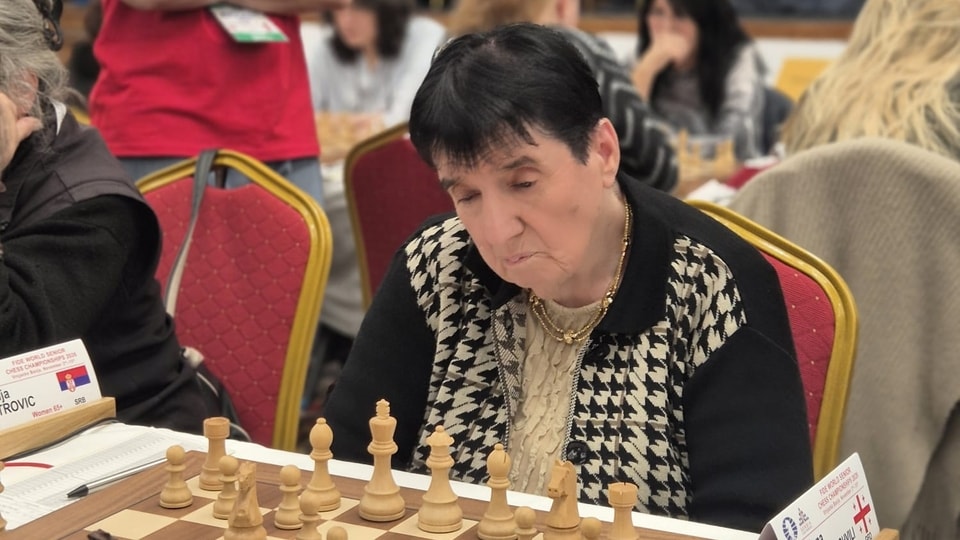
The Georgian legend – the first female chess player to earn the grandmaster title – is the top seed at the ongoing Fide Women’s World Senior Chess Championship in Vrnjacka Banja, Serbia being held from November 3-14. Divided into two age groups – 50+ and 65 + across women and open sections, it has 385 players from 65 national federations, including 44 GMs and eight WGMs.
Nona is competing in the 65+ age group and has so far scored 1.5 points from two rounds so far. India’s Bhagyashree Thipsay is also competing in the same age category.
Nona has won the Fide Women’s World Senior Championship eight times, the first title coming in 1995. Her previous title came in Assisi, Italy, in 2022, when she was 81. She scored seven points and won gold on tiebreaks.
The octogenarian is now on the quest for her ninth title.
Born during the Second World War, Nona grew up in Zugdidi, a town in western Georgia, with four older brothers. She played football, often as goalkeeper, and learned chess by watching her brothers.
Her entry into competitive chess was almost accidental. When her older brother could not participate in a team tournament, she was asked to replace him, since they needed a girl on the team. On their way to the Championship by train, the young Nona played the other team members and defeated the team’s strongest player. She was barely 12 then. The team finished fifth in the Championship, a creditable performance for a small town like Zugdidi.
Chess took Nona from Zugdidi to Tbilisi, where she trained under Vakhtang Karseladze, an influential figure in Georgian women’s chess. Her progress was remarkable. In 1961, she won the Candidates Tournament, earning the right to challenge reigning women’s world champion Elisaveta Bykova.
A year later, at 21, she defeated the vastly more experienced Soviet player 9–2 in Moscow, without losing a game. The final game ended not with a handshake across the board but with Bykova resigning an adjourned position over the telephone. It was an unusual end to a match that would change the course of women’s chess. It made Nona the fifth women’s world chess champion and was the start of a 16-year reign.
A month before her match, Nona arrived at a Soviet Academy of Science holiday home near Moscow to prepare for the biggest contest of her life. She went looking for a billiards table. Small and slight, she was repeatedly directed towards the beginners table by everyone, while those at the advanced tables used personalised cues. It took her two days to defeat them all. By the end of her stay, the academics were offering her their own cues.
Among those who helped her prepare for the match was David Bronstein, who had come agonisingly close to winning the world title in 1951. But his involvement was complicated by the conventions of Soviet chess. Leading male grandmasters were not permitted to train women players, and Bronstein, like her opponent Bykova, was from Moscow. He could therefore help during the preparation phase but could not openly accompany her during the match. Bronstein travelled to Siberia to play simultaneous exhibition games, placing himself far from the Championship venue.
“At the beginning of the match, I was practically unknown in Moscow,” Nona recalled in a 2018 interview. “On my first free day I decided to visit a football match in which Torpedo, from Moscow, played. At the time, it was my second favourite club. As I was sitting at the western side of the stadium, someone from the crowd recognised me and started shouting ‘Nona win’, and soon everyone in the crowd followed.”
In 1977, Nona travelled to Lone Pine in California, where she shared first place in a strong open tournament. Among her most memorable victories was a game against American grandmaster James Tarjan, in which she sacrificed a piece to create a winning attack. Afterwards, Tarjan congratulated her and acknowledged that the idea hadn’t occurred to him even in his pre-game analysis with a fellow grandmaster. Another important victory came against John Peters, who employed the then relatively unfamiliar Sveshnikov variation of the Sicilian Defence. Nona responded with an unusual line suggested by fellow Soviet grandmaster Yuri Balashov. The following year, Fide awarded her the grandmaster title, making her the first woman to receive the distinction.
Six decades after she first became women’s world champion, Nona is still finding reasons to compete. The game has changed beyond recognition, and her opponents have grown much younger. But neither is reason enough to keep her away from the chessboard or dim her hunger for yet another world title.