
In August 2003, a teenager with a mop of hair walked onto the pitch in Chaves against Kazakhstan. Slender-framed and wearing the No. 17 shirt, he came on as a substitute for Luis Figo, the Ballon d’Or winner and one of the finest footballers of his generation. Twenty-two years later, after perhaps overstaying a bit, he walks away as the greatest goalscorer and the most-capped player in men’s international football.
Cristiano Ronaldo did not just play for Portugal. He changed what Portugal believed it could achieve. For two decades, the story of Portugal and the story of Ronaldo were one and the same.
That match in Chaves was perhaps where it all began, rather quietly. In hindsight, that substitution seems almost symbolic. Portugal’s golden generation, led by Figo and Rui Costa, had ruled the world at youth level and was hungry for a senior international trophy. With Euro 2004 being played at home, it seemed destined to be the perfect farewell for the group.
Portugal reached the final, with 19-year-old Ronaldo scoring twice in the tournament, including once in the semi-final victory over the Netherlands. But Greece stunned the hosts, winning 1-0 in Lisbon. Ronaldo was inconsolable. He sobbed.
That night changed him, and it changed what the country expected of him. The golden generation gradually faded, but the hunger for a major trophy remained. Portugal finished fourth at the 2006 World Cup, and over the years, the weight of expectation increasingly settled on one pair of shoulders. Ronaldo was no longer just the face of the national team. His success at Manchester United, followed by his exploits at Real Madrid, where he won five Ballon d’Or awards, turned him into a global brand. Today, he has more than 680 million Instagram followers. To the outside world, Portugal meant Ronaldo.
Twelve years after Lisbon, Portugal had another chance, this time with Ronaldo at the helm. Before the final, he said he hoped to “turn those tears into a smile”. But Portugal had hardly looked like a team anyone would have backed to lift the trophy. They drew all three of their group-stage matches and qualified only as one of the best third-placed teams. Yet they made it to the final, where France’s Dimitri Payet collided with Ronaldo’s knee. Ronaldo tried to play through the pain but eventually had to leave on a stretcher, in tears, handing the captain’s armband to Nani.
But Ronaldo was not going to walk into the night with tears of pain. With his knee strapped, he hobbled out of the dressing room and made his way to the touchline at the start of extra time, where he encouraged and inspired his teammates. He remained on his feet throughout, refusing to sit down even for a moment.
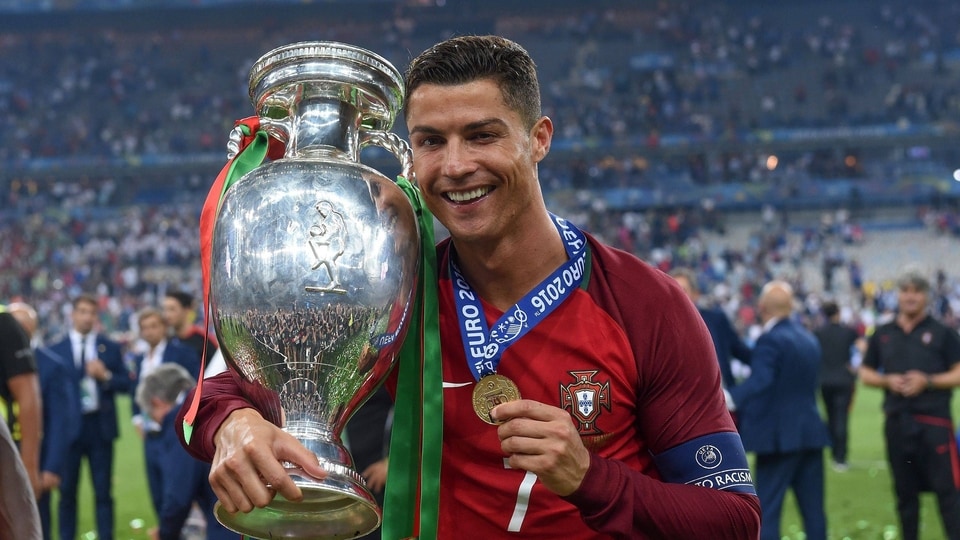
France continued to press, with Portugal largely on the back foot. Then, in the 109th minute, Eder found the back of the net. Portugal had its first major international trophy. Ronaldo dropped to his knees, raised his hands and cried for the second time that night, this time with joy. He called it “one of the happiest moments of my life”. He dedicated the victory to all Portuguese people, including immigrants.
His home island treated him like a hero. Eight months after the triumph in Paris, Madeira renamed its airport after him.
Under Ronaldo’s leadership, they won the inaugural Nations League in 2019 and lifted the trophy again in 2025. The No. 7 scored the equaliser against Spain in Munich before limping off. The match went to penalties, where five young Portuguese players stepped up and all converted. Ronaldo watched from the sidelines, in tears once again.
Perhaps his most lasting legacy is in the dressing room. The children who once watched him shine in Portugal’s red shirt and grew up idolising him were now walking out in the same national colours alongside him. Bruno Fernandes said the entire squad looked up to Ronaldo, recalling how Euro 2004 was when the forward became his role model. Joao Felix was just four years old when Ronaldo cried in Lisbon. Joao Cancelo calls him “the best player Portugal has ever had”. Today, this generation is ready to stand on its own.
The signs of that transition were there when Rafael Leão wore the No. 7 shirt in Ronaldo’s absence during the recent Nations League matches. Portugal won all three games without him to progress to the quarter-finals. More tellingly, Ronaldo’s son, Cristiano Jr., is beginning to follow in his footsteps, having earned a place in Portugal’s Under-17 team.
The ending, though, was not kind. This summer, Ronaldo became the first man to score at six different World Cups, but Spain knocked Portugal out in the last 16. It was a tournament in which he faced intense criticism for his poor form and was accused of occupying a place that could have gone to a deserving youngster. Then, in September, he fell out with new coach Jorge Jesus over playing time.
He was suspended and was expected to return to the national team later this month, but instead, Ronaldo surprised everyone by announcing his retirement.
It was not the ending he wanted, but careers are not judged by their final chapters alone. Ronaldo walks away not just with 146 goals, 234 caps, a European Championship and two Nations League titles, but also with a legacy of character, attitude and ambition. He instilled in Portuguese football a belief that trophies were worth chasing, and showed an entire generation what it meant to keep chasing them. For two decades, Portugal watched one man refuse to stop believing. Now, it must learn to carry that belief forward.