
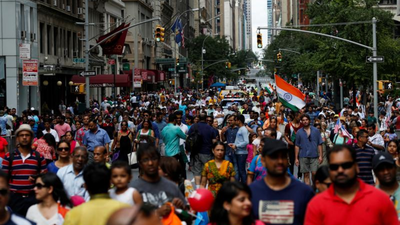
Forsyth County in northern Georgia has undergone a significant demographic shift over the past two decades, with a growing Indian-American population reshaping its neighbourhoods, businesses and cultural landscape. Thousands of Indian families have settled in the area, attracted by established community networks, schools and employment opportunities. Their growing presence, however, has also raised questions about integration and relations with long-time residents.According to a PTI report, the county now has around 52,000 Indian residents, accounting for approximately 16% of its population. They form the second-largest ethnic group in the area, behind White residents, who make up 63.5%.The expansion has not always been welcomed by everyone. Community leaders say limited social interaction between Indian immigrants and White residents has contributed to resentment, while anti-immigrant sentiment has grown alongside the rise of President Donald Trump’s MAGA movement.
How Forsyth became a destination for Indian families
Indian migration to Georgia began in the 1960s, when students and academics arrived to study or work at institutions such as Emory University and Georgia Tech. The community remained small for decades. Even as migration to the US increased in the late 1990s, the 2000 census recorded just 160 Indian residents in Forsyth County, as per the report.The subsequent growth has been driven partly by the support network available to newcomers. Ani Agnihotri, programme chair of the USA India Business Summit, told PTI that the presence of Indian grocery stores, temples, established residents and good schools has made Forsyth an attractive destination for families moving to Georgia.He also pointed to the community’s relatively high earnings. The median annual income of Indians is around $150,000, considerably above the broader American average, he said.“What do Indians want? We come to the US with these five goals: we want to buy big houses, big cars, earn good money, go to temples and send our kids to Ivy League colleges,” Agnihotri told PTI. He moved to Georgia as an MBA student in 1991.The community’s presence is visible in residential developments and commercial districts across the county and neighbouring towns. In Suwanee, Indian supermarkets, restaurants, clothing stores and salons cater to a growing customer base. At Suvidha supermarket, shoppers can find dosa and idli batter, yoghurt and flour alongside traditional Indian sweets.Religious institutions have also expanded. Agnihotri told PTI that the greater Atlanta area has around 100 Hindu temples, including the BAPS Swaminarayan temple, which opened in 2007 with a procession featuring elephants. Ganesh Chaturthi celebrations in the region have also included flower showers from a rented helicopter.
A history of racial exclusion
The demographic transformation is taking place in a county with a long history of racial violence. Before White settlers expanded into the region, it was home to Cherokee communities, who were progressively pushed from their ancestral territories during the 19th century.The discovery of gold in Georgia in 1828 accelerated their displacement. White settlers used threats, coercion and legal measures to force Cherokee communities from their land towards reservations in present-day Oklahoma. Their removal became part of the history known as the Trail of Tears.Forsyth’s history of racial violence continued into the early 20th century. In 1912, the rape and murder of 18-year-old Mae Crow in Cumming triggered attacks against Black residents. Rob Edwards, a Black man accused in the case, was taken from the county jail by a mob, shot and lynched. Two other Black men were subsequently hanged after trials described as one-sided,according to the news agency’s report.The violence drove Black residents out of the county, leaving Forsyth overwhelmingly White for decades. Racial hostility remained visible in 1987, when civil rights activists travelling from Atlanta to organise a peace march were confronted by White residents near Cumming. Protesters blocked their bus, shouted racist abuse and displayed signs opposing the presence of Black people in the county.Patrick Phillips documented the area’s history in his 2016 book Blood at the Roots, examining the violence and racial discrimination that shaped Forsyth.Venu Challa, a longtime Georgia resident who recently moved to Cumming, told PTI that many Indian families settling in the area may be unaware of the history of the land they now call home.“Few Indians are cognizant of the irony that they are settling on a soil that was once splattered by the blood of racist violence for two centuries,” he said.Challa lives in a newly developed neighbourhood of 56 five-bedroom houses, each valued at around $1.5 million. Indian families own and occupy 45 of the properties, while the remaining homes are occupied by White American, African American and East Asian families.
Assimilation and the next generation
Despite the community’s economic contribution, some local leaders believe Indian residents need to make greater efforts to engage with people outside their own social circles. Agnihotri told PTI that immigrants should participate more actively in the wider community.Challa said limited interaction with the host population is common among first-generation migrants of different nationalities. He believes the next generation generally becomes more integrated as it grows up in the US.He also pointed to the regional, linguistic, cultural and caste divisions within the Indian community, which can be unfamiliar to many Americans. Such distinctions, he said, are less prominent among second-generation Indian Americans.Their growing involvement in local politics offers one indication of the community’s changing position. Shuchita Patel, a second-generation Indian American, contested a recent Forsyth County commissioner election as a Democratic Party candidate. Although she lost, her campaign reflected the increasing participation of Indian Americans in local public life. Other Indian-origin candidates also took part in the November 3 midterm elections.Challa said awareness of Forsyth’s history could help newcomers understand the community they are joining. While overt racism is now uncommon and Indian residents rarely face discrimination, he believes knowing the past is important when building a life in the area.“It is important for Indians to know the past of the land where you want to build a new life. It gives you context and helps you adapt and shape your conduct,” he told the news agency.