
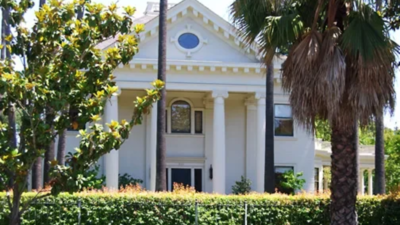
A century-old mansion in California, once threatened with demolition and later saved through a community-led preservation campaign, has returned to the property market with an asking price of nearly $20 million. The historic Squire House, a white-columned Neoclassical estate on Palo Alto’s University Avenue, is listed for $19.988 million. It is the first time the property has been offered for sale since it last changed hands in 1999, according to a report by The Almanac.Built in 1904 for John Adams Squire and his wife, Georgiana, the mansion stands on a nearly one-acre property in the city’s Crescent Park neighbourhood. The main residence spans 7,794 square feet, while a separate 600-square-foot guest house brings the total built-up area to approximately 8,394 square feet. The estate also includes landscaped gardens, a swimming pool and a terrace with a fireplace, according to the property’s listing by DeLeon Realty.But the house’s significance extends beyond its size and price. Known for its grand two-storey portico and Ionic columns, it is recognised as California Historical Landmark No. 857 and is listed on the National Register of Historic Places. Its survival helped galvanise Palo Alto’s historic-preservation movement.
Built for a man fascinated by the classics
Squire, who lived from 1857 to 1930, came to Palo Alto in 1891 when he enrolled at Stanford University for advanced studies in classics. Originally from Massachusetts, he was the son of a wealthy meat packer whose business interests were eventually sold to the Swift company. However, Squire was more interested in ancient languages and teaching than in the family business. He had earlier tutored students in Latin and Greek at the San Jose Normal School, now San Jose State University, and College of the Pacific. After moving to Palo Alto, he and Georgiana became part of the city’s early community, among its first 35 households.The couple initially lived in a smaller home on Emerson Street before commissioning San Francisco architect T. Paterson Ross to design their University Avenue residence. Builder George W. Mosher constructed the house in 1904. The architecture reflected Squire’s academic interests. Designed in the Roman Classic Revival style, the mansion drew inspiration from ancient Greek and Roman buildings. Its imposing two-storey entrance features a triangular pediment supported by Ionic columns, while the interiors retain details such as quarter-sawn oak floors, leaded-glass windows, oak panelling, pocket doors and elaborate woodwork.The living room has a fireplace with a mahogany mantel, while the dining room features oak panelling and a built-in sideboard. One of the more unusual details of the property is its attic, which Squire’s three daughters reportedly used as a roller-skating rink while growing up. The house also survived the 1906 San Francisco earthquake. Although two chimneys collapsed, its columns and exterior remained standing, according to historical accounts cited by The Almanac.
The campaign that saved the mansion
The Squire family continued to occupy the property until Georgiana’s death in 1959. By the early 1970s, however, the mansion faced a very different future. Its owner planned to sell the land to a buyer who intended to demolish the house and construct four homes on the site. The proposal prompted opposition from neighbours and local preservationists. The Palo Alto Historical Association organised a Save the Squire House Committee, while residents rallied to prevent the loss of one of the city’s most recognisable buildings.The city purchased the property and held it for a year, giving preservation advocates time to raise funds. The campaign collected $90,000, with local Girl Scouts even organising bake sales to contribute to the effort. The city separately spent $118,000 on structural improvements before selling the mansion to a private buyer for $135,000. The sale came with a façade easement, which protects the home’s exterior and grounds and requires city approval for changes. The preservation effort helped build momentum for wider protections of historic buildings across Palo Alto.The Squire House was registered as California Historical Landmark No. 857 on October 31, 1972. The city also adopted its Historic Preservation Ordinance in 1979 and established a Historic Resources Board to review proposed changes to designated properties.
What the nearly $20 million estate offers
More than 120 years after its construction, the mansion combines its historic exterior with modern luxury features. The current listing describes a five-bedroom property with six full bathrooms and a half-bath, formal living and dining spaces, a private study and a marble kitchen.A finished lower level includes a game room and theatre, while an additional top-floor space can be used for work or recreation. Outside, the grounds feature sweeping lawns, a swimming pool and a trellis-covered terrace with a fireplace. The separate one-bedroom guest house provides additional accommodation.The property is being marketed at $19,988,000, according to the real estate listing. Its main residence accounts for 7,794 square feet, with the guest house adding another 600 square feet.