
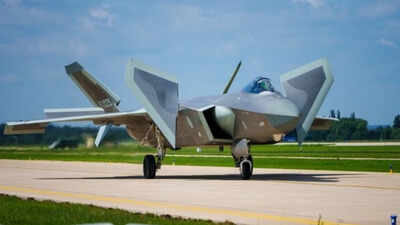
Developing a fifth-generation stealth fighter takes decades of research, billions of dollars in investment and technological expertise that only a handful of countries possess.But building one is only half the battle. Keeping these sophisticated machines combat-ready is an equally demanding task for the air forces operating them.China’s Chengdu J-20, also known as the ‘Mighty Dragon’, offers a glimpse into this challenge. A recent study by Chinese researchers has highlighted how damage to radar-absorbing material could weaken a stealth aircraft’s ability to evade radar detection.According to a report by Interesting Engineering, the researchers found that losing just 10 per cent of an experimental radar-absorbing coating nearly doubled the amount of microwave energy reflected by the material in laboratory tests.The researchers examined how scratches, surface wear and peeling affect the coating’s ability to absorb radar waves. They developed a composite material using carbonyl iron powder and silicone resin, applied it to titanium alloy plates and tested its performance across frequencies ranging from 2 to 18 GHz.The experiments showed that while superficial scratches had a relatively limited impact, deeper wear and coating detachment significantly weakened its radar-absorbing performance.When sections of the coating peeled away, the exposed metal reflected more electromagnetic energy, while the boundaries between damaged and undamaged areas caused additional scattering and diffraction.However, the study did not test the actual stealth coating used on China’s J-20. Instead, it demonstrated how damage to a radar-absorbing material can affect its performance, highlighting one of the challenges involved in maintaining low-observable aircraft.Why maintaining a fifth-generation fighter is a difficult taskThe difficulty of maintaining a fifth-generation fighter lies in the fact that its advanced capabilities depend on several interconnected systems that must remain functional at all times.Unlike conventional fighter jets, stealth aircraft require specialised maintenance not only to keep their engines, weapons and avionics operational but also to preserve the low-observable features that make them difficult to detect. A routine repair can sometimes involve additional work to ensure that the aircraft’s stealth characteristics are not compromised.The US Air Force’s experience with the F-22 Raptor provides a clear example. Its radar-absorbing coating is not simply an external layer of paint but a specialised system of materials that must be carefully applied, inspected and restored.Even routine maintenance involving the removal of an aircraft panel can require additional work because technicians must first remove the coating to access the component and then restore it after the repair.Beyond stealth coatings, maintaining the aircraft’s advanced electronics, sensors, engines and software presents another layer of complexity.Fifth-generation fighters rely on integrated systems that allow pilots to combine information from radar, infrared sensors, electronic warfare equipment and other onboard technologies.A problem with a component or software system can restrict the aircraft’s ability to perform certain missions, even if it remains capable of flying. Repairs also require specialised diagnostic equipment, technical documentation and trained personnel.The F-35 Lightning II illustrates how these challenges can affect the readiness of an entire fleet. According to a June 2026 report by the US Government Accountability Office (GAO), the F-35 fleet’s mission-capable rate declined from 67 per cent in fiscal year 2021 to 44 per cent in fiscal year 2025.Its full mission-capable rate fell from 38 per cent to 25 per cent during the same period. Mission-capable aircraft can perform at least one assigned mission, while full mission-capable aircraft can perform all their assigned missions.The GAO identified shortages of spare parts, delays in component repairs, corrosion and inefficient maintenance practices among the major reasons behind the F-35’s persistent readiness problems.The aircraft’s continuous technological development has also resulted in multiple configurations, each requiring different maintenance procedures and spare-part requirements. According to US Air Force officials cited in the report, software delays meant some newly accepted F-35s were classified as non-mission capable in fiscal year 2025.The American experience highlights a central challenge of fifth-generation fighter operations: developing an advanced aircraft does not automatically guarantee that it will remain available for combat.Preserving stealth capabilities, maintaining complex electronic systems, securing specialised spare parts and ensuring access to trained technicians require a dedicated support network and sustained investment.For operating air forces, the real test is not simply how many fifth-generation fighters they acquire, but how many they can keep mission-ready when a conflict demands them.