
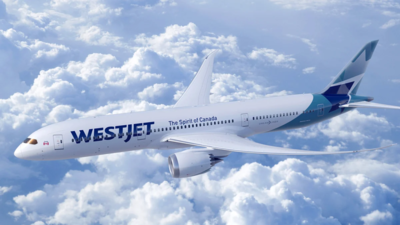
A Canadian couple who arrived in Vancouver nearly 16 hours late have won $2,000 in compensation from WestJet after a British Columbia tribunal rejected the airline’s argument that strong winds caused the delay. The British Columbia Civil Resolution Tribunal (CRT) ruled that WestJet had failed to prove that an unexpected weather event was responsible for the disruption experienced by Kevin and Marie Isobel Fraser. According to CP24, the couple were travelling from Minneapolis to Vancouver on 6 June 2024 when their first flight, which was due to take them to Regina, arrived one hour and 37 minutes late. This caused them to miss their connecting flight, leaving them stuck overnight in a hotel in Regina. WestJet booked the couple onto new flights to Vancouver through Calgary the following day. They eventually reached home almost 16 hours later than planned. However, when the Frasers asked the airline for compensation, WestJet refused to pay.
Why WestJet claimed a weather exemption
Under Canada’s Air Passenger Protection Regulations (APPR), major airlines such as WestJet must pay passengers $1,000 each when a flight disruption makes them arrive at least nine hours late. Airlines can avoid paying this compensation if they prove that the delay was caused by something beyond their control, such as severe weather. They can also claim an exemption for unexpected maintenance work that is strictly needed to keep a plane safe. As reported by CP24, WestJet told the tribunal that the delay qualified for both the safety and weather exemptions. The airline said strong winds in Minneapolis had pushed a luggage belt loader into the aircraft, damaging the net used to secure baggage in the cargo area. WestJet argued that aviation rules do not allow planes to take off unless baggage is properly secured and cannot move during the flight. It said maintenance workers therefore had to repair the damage before the aircraft could depart.
Tribunal rejects airline’s weather defence
To support its argument, WestJet gave the tribunal an internal document called a “defect report”, which recorded the damage to the aircraft. However, CRT member Deanna Rivers found that the airline’s own report did not support its claim that the weather had caused the problem.“It shows that on June 6, 2024, the pilot reported that a belt loader had damaged the aft baggage door threshold net while moving away from the aircraft,” Rivers wrote in her decision, as quoted by CP24. “The damage affected five lower attachment points on the sill. The report identifies the resolution as replacing the aft baggage door restraint net. This was done in Calgary on June 16, 2024.” Rivers noted that the report did not mention wind or bad weather as a reason the aircraft could not leave on time.“The defect report identifies the belt loader as the source of the damage but does not mention weather or wind conditions,” Rivers’ decision reads. “There is also no other documentary evidence connecting the damage to the weather.”
Equipment handling deemed within airline control
When deciding whether WestJet was responsible for the damage caused by the belt loader, Rivers considered earlier decisions by the Canadian Transportation Agency. These rulings say that delays caused by airline staff failing to take proper care remain within the airline’s control. Rivers used the same principle when considering the Frasers’ case. She found that WestJet could not rely on the safety maintenance exemption to avoid responsibility for damage caused by ground equipment.“Here, even if the damage to the baggage net required maintenance before the aircraft could safely operate, WestJet has not established that the damage resulted from an unforeseeable weather event,” Rivers stated in the ruling.“Rather, the evidence only establishes that a belt loader damaged the net. As WestJet has not proved the damage was outside of its control, I find the resulting delay was within WestJet’s control and not required for safety purposes.”
Full breakdown of the $2,226.92 payout
Because the couple arrived more than nine hours late and the tribunal found that the delay was within WestJet’s control, Rivers ordered the airline to pay Kevin and Marie Isobel Fraser $1,000 each under the APPR. This brought their main compensation award to $2,000. According to CP24, the tribunal also ordered WestJet to repay the couple for other expenses they had paid during the disruption, as well as the costs of bringing their case. These included $35.28 for taxi journeys between the airport and their hotel in Regina. Kevin Fraser was also awarded $51 after being given a lower-class seat on the replacement flights through Calgary. WestJet was also told to repay the couple’s $125 fee for filing their case with the Civil Resolution Tribunal, along with $15.64 for sending legal documents to the airline by registered mail. With the $2,000 compensation award and all additional expenses included, WestJet must pay the couple a total of $2,226.92.