
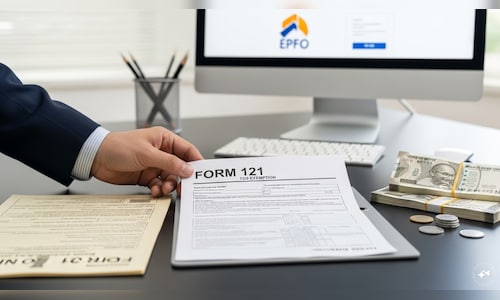
In an order, the retirement fund body said the change comes into effect with the new tax regime replacing the Income-tax Act, 1961 from April 1, 2026.
Single form replaces 15G/15H
Under the revised framework, taxpayers who wish to avoid TDS on eligible incomes must submit Form 121, a consolidated declaration replacing the earlier Forms 15G and 15H.
The EPFO said the form can be filed by a resident individual whose estimated tax liability for the financial year is nil. The declarant must fill and sign Part A of Form 121, while the payer—such as an EPFO regional office—will complete Part B.
The organisation clarified that submission of Form 121 is not mandatory and applies only to those who seek non-deduction of tax at source.
UIN requirement and reporting timelines
EPFO has made it mandatory for its regional offices, acting as payers, to assign a Unique Identification Number (UIN) to each Form 121 received. The UIN must include a sequence number, the relevant tax year and the Tax Deduction and Collection Account Number (TAN) of the payer.
Offices are required to compile a consolidated statement of all Form 121 declarations received in a month and upload it on the income-tax e-filing portal by the 7th of the following month. These UINs must also be quoted in the quarterly TDS return filed in Form 140.
Digital filing facility under development
The EPFO said its internal systems division has been asked to enable a facility for members to digitally e-sign and submit Form 121 online. Until the system is operational, physical signed forms uploaded by members in place of Forms 15G or 15H will be accepted for compliance and reporting purposes.
The circular added that UINs must be generated in a running sequence starting April 1, with continuity to be maintained once the online system becomes available.
Compliance and member awareness
The EPFO cautioned that non-compliance with provisions of the new tax law—such as failure to generate UINs or incorrect reporting—could attract penalties under the applicable rules.
It has asked all zonal and regional offices to ensure strict adherence to the guidelines and to sensitise eligible members about submitting Form 121 instead of the earlier forms.
At the same time, the EPFO clarified that claims already filed with Forms 15G or 15H on or after April 1 should not be rejected. Instead, offices should follow up with members to obtain Form 121 separately.
The order was issued with the approval of the Central Provident Fund Commissioner, the EPFO said.