
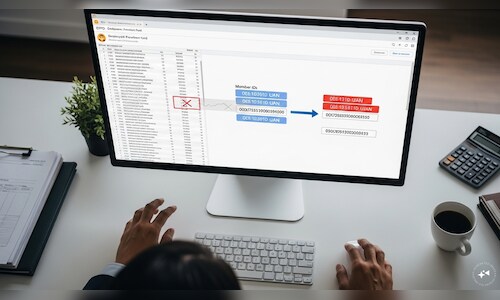
In a circular, EPFO said the facility will now cover cases where Member IDs were generated without the employee’s knowledge and contributions were subsequently credited to those accounts.
The move is aimed at cleaning up service records and addressing long-standing grievances related to duplicate or incorrectly mapped PF accounts.
Under the revised framework, employees can initiate a de-linking request through the EPFO Unified Member Portal by logging in with their UAN credentials and selecting the incorrect Member ID from their service history. They must specify a reason—such as erroneous mapping or non-joining of employment—and complete Aadhaar-based e-KYC authentication via OTP.
Once submitted, the request is first reviewed by the employer, who verifies contribution and claim details before approving or rejecting it. If the employer fails to act, rejects the request, or if the account has higher-than-permitted contributions, the case is escalated to the EPFO’s field office.
The final decision is taken by the Regional Provident Fund Commissioner after due examination.
However, EPFO has imposed several safeguards.
Member IDs linked to claims that are settled, pending, or under process will not be eligible for de-linking. Similarly, IDs with more than a specified number of contributions—set at over six instances—will be blocked from this facility. Additional system-level checks include restrictions on older IDs created before December 31, 2016.
The retirement body said the updated process is designed to improve the accuracy of UAN-linked service history while ensuring robust verification at multiple levels.
ALSO READ |EPFO asks offices to switch to Form 121: What it means for TDS exemption