
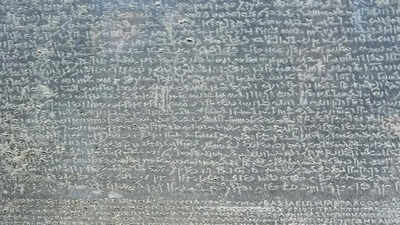
There is something rather sneaky about history. World-shattering revelations can happen when one doesn’t think they’re coming. Sometimes they happen amid the humdrum tasks of everyday life. Consider the summer of 1799. A detachment of French troops, led by Napoleon Bonaparte, was positioned near Rashid, known as Rosetta in Egypt. This group was not out on some adventure seeking treasure or uncovering ancient civilisations. Rather, they were repairing a wall near Fort Julien. During the demolition work, they found a blackened, angular piece of granodiorite, a mere piece of trash, they thought.This “dirty stone” would eventually be recognised as the Rosetta Stone, perhaps the most famous piece of rock in the world. At the time, the soldiers only knew it looked important because it was covered in strange, cramped writing. They had no idea that they were holding the key to a lost civilisation. For centuries, the beautiful and mysterious carvings found on Egyptian temples and tombs had been a complete riddle. No one alive knew how to read them. That single moment of manual labour at a fort wall provided the bridge that finally allowed the modern world to hear the voices of the Pharaohs again.A code written in three scriptsThe magic of the Rosetta Stone was not in what it was made of, but in the specific way it was written. It featured a royal decree issued in 196 BC, but the message was repeated three times using three different scripts. At the top were the formal Egyptian hieroglyphs used by priests. In the middle was Demotic, the everyday script of the people. At the bottom was Ancient Greek. Because scholars in the 18th century could still read Ancient Greek, they finally had a “cheat sheet” to compare the known language with the unknown one.The findings from research by Lehigh University into Egyptian Hieroglyphics show that this trilingual system became a revolutionary turning point for Egyptologists who would now be able to abandon speculations in favour of scientifically proven methods of comparison. By matching the location where names of the kings could be found in Greek inscriptions to their counterparts in Egyptian columns, linguists discovered that these symbols were much more than representations of abstract notions – they were the characters of a rather complicated phonetic alphabet representing sounds of the spoken language.
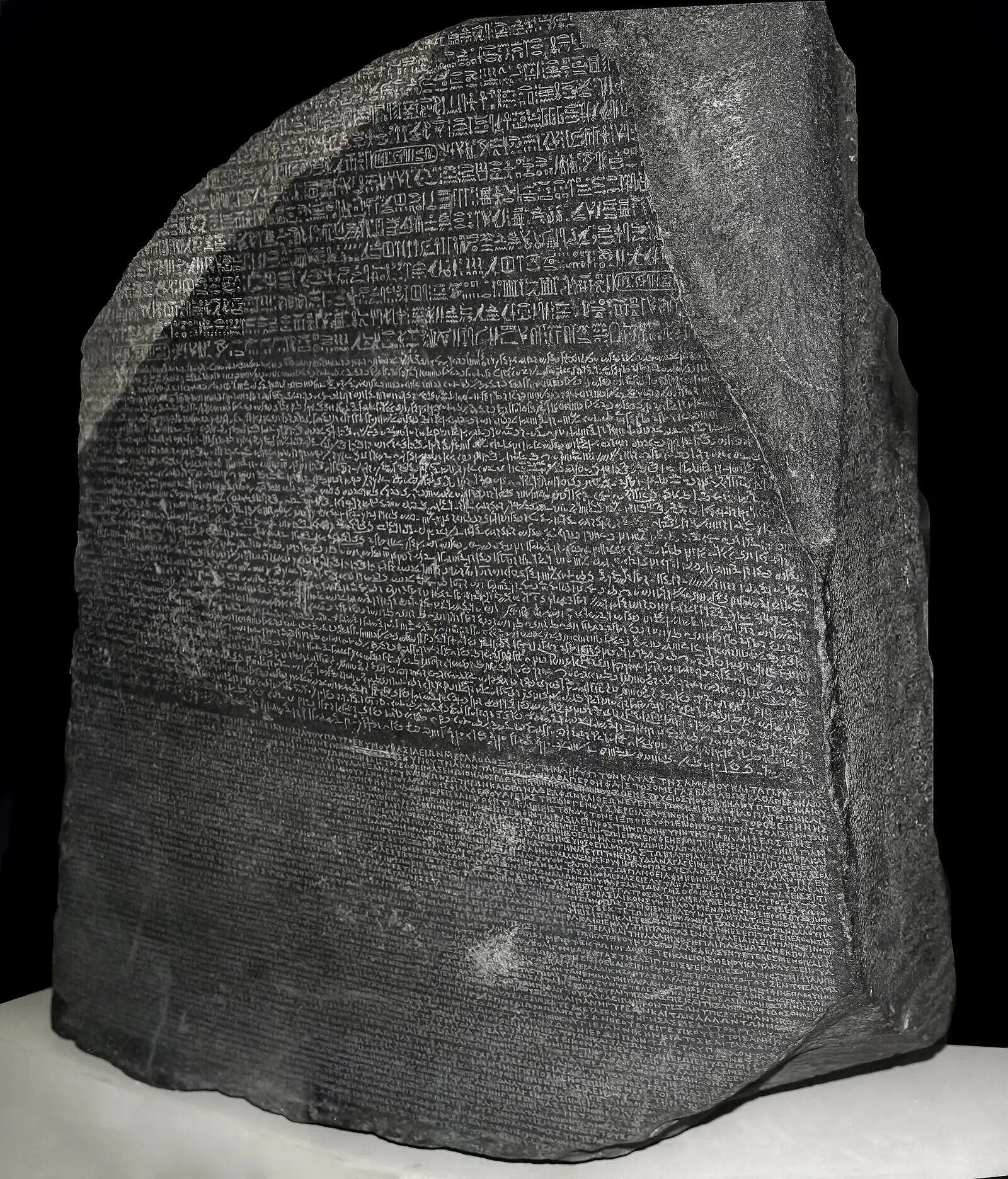
Jean-Francois Champollion’s groundbreaking work, comparing the stone’s inscriptions with Coptic, revealed that hieroglyphs represented sounds, unlocking millennia of Egyptian history. Image credits: via Wikimedia Commons
The phonetic alphabet decipheredThis process did not occur quickly. After decades of painstaking efforts and fierce competition between numerous gifted specialists, the final breakthrough was achieved by a young French linguist, Jean-Francois Champollion. Being sure that the true understanding of the stone required a different approach toward it, he started to compare the inscriptions with Coptic, which is still used in Egyptian churches and represents an evolution of the ancient language.The Précis du système hiéroglyphique des anciens Égyptiens, published by the Yale Peabody Museum, describes the extent of the linguistic system. The Rosetta Stone is the object that Champollion used to prove the phonetics of hieroglyphics, where each character denoted a sound rather than just serving as an idea. This was quite contrary to the contemporary belief that each character denoted only symbols. In addition to deciphering the text on this stone, Champollion gave the linguistic community a means to understand all texts in Egypt thanks to his grammar and alphabet.The Rosetta Stone is currently on display in the British Museum, symbolising the human thirst for exploration and perseverance. It highlights the fact that the most mundane of objects may have hidden layers of meaning once they are understood in their true perspective. While the soldiers at Fort Julien were only trying to repair a wall so that they could protect themselves in times of war, they had unwittingly helped preserve an artefact that would allow us to connect with five thousand years of human history.