
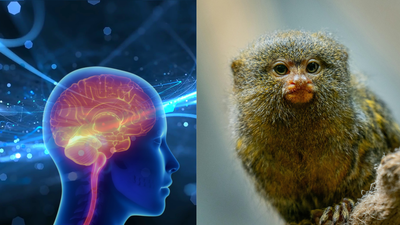
Scientists from China have identified the existence of human-like speech pathways in the brains of marmoset monkeys, providing insights into the evolution of speech and communication in primates. According to the study, published in the Proceedings of the National Academy of Sciences, marmoset brains contain an arcuate fasciculus, which is believed to be responsible for human language processing and speech development. By using ultra-high resolution diffusion MRI images and neural tracing technologies, the researchers were able to identify the network structure in the brain of the primates, which was strikingly similar to that in humans. Researchers think that their discovery may help revolutionise studies related to speech impairments, language evolution, and auditory-motor integration.
How Chinese scientists discovered a human-like language pathway in the Marmoset
In previous years, neuroscientists assumed that macaques were the most suitable non-human primate model for the study of language evolution. Nonetheless, researchers at the Chinese Academy of Sciences, through ‘Homologous specialisation of arcuate fasciculus ventrolateral frontal connectivity in marmosets and humans’, have identified that marmosets might provide an even better model than macaques in specific brain pathways related to language. The discovery is related to the arcuate fasciculus or AF, which is a group of nerve fibres linking the auditory and motor parts of the brain. This pathway is responsible for language skills such as speech production, comprehension, and word retrieval in humans.The team used neural tracing and diffusion magnetic resonance imaging to examine the brain structures of common marmosets. They discovered that there is a “robust AF homolog” in marmosets with frontal lobe projections similar to humans rather than macaques.Yufan Wang, who is a doctoral student at the institute, said that scientists discovered a “complete and efficient auditory-motor regulatory circuit” in marmosets similar to the one in humans.
Why marmosets are important for language evolution research
The attention on marmosets has grown due to their highly social and vocal nature. The animals behave unlike other primates, since they participate in call-and-response communication like humans. Marmosets even learn how to call based on social feedback from their parents, which is a rare ability among non-human primates.“The study provides direct evidence that primates share profound similarities in neural substrates underlying vocal control,” said researcher Fan Lingzhong of the Chinese Academy of Sciences.It was concluded that the special ability of social vocal learning in marmosets can be linked to the development of an arcuate fasciculus different from that of macaques. Associate professor Cheng Luqi explained that vocalisations in macaques are predetermined and emotion-based, while the marmosets adjust their sounds to social behaviour and parental instructions. The difference is important, since language does not involve the generation of sound only. It involves fast coordination of auditory, memory, motor and social learning skills. Scientists suppose that the marmoset brain could serve as a biological model of the human brain regarding the evolution of human speech.
What the study means for neuroscience and speech disorders
The discovery may eventually help researchers better understand conditions linked to speech and communication difficulties. Scientists say the marmoset’s neural pathways could support future research into language disorders, rehabilitation therapies and brain development. The study also adds to growing evidence that the roots of human language may be far older than previously believed. Earlier research titled ‘Primate auditory prototype in the evolution of the arcuate fasciculus’ from Newcastle University suggested that components of the human language pathway could date back at least 25 million years. Professor Chris Petkov described the discovery as “like finding a new fossil of a long-lost ancestor”.Importantly, researchers stress that marmosets do not possess human language itself. Instead, they appear to share foundational neural structures linked to vocal communication. Human brains still contain additional extensions connected to semantic memory, storytelling and abstract meaning.Even so, the findings are significant. They suggest that some of the neurological foundations required for speech may have emerged far earlier in primate evolution than scientists once thought.