
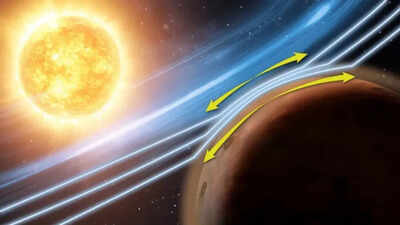
Scientists are analysing information from NASA’s MAVEN mission, which reportedly came across patterns that did not fit any known behaviour in the Martian atmosphere. At first, the signals looked like simple noise or random interference. But the pattern kept repeating in a structured way that slowly began to attract attention. Over time, this small curiosity turned into a real scientific question about what might actually be happening inside Mars’ upper atmosphere.The discovery is linked to observations from NASA’s MAVEN spacecraft and suggests an atmospheric effect that has never been confirmed on Mars before. Scientists say it might even change how we understand the interaction between solar wind and the Red Planet. It appears to be connected to a phenomenon previously observed only near Earth.
NASA data reveals the Zwan-Wolf effect hidden inside Mars’ ionosphere
The first signs came from magnetic field measurements collected in the Martian ionosphere. NASA Scientists reportedly noticed small fluctuations or “wiggles” in the data while reviewing long observation sequences. These changes did not match known Martian atmospheric activity. At first, they assumed it could be instrument noise or some kind of external distortion caused by solar activity. But the pattern did not disappear; instead, it became more noticeable during periods of strong solar storms. When charged particles from the Sun hit Mars more intensely, the signals inside the data seemed to become clearer. This made researchers take a closer look to follow a structured form that needed an explanation.The team eventually focused on a region deep inside the ionosphere, below about 200 kilometres above the surface. That is where the charged particles seemed to be behaving unexpectedly.
What is the Zwan-Wolf effect
The phenomenon identified in the study is known as the Zwan-Wolf effect. It was first discovered in 1976, but until now, it had only been observed in Earth’s magnetosphere. On Earth, it plays a role in how charged particles move along magnetic field structures. Scientists often describe it as a squeezing or channeling effect, where plasma behaves almost like it is being pushed through invisible tubes in space.At Earth, this helps shape how solar wind is deflected around the planet. It is part of a complex interaction between magnetic fields and charged particles coming from the Sun.What makes the Mars discovery unusual is that the planet does not have a global magnetic field like Earth. Instead, Mars has a weak and patchy induced magnetic environment created by solar wind interactions. Because of this, scientists did not expect the same structured behaviour to appear in its atmosphere.Yet the data suggests something very similar may be happening inside Mars’ ionosphere.
What happens when a strong solar storm hits Mars
Researchers believe the effect was always present at some level, but it was too weak to detect under normal conditions. It only became visible when a strong solar storm hit Mars and disturbed the environment.During this event, the solar wind increased in intensity and compressed the Martian ionosphere. This made the charged particles behave more actively. Scientists analysing data from MAVEN reportedly noticed that the magnetic and plasma readings began to show a clearer structure during this time.What was previously hidden in background noise suddenly became measurable. The charged particles appeared to be squeezed and redistributed in a pattern consistent with the Zwan-Wolf effect.
How Mars’ exposed atmosphere responds to constant solar pressure
Mars has a very different space environment compared to Earth. Without a strong global magnetic field, it is directly exposed to solar wind. This constant flow of charged particles interacts with the upper atmosphere and slowly contributes to atmospheric loss over long periods.This is one of the key reasons NASA launched the MAVEN mission in the first place. The spacecraft was designed to study how Mars is losing its atmosphere and how solar activity affects its ionosphere and climate. If the Zwan-Wolf effect is confirmed as a regular feature of Mars, it could change how scientists model these interactions. Experts say this might also apply to other unmagnetised bodies such as Venus or Saturn’s moon Titan, though this is still under investigation.