
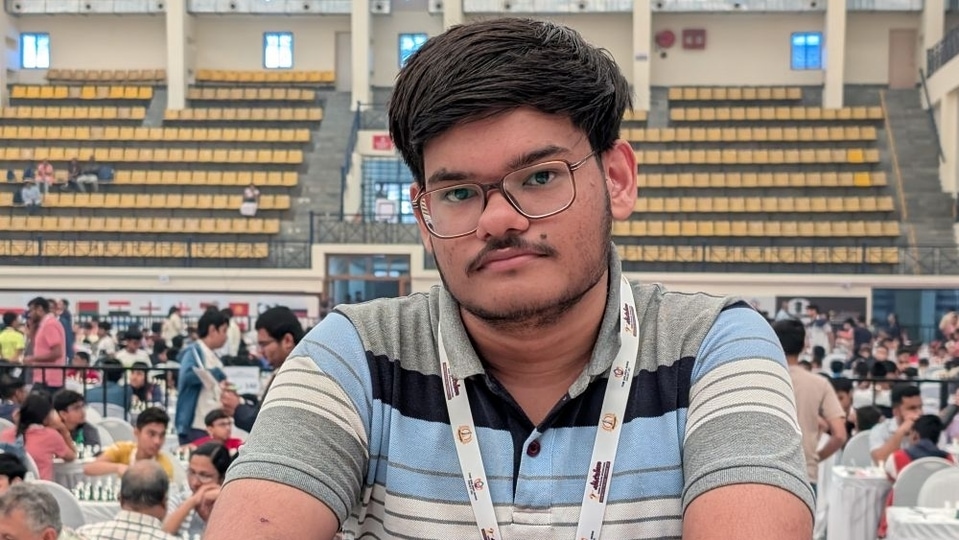
In June last year, Anuj Shrivatri had to choose between a remote job offer from a German-Indian enterprise technology and consulting firm and chess. He picked the seemingly less secure path. A little over a year later, he has earned himself a place in Indian chess history – and perhaps in trivia quizzes – as the country’s 100th grandmaster.
Nearly four decades after Viswanathan Anand became India’s first grandmaster, Indian chess has reached a milestone that once seemed distant. Anand’s improbable run – carving his path as the lone Indian GM in elite chess, to winning the World Championship five times, lent belief.
Others followed, and with them grew an ecosystem that made the journey a little less improbable.
Grandmaster Shyam Sundar is among them.
As a young chess player travelling to Moscow for the Aeroflot Open, he remembers being struck by how deeply the game was woven into everyday life. Chess seemed to be everywhere. He wondered what it would take for India to produce grandmasters in such numbers.
He ended up doing something about it.
Six of his students have since become grandmasters, four of them in a single calendar year – 2025. The 34-year-old is pleased with the unusual distinction. “If I count myself among my students, it’s seven GMs,” Shyam laughs.
Shyam, who runs Chess Thulir, an offline academy in Perambur, Chennai, recalls helping fellow players with their chess even as a teenager. He became an international master at 14 and a grandmaster six years later. The transition to coaching came almost naturally. It has sometimes meant travelling overseas and living alongside his students for months at a stretch as they moved from one tournament to another. He did just that during the 2025 GM chase.
Ramesh, India’s 10th grandmaster, recalls the exact moment he decided to become a full-time coach – walking into a tournament hall in Mumbai in 2006 and having close to 40-odd students stand up to greet him. Two years later, he quit his government job and set up his academy – Chess Gurukul, in Chennai.
He belonged to an early generation of Indian GMs who turned to coaching, passing on knowledge that had once been difficult to come by. Among the many grandmasters to emerge from his academy are siblings Praggnanandhaa, currently India’s highest-ranked player, and Vaishali, Women’s World Championship challenger.
There was a time when merely catching sight of a Grandmaster was an event.
“Back in our time, we used to wait for the Goodricke tournament which would happen once a year. That was the only time we got to see a Grandmaster in the flesh. Among us, we would joke — ‘I know about this position, because I once saw a grandmaster’. If you saw a grandmaster it meant you were better at chess,” GM Surya Sekhar Ganguly laughed. “We’ve come a long way since.”
For every young player who collects norms and crosses the rating threshold, there is often a small army of people who helped make it possible. Coaches who spot promise early, become mentors and sometimes waive fees when families struggle to afford lessons. Parents who rearrange their lives around tournament calendars, dip into savings and put careers on hold.
Reigning world champion Gukesh spent many nights curled up in the back of a car as a young boy while his father, Rajini Kanth, an ENT surgeon, drove him to weekend chess tournaments near Chennai. Often, it was after a tiring day at work, but Rajini Kanth made the journey anyway. As Gukesh’s promise grew, he stepped back from his medical practice to accompany his son to tournaments around the world.
Four years ago, Monomita Chakraborty left her job of 15 years as a consultant gynaecologist at an Assam government hospital so she could travel with her son, Mayank, to tournaments. In March this year, Mayank became northeast India’s first grandmaster.
Then there is Nagalakshmi, mother of Praggnanandhaa and Vaishali, a familiar presence in her printed saris and with her ready smile. She travels the world with her children, quietly preparing meals in hotel rooms and waiting for hours outside playing halls. Whether the siblings emerge crushed or elated, hers is often the first familiar face they see. On the rare occasions she isn’t around, she is the first person they call.
Heena Sadhwani, decided to take a step back from working in the family-run chemical repacking business, to be by her son Raunak’s side on his road to becoming grandmaster. She earlier had a job with the Tata Group. “Leaving my career was not an easy decision. We didn’t know for sure that he would become a grandmaster. We were taking a risk based on his potential. Once I began travelling with him full-time I began handling all the travel and accommodation logistics, basically everything that he needed outside chess.”
A parent is often a player’s Man Friday, taking care of everything so they don’t have to expend energy on anything other than chess. Sometimes, it’s as simple as quiet company on the walk to the tournament hall, or someone to sit across from at dinner in a hotel restaurant when chess is the last thing the player wants to talk about.
The extraordinary commitment of Indian chess parents has not gone unnoticed by those looking in from the outside.
“When I was working with the Italian Federation, I recall coaches there being impressed by Indian parents,” Ramesh says, “It amazed them that Indian parents would accompany their kids to the playing venue and just stay put till whatever time the games ended. ‘How do they sit doing nothing else, but just waiting for their child? This is so impressive. Our parents would never do this,’ one of folks there told me.”
Yet for all the shared sacrifices, chess parenting can also be a lonely, competitive pursuit.
There is camaraderie among chess parents, but also a certain wariness. They run into each other in tournament corridors, exchange stories of missed flights and expensive hotel rooms, and understand one another’s anxieties better than most. Yet, information can be precious currency in a fiercely competitive pursuit. A good coach, a promising tournament, an affordable training arrangement – not everything is readily shared. The same parents who commiserate over a child’s defeat may find their children sitting across from each other the following morning.
“Over the years, as a chess parent, you learn to be cordial with other parents, with the understanding that ultimately, everyone’s looking out for their own child.”
Also Read: India’s 100 Grandmasters: How the numbers stack up state-wise
There’s also something to be said about the growing network of philanthropic initiatives and private backers attempting to ease some of that burden. HelpChess, Pravaha Foundation’s 64 Squares programme and Group e4 are among those supporting promising young players with the costs of coaching, travel and tournament participation. Their interventions matter in a sport where talent can emerge anywhere, but the means to nurture it are far more unevenly distributed.
In 2025-26, HelpChess supported 52 players, offering a measure of assistance to families navigating the fairly expensive path of competitive chess.
Reaching 100 Grandmasters has taken more than just a generation of gifted players. It has taken coaches willing to share what they know, parents prepared to give up more than they imagined, and people willing to invest in talent that comes with no guarantee of success.
For Shyam, coaching hasn’t entirely snuffed out the urge to compete. Every so often, he misses the tournament hall enough to return to it.
“I played three tournaments back to back a couple of months ago. Thankfully I did alright, finished in the top three-four,” he laughs. “It’ll save me from trolling from my students.”