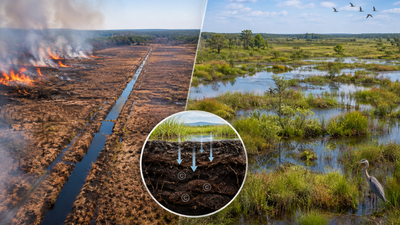
For thousands of years, layers of partially decomposed plants accumulated beneath a vast wetland in North Carolina, creating a deep store of carbon. That changed when an abandoned farming venture carved about 50 miles of drainage ditches through the land, lowering the water table and exposing the ancient peat to air. The 23-square-mile tract near Belhaven is now much more vulnerable to drought, decomposition and wildfire. The degraded peatland also releases an estimated 130,000 tons of carbon dioxide each year, turning what was once a long-term carbon store into a source of greenhouse gas emissions. According to The Associated Press (AP), scientists and investors are now working to reverse that damage by restoring water to the landscape. Colorado-based Pantheon Regeneration plans to block drainage ditches, raise the water table and restore native vegetation across the property. The project is part of a broader effort to protect North Carolina’s threatened peatlands and demonstrate how restoring degraded wetlands could keep large quantities of carbon underground.
How farming transformed the peatland
The site lies in North Carolina’s Inner Banks, where the peat can reach depths of about 15 feet. The organic soil developed over thousands of years as vegetation accumulated in waterlogged conditions. Because the environment remains saturated and low in oxygen, plant material decomposes slowly, allowing carbon to build up within the peat. The drainage system fundamentally changed that process.The roughly 50 miles of ditches were created decades ago as part of an agricultural development effort that was eventually abandoned. By carrying water away from the land, the ditches lowered the water table and exposed previously saturated peat to oxygen. Once dried, peat decomposes more readily and releases carbon dioxide. It also becomes much more susceptible to fire. Instead of remaining locked away in wet soil, some of the carbon accumulated over millennia can therefore return to the atmosphere. North Carolina has an especially extensive network of drainage infrastructure. Scientists cited by AP estimate that about 11,000 miles of canals drain peatlands across the state before the water eventually reaches coastal estuaries.
Why drying peat creates a wildfire threat
Water does more than preserve the carbon in a peatland; it also helps protect the ecosystem from severe fire. When peat remains saturated, underground combustion is difficult. But prolonged drying can allow fires to penetrate the organic soil and continue burning beneath the surface for weeks or even months. The consequences can be much greater than the loss of surface vegetation. A peat fire can consume layers of soil that took thousands of years to accumulate, releasing the carbon stored within them. As reported by AP, a major fire at the nearby Pocosin Lakes National Wildlife Refuge in 2008 burned above ground for about three months and continued smouldering underground for another four months. Another fire at the refuge area in 2022 burned almost 2,000 acres. In some places, the burning peat lowered the ground surface by around 1.5 feet. Restoring water levels is therefore important not only for climate reasons but also for reducing the risk of destructive peat fires.
Scientists want to make the land wet again
Pantheon Regeneration’s restoration plan focuses on reversing the effect of the drainage system. The company intends to block sections of the ditches so water can remain on the landscape and the water table can rise. Once the hydrology is restored, the project will also involve removing invasive species and replanting native grasses, flowers and other vegetation. The approach follows restoration work already undertaken by conservation organisations and government agencies in nearby peatlands, including Pocosin Lakes National Wildlife Refuge.The objective is not simply to create a wetter landscape. Rewetting the peat should slow decomposition and reduce the amount of carbon dioxide escaping from the soil, while also making the ecosystem more resilient to drought and fire.
A carbon store with a wider ecological role
The importance of the site extends beyond its carbon emissions. According to the World Economic Forum, peatlands cover only about 3% of Earth’s land surface but store roughly one-third of the planet’s carbon. When these ecosystems are damaged or burned, they can shift from storing carbon to releasing greenhouse gases. The North Carolina peatland also supports diverse wildlife. The surrounding ecosystem provides habitat for birds, mammals, reptiles, insects and native plants. Nearby Pocosin Lakes National Wildlife Refuge is home to species including red wolves, yellow pitcher plants and Atlantic white cedar and serves as a stopover for migrating birds.Pantheon’s project is also being linked to carbon-credit financing. The company plans to use scientifically monitored carbon reductions from restored peatlands to generate credits that can be purchased by companies seeking to compensate for emissions. The measurements will include groundwater monitoring, gas measurements, computer modelling and soil-core sampling, with results intended for independent verification. The North Carolina project therefore represents an attempt to reverse the chain of damage that began with drainage for agriculture. By putting water back into the peatland, scientists and conservationists hope to slow carbon loss, reduce wildfire vulnerability and restore an ecosystem that spent thousands of years building its underground carbon reserve.