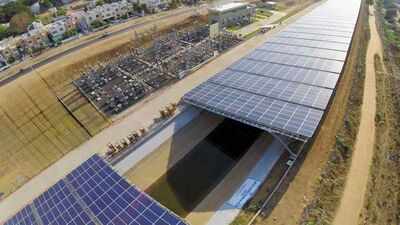
When it comes to solar panels, they are usually spread across rooftops or open fields where they serve more purposes than just providing energy. But near Chandrasan village in the western Indian state of Gujarat, a roughly 2,460-foot ribbon of panels sits above moving irrigation water, turning an existing canal into both a power site and a shade structure.
A solar plant on the water
The Gujarat State Electricity Corporation developed the canal-top plant with support from Sardar Sarovar Narmada Nigam, the public company that owns and maintains the canal network. Commissioned in 2012, the installation placed solar equipment on an elevated steel structure spanning about 0.47 miles of a branch canal.A conventional utility-scale solar project usually needs a large, unobstructed plot. But this project used the airspace over infrastructure that was already public, so no crop rows had to disappear beneath the panels and no separate parcel had to be acquired for the array. This detail is vital for the region that depends on both land and water.
Preserving water
The solar panels block part of the intense sunlight that would otherwise strike the canal throughout the day. According to the official project presentation, that shade keeps about 2.38 million gallons of water in the channel each year instead of losing it to the air.The reduced sunlight also limits algae growth in the canal, another benefit listed by the planners. The same roof produces electricity above the water and helps protect irrigation supplies below it. There is also a widely discussed cooling benefit, since photovoltaic panels generally lose some efficiency as they become hotter.Gujarat’s vast canal network means the idea could be scaled up significantly. State projections suggest that covering just 10% of the canal network could:
- Generate around 2,200 MW of solar power.
- Save nearly 11,000 acres of farmland from being converted into solar parks.
- Prevent the evaporation of around 200 billion litres of water annually.
- These figures are estimates based on projected expansion and have not yet been fully realised.
The shocking numbers
For a pilot, the figures were astonishing and promising. The plant was designed for one megawatt of capacity and about 1.6 million kilowatt-hours of annual generation while conserving six acres that might otherwise have been needed for a ground-mounted project. One official assessment examined about 5,068 miles of main canals, branches, and distributaries, estimating that using 30% of their length could support roughly 2,000 megawatts and cut evaporation by around 15.9 to 23.8 billion gallons per year.Those totals are planning scenarios, not completed projects. Estimates also change with canal width, local climate, panel spacing, water flow, and the share of the network considered, so the biggest numbers should be read as potential rather than a promise.
Why the project can not be imitated all over
Building above flowing water is more complex and complicated than placing racks on flat, stable ground. Steel supports must span the canal, withstand weather and corrosion, allow for water operations, and provide safe access for cleaning, inspection, and repairs. That extra structure can push up construction costs, while maintenance crews cannot drive between rows as they might at a normal solar farm. Ground-mounted solar can therefore remain the cheaper and easier choice where suitable land is available and inexpensive.Canal-top solar makes the strongest case where farmland is scarce, evaporation is costly, and power can be used nearby. India recognised that promise in 2014 by launching a national program for 100 megawatts of canal-top and canal-bank solar, but deployment has remained gradual rather than covering entire water networks overnight.
Revisiting the experiment
A 2025 study by Amandeep Singh Makhija and Shabbir S. Bohra, published in Energy for Sustainable Development, returned to the pioneering Indian installation to examine its long-term performance and degradation. The Chandrasan pilot helped turn a curious design into a real operating project. Gujarat later added a larger 10-megawatt canal-top plant on the Vadodara Branch Canal, while engineers and researchers continued testing how the idea performs at a greater scale.The broader lesson is not that canal-top arrays should replace every solar field. It is that existing infrastructure can sometimes do two jobs at once, especially in places where the electric grid, freshwater supplies, and productive land are all under pressure.