
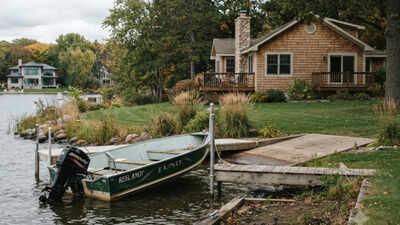
A Minnesota couple’s attempt to sell two waterfront properties was disrupted after their neighbour challenged their right to access the adjoining harbour, put up a sign making the claim and parked his boat along their shoreline. The dispute went to court, with the Minnesota Court of Appeals ruling on Monday, that the neighbour had wrongly interfered with the couple’s property rights.According to the ruling, the court upheld an earlier decision in favour of Brandon and Sara Buckingham. It also confirmed that they were entitled to $64,061 in legal fees, rejecting their neighbour Francis Branch’s challenge to the award.The disagreement began after the Buckinghams listed their two properties for sale in 2024. The plots are part of the Port Mille Lacs South Harbor development and are located beside a stretch of water connected to Lake Mille Lacs. Branch owns the neighbouring property.The couple initially received calls from people interested in buying the plots. However, the interest stopped after Branch placed a sign near their property declaring it private and stating “No Harbor Access”. He also moored his boat in the water directly alongside their shoreline.The Buckinghams said the sign and the boat affected both their access to the harbour and their efforts to sell the properties. They asked Branch through their lawyer to remove the sign, warning that they would take legal action if he continued to dispute their rights. Branch refused, maintaining that the couple had no right to access the harbour.
Property documents support couple’s claim
The Buckinghams took the matter to court in December 2024, accusing Branch of making false claims about their property rights and interfering with their use of the land. They also raised a trespass claim.The district court ruled in the couple’s favour on two claims, finding that Branch had wrongly challenged their ownership rights and interfered with their enjoyment of the properties. The couple later withdrew the trespass claim and sought compensation for their legal expenses.Branch challenged the findings, arguing that the couple did not have the right to access South Harbor. However, the appeals court found that their property documents clearly supported their claim.The title certificates for both Buckingham properties included rights allowing the owners to reach the water’s edge and keep boats in the harbour. The same provision was also present in the documents held by previous owners.Branch owned a one-fourth share of a portion of the submerged land beneath the harbour. But the court said this ownership did not cancel the access rights recorded in the Buckinghams’ property documents.The court also rejected Branch’s reliance on an earlier ruling involving the same harbour. That case concerned whether property owners could remove existing docks, not whether they could reach the water from their land. The judges said it did not support his claim that the Buckinghams had no harbour access.
Earlier dispute also raised questions
The court also considered Branch’s involvement in an earlier disagreement over the boundaries of properties around South Harbor.In that dispute, a proposed change to the boundaries would have created a strip of land between several waterfront properties and the water. This could have prevented the owners from reaching the harbour without crossing land belonging to others.Branch had acquired an ownership interest in this strip of land. He had also supported an earlier legal action against other property owners over access to the harbour.However, the case was dismissed after the proposed boundary changes were found not to have been properly approved or communicated to the affected owners.The appeals court said Branch’s knowledge of these earlier proceedings was important. It found that he had reason to know that his ownership interest did not take away the Buckingham properties’ existing access rights.The judges also considered the original developer’s permits for the harbour. These required the extended water area to remain open and unobstructed for public use. State authorities had also stated that the harbour was an extension of public waters, although people still needed to obtain legal access to reach it.Taking these circumstances together, the court rejected Branch’s argument that he had made the claims in good faith. It upheld the finding that he had acted with disregard for the truth when he challenged the couple’s access rights.
Court says boat interfered with property use and sale
The appeals court separately examined the boat parked along the Buckinghams’ shoreline. Branch did not dispute that he had moored his old deck boat in the water beside their properties.Evidence before the court showed that the boat blocked the shoreline, making it difficult for the couple to access South Harbor. The judges also found that the boat, along with the sign, had affected their attempts to sell the land.The couple had received enquiries from potential buyers before the sign appeared. Those calls stopped afterwards, and they were unable to sell the properties.The court agreed that Branch’s actions had interfered with the couple’s use and enjoyment of their land. It therefore upheld the lower court’s decision on this issue as well.Branch also challenged the $64,061 legal fee award. He argued that the couple should receive fees only for work directly connected to their successful claim over the false property statements.The appeals court disagreed. It said the three claims arose from the same events and involved overlapping work. The fact that the couple did not pursue the trespass claim to a final decision did not mean their legal expenses had to be reduced.