
How close is too close when a neighbour builds a swimming pool beside a waterfront property already vulnerable to flooding? For one family in Toms River, New Jersey, the proposed installation of an in-ground plunge pool raised concerns about tidal water flowing onto their land, coastal construction rules and whether local authorities had properly issued the necessary permits. David Faloba, acting on behalf of his parents, challenged the project, arguing that the pool could worsen flooding and that the approvals did not comply with environmental requirements.On October 26, 2026, the New Jersey Superior Court’s Appellate Division upheld the dismissal of Faloba’s lawsuit against his parents’ neighbour, Antoinette Vento, the Township of Toms River, its Board of Adjustment and the New Jersey Department of Environmental Protection (DEP). In its opinion in David Faloba v. Antoinette Vento, available on LAWS.com, the court explained that the environmental agency had determined the pool complied with the applicable requirements, leaving no basis for the relief Faloba sought. The decision also addressed the limits of local authorities’ powers and the proper legal route for challenging state agency action or inaction.
Pool plans raised concerns over tidal flooding
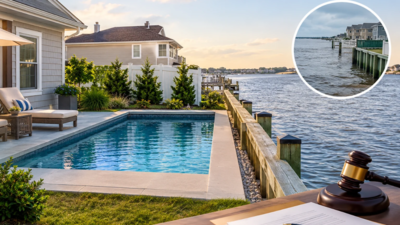
The dispute began in 2024, when Vento applied to the Toms River Township Board of Adjustment for variances to construct an in-ground plunge pool on her residential property. The property sits on a barrier island beside a lagoon connected to Barnegat Bay, with a bulkhead separating the land from the water.An engineer representing Vento testified that the proposed pool would be 8.3 feet from her property’s bulkhead. Although this distance complied with the relevant municipal setback requirement, it was less than the 15-foot setback generally specified under New Jersey’s coastal development regulations. Faloba objected to the project, saying his parents’ property experienced tidal flooding approximately once a month. He argued that the elevated pool could increase the flow of floodwater from Vento’s property onto theirs.An engineer retained by Faloba also warned that the construction could worsen flooding and suggested changes to reduce the risk. Vento’s attorney agreed that a retaining wall could be installed along the property boundary to help address the water flow. The Board of Adjustment granted the requested variances on May 23, 2024, subject to applicable approvals and requirements from other agencies. Faloba did not appeal that decision.
Dispute centred on coastal construction regulations
A central question was whether Vento needed an individual environmental permit or could proceed under a permit-by-rule system. The rules applicable at the time allowed certain construction on waterfront lots with existing bulkheads, provided specified conditions were met.These conditions included demonstrating that there was no alternative to locating the proposed structure within 15 feet of the bulkhead, providing an engineering certification concerning future bulkhead replacement, and recording a conservation restriction. The rules have since been recodified. The regulation cited by Faloba, N.J.A.C. 7:7-4.22, concerned construction of pools and associated decking on bulkheaded lots without wetlands. The court explained that the relevant permit-by-rule requirements were subsequently moved to another section of the state regulations.Toms River issued a development permit for Vento’s pool in July 2024 and a building permit the following month. Vento subsequently supplied the engineering certification and recorded a conservation restriction addressing future reconstruction of her bulkhead. Faloba continued to object, arguing that the permits had been issued before the environmental requirements were satisfied and that the project could not qualify under the applicable rules. He also alleged that the approvals infringed his parents’ rights and amounted to a nuisance.
Environmental agency found no violation
The DEP inspected the property in March 2025. Its records stated that the pool was eight feet from the bulkhead, that an engineering certification had been provided and that a conservation restriction had been recorded. The agency determined that the installation met the applicable permit-by-rule requirements for construction on a bulkheaded lagoon lot. It also found compliance with the relevant rules for construction in a tidal flood hazard area and recorded that no violation had been found.The DEP closed the matter on March 14, 2025. However, the agency’s determination was not disclosed to the parties or the trial court at that time. Meanwhile, Faloba had filed a lawsuit seeking to invalidate the permits, halt construction and compel the authorities to enforce the environmental regulations. On April 25, 2025, the trial court dismissed the case with prejudice, rejecting his requests for relief, damages and legal costs.
Appeals court upholds dismissal
On appeal, Faloba argued that the lower court had wrongly rejected his claims and that the authorities should have been compelled to enforce the law. The appellate court upheld the dismissal, finding that the trial court lacked jurisdiction to order the DEP to take the enforcement action he sought.The judges explained that challenges to state agency action or inaction must be brought through the appropriate appellate process. They also found that the DEP’s determination that the pool complied with the relevant requirements had rendered the principal requests for relief moot. The court rejected the remaining claims as well, finding no basis to revive the civil rights and nuisance allegations. It therefore affirmed the dismissal of the lawsuit. The opinion was designated unpublished, meaning it is binding on the parties but generally cannot be cited as precedent in other cases under New Jersey’s court rules. The ruling does not establish that waterfront pools can never worsen flooding or that every similar project automatically complies with coastal regulations. Instead, it underscores the importance of following the correct legal process and identifying the authority responsible for reviewing permits and enforcing environmental rules.