
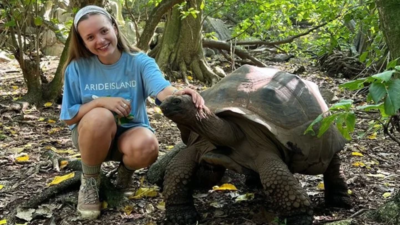
An unusual conservation experiment on a small island in the Seychelles has demonstrated how bringing back a missing animal species can help restore important ecological processes. Scientists reintroduced 10 Aldabra giant tortoises to Aride Island in 2018, more than 180 years after the species had disappeared from the island. When researchers studied the animals six months after their release, they found that the reptiles were already interacting with native vegetation in several ways. During a two-month observation period, the tortoises dispersed more than 10,000 native seeds, while also feeding on living vegetation and fallen leaves. The findings highlight how the return of a single species can help revive ecological relationships that have been missing for generations.
How scientists brought giant tortoises back to Aride Island
The 10 Aldabra giant tortoises (Aldabrachelys gigantea) were transferred from nearby Frégate Island to Aride Island in 2018. The animals underwent a quarantine period before being released as a free-roaming population without supplementary feeding or active management.Historical records indicate that giant tortoises had disappeared from Aride by the mid-19th century, around 1840. Their absence meant the island had lost an important large herbivore and fruit-eater that could influence vegetation through feeding, seed dispersal and the consumption of fallen plant material.Aride, which covers approximately 0.71 square kilometres, has a diverse plant community comprising both native and introduced species. Researchers wanted to understand whether the returning tortoises could re-establish ecological interactions that had been disrupted following their disappearance.
Tortoises dispersed more than 10,000 native seeds
One of the most significant findings involved the animals’ contribution to seed dispersal. Researchers recorded more than 10,000 native seeds being dispersed by the tortoises over a two-month period. The detailed analysis reported 11,241 seeds, with three of the 10 animals accounting for approximately 78% of the recorded total.The native plant Morinda citrifolia dominated the seed dispersal findings, accounting for around 81% of the recorded seeds. The tortoises consume fruits and subsequently deposit seeds through their droppings, allowing plants to spread beyond the locations where the fruits were originally produced.This process is important for natural vegetation regeneration, particularly on islands where the disappearance of large fruit-eating animals can disrupt the movement of seeds. The researchers noted that seeds passing through tortoises may also benefit from the nutrients and moisture available in their droppings, although further research is needed to establish the long-term effects on plant populations.
Their feeding habits also influence native and exotic plants
Seed dispersal was only one part of the ecological role performed by the reintroduced animals. Researchers also documented browsing and grazing, in which the tortoises fed on living vegetation, as well as detritivory, which involves consuming fallen leaves and other dead plant material.The study recorded interactions with 54 plant species through browsing and grazing. The tortoises consumed both native and exotic vegetation, with their feeding interactions involving a wide variety of introduced plants.This behaviour could help limit the growth and spread of certain non-native plants, which compete with indigenous vegetation for resources. Previous research has also indicated that giant tortoises can reduce the vegetation cover, height and seed production of some introduced plants.However, the researchers did not establish that the tortoises had already reduced invasive plant populations across the entire island. Their findings instead demonstrate how the animals’ feeding habits could contribute to the management of exotic vegetation.
Scientists found that some tortoises contributed more than others
The research also revealed considerable differences in the ecological roles performed by individual animals. Although all 10 tortoises participated in interactions with the island’s vegetation, their contributions varied depending on their feeding behaviour and the plant species they encountered.Three tortoises were responsible for approximately 78% of the recorded seed dispersal, demonstrating that a small number of individuals can account for a disproportionately large share of an ecological function.The researchers used direct field observations, examinations of faecal samples and DNA metabarcoding to identify the plant species consumed by the animals. These methods helped them examine the individual contributions of each tortoise to seed dispersal, browsing and grazing, and the consumption of fallen leaves.The findings suggest that simply counting the number of animals reintroduced may not be enough to assess the success of a conservation programme. Understanding how individual animals interact with their surroundings can provide a clearer picture of their contribution to ecosystem restoration.
What the experiment means for island conservation
The study provides evidence that reintroducing a missing species can help restore ecological interactions that were disrupted by its disappearance. On Aride Island, the return of giant tortoises re-established several important functions, including the dispersal of native seeds, feeding on vegetation and the consumption of leaf litter, which contributes to nutrient cycling.The researchers argue that these animals could play an important role in restoring ecological functions on small islands, where the loss of large herbivores and fruit-eaters can have particularly significant consequences.The research, titled Individual variability shapes interaction rewiring and fosters ecosystem restoration by reintroduced giant tortoises in the Seychelles, was published in the journal Restoration Ecology on February 18, 2026. It was conducted by researchers associated with Spain’s National Research Council (CSIC), the Royal Botanical Garden of Madrid and the University of Exeter.The authors emphasised that the differences between individual tortoises should be considered when designing future reintroduction programmes. Their findings provide an important starting point for understanding how bringing back a missing species can help restore the natural relationships between plants and animals.