
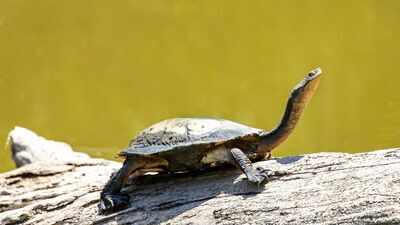
Research projects of scientists are like their babies, they celebrate wins and learn lessons from losses. Sometimes researchers involved in the business of conservation of species have actual babies to take care of. A PhD candidate, April Sturm comes across a similar situation when he captures a juvenile turtle during his routine population surveys of Perth turtles. This year in October, a baby turtle that had hatched in a lab under his supervision resurfaced in the survey. The incident means more to the status of conservation of turtles in the region than just a personal win for Sturm.According to Murdoch University’s press release, the tiny southwestern snake-necked turtle weighed just 4.77 grams when it was released into the water at Manning Lake in July 2025. Like all released hatchlings, it disappeared into the lake. Upon resurfacing, it was observed that its weight had increased to 100 grams, roughly 21 times its release weight. Murdoch University announced the find in its news release on 20 November, calling it the first confirmation that a lab-incubated hatchling of this species has survived long-term in the wild.PhD candidate April Sturm and Dr Anthony Santoro, both from Murdoch’s Centre for Sustainable Aquatic Ecosystems, were running their annual population surveys when they recaptured the young turtle. They knew what they had because it was one of their own: a turtle that began as an egg incubated at the university.
Why Perth’s turtles need the help
The southwestern snake-necked turtle (Chelodina oblonga) is not currently listed as threatened. Even so, studies show its populations are declining, particularly around Perth, according to Western Australia’s Department of Biodiversity, Conservation and Attractions (DBCA). The report adds that if Perth’s populations are left unmanaged, they appear to be at significant risk of local extinction.The biggest worry is a missing generation. Dr Anthony Santoro, who has studied the species for years, found that most populations lack juveniles and are skewing male. A Murdoch study of 35 Perth wetlands turned up very few young turtles. The report by WA’s DBCA lists destruction of nests full of eggs by predators such as foxes and ravens, and loss of native vegetation around urban wetlands. WA’s Department of Biodiversity, Conservation and Attractions notes that West Australia’s changing climate is also a factor in the declining turtle population.
The solution proposed by researchers
Santoro’s response was the Saving Our Snake-Necked Turtle project, one of the biggest citizen science efforts attempted in south-western Australia. Volunteers called Turtle Trackers walk their local wetland at least once a week during peak breeding season, from mid-September to mid-November, and log what they see, including dead turtles and destroyed nests, through the TurtleSAT app.If nests are the weak point, the idea is to take the eggs out of the danger zone. Murdoch began its incubation program in 2021–22 with the City of Cockburn. The goal was to build up turtle numbers across Perth’s southern suburbs through restocking.Sturm welcomed 61 hatchlings over five months. Each was 2–3 cm long and weighed 3–6 grams. After eight months of care from Sturm and fellow Honours student Liz Whatmore, the turtles were released at Bibra Lake. The spot was sheltered from birds and had plenty to eat, including macroinvertebrates, tadpoles and fish.According to the Department’s report, when a volunteer spots a nesting turtle, they follow at a distance of at least 15 metres so they don’t spook her. If she lays, they cover the nest with mesh to keep predators out. In the 2022 season, Turtle Trackers protected almost 280 nests across 12 wetlands. The program has since expanded to more councils and more wetlands.Raising hatchlings only counts as conservation if they live past release day, and until now the team had no proof of that. Now they have one turtle. The researchers say so themselves. In the release, Sturm said the next step is to catch and identify more of the artificially incubated hatchlings in future surveys.