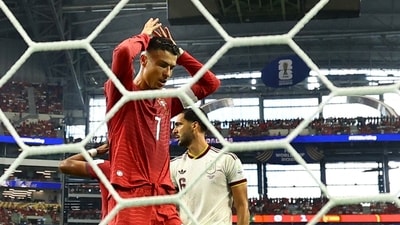
Cristiano Ronaldo‘s final World Cup finished exactly as it started — under a cloud of doubt about whether a 41-year-old had any business still starting for his country at the grandest stage. Portugal’s 0-1 defeat to Spain in Texas on Monday, in the Round of 16, didn’t answer that question so much as confirm it. It was at this tournament that Ronaldo became the first man to score in six different World Cups, but that record will be a lonely bright spot in a tournament that, for long stretches, asked more questions of Ronaldo than it gave him answers.
The debate over his place in the starting XI never really went away, and it began well before the tournament even got underway in North America. Fernando Santos had shown one way to handle it at the Qatar World Cup four years earlier, leaving Ronaldo out of the knockouts, albeit with little conviction behind the call. His successor, Roberto Martinez, showed the opposite instinct, trusting Ronaldo to get the job done. He was warned and repeatedly told to reconsider, but he backed him anyway, and the opening test looked like it would prove the doubters right. Ronaldo cut an anonymous figure against DR Congo, short of sharpness and short of impact. Then, against Uzbekistan, he found two goals and, with them, a familiar defiance, effectively telling the world he wasn’t finished. But that came against a side that lost all three group matches. Against Colombia and Croatia, though, the struggle resurfaced, and so did the questions.
ALSO READ: ‘No point in continuing’: Roberto Martínez resigns as Portugal boss after World Cup heartbreak
What Ronaldo could argue was that Portugal’s midfield, on paper the most talented in the competition, rarely gave him the service a forward of his profile needs, with crosses and clean chances harder to come by than the squad sheet suggested they should be. The DR Congo back line had suffocated Portugal’s midfield, cutting Ronaldo out of the picture altogether. Against Uzbekistan, his side found room on the wings to press, breathe and create. But neither Colombia nor Croatia allowed him that same space for large parts of their meetings.
Even accounting for that, age had visibly caught up with him. The explosive first step and the split-second reflexes that once separated him from everyone else were gone, replaced by a wiser, more stationary poacher’s game whose positioning increasingly let him down. It got loud enough that many were calling for Goncalo Ramos to start ahead of him — the same Ramos who had played in the Round of 16 at the last World Cup and scored a hat-trick when Santos found the courage to leave Ronaldo out. Martinez obliged, and the switch was instantly vindicated when Ramos scored the winner against Croatia, adding to Ronaldo’s own second-half penalty in that game.
Yet Ronaldo returned to the side against Spain, struggled again, and, strikingly, was left on the pitch for the full 90. He had just 12 touches in the opening half, nine fewer than the next-lowest player on the pitch, Spain centre-forward Mikel Oyarzabal, but he was the only one with two shots on target — and even that did not tell the full story. His first attempt was hit with more conviction after a stepover created half a yard of space, though the angle was always against him. The second drew gasps from the crowd when Ronaldo flicked the ball goalbound after Joao Felix nodded Pedro Neto’s inswinging cross back across goal, but replays showed the effort lacked any real sting, and Unai Simon made a comfortable save.
At times, Ronaldo cut a visibly frustrated figure. Early in the second half, there was a run in behind the defence, but Joao Neves turned down the pass, leaving him annoyed. Moments later, as Ronaldo moved into the centre of the box, a Joao Cancelo cross drifted instead to the far post. Later still, he fumed at Pedro Neto for laying the ball off to him rather than carrying it forward during a counter-attack that ultimately fizzled out.
In a nutshell, that final performance was Ronaldo’s World Cup in miniature: a two-goal burst against Uzbekistan and a penalty against Croatia were as good as it got, and against Spain, he simply faded into the background.
There were tears in his eyes at the final whistle as he cut a lone, inconsolable figure on the Texas turf, but he left with his head up all the same. “I’m leaving with a clear conscience. Sometimes you win, sometimes you lose,” he said afterwards. “I’m sad now after being eliminated like this… but I gave it all, my very best. We played a good game, the performance was well done. We could have done better, but Spain are among the best, they will get to the final or close.” There was no bitterness in defeat, only perspective: “I will wake up tomorrow with the same mood as I did today. I did my best.”
That perspective is really the point. Ronaldo’s World Cup résumé will always have a gap where a trophy should be, but as he himself put it, “I won three titles with Portugal, before me it was zero. I can only be happy.” He rates Euro 2016 alongside any World Cup he might have lifted, and he’s entitled to. “That remains forever. Tomorrow is a new day, and we go.” A tournament too far, perhaps, but never a career diminished by it.