The project was developed by Adani Green Energy Twenty Six A, a wholly owned step-down subsidiary of AGEL.
Following the commissioning, AGEL’s operational renewable generation capacity stands at 20,280.8 MW, the company said in a stock-exchange filing. Its operational battery energy storage system capacity stands at 3,551 MWh.
The filing didn’t disclose the investment in the 139 MW project, details of any power-purchase agreement or its expected annual electricity generation.
Khavda heads towards 30 GW
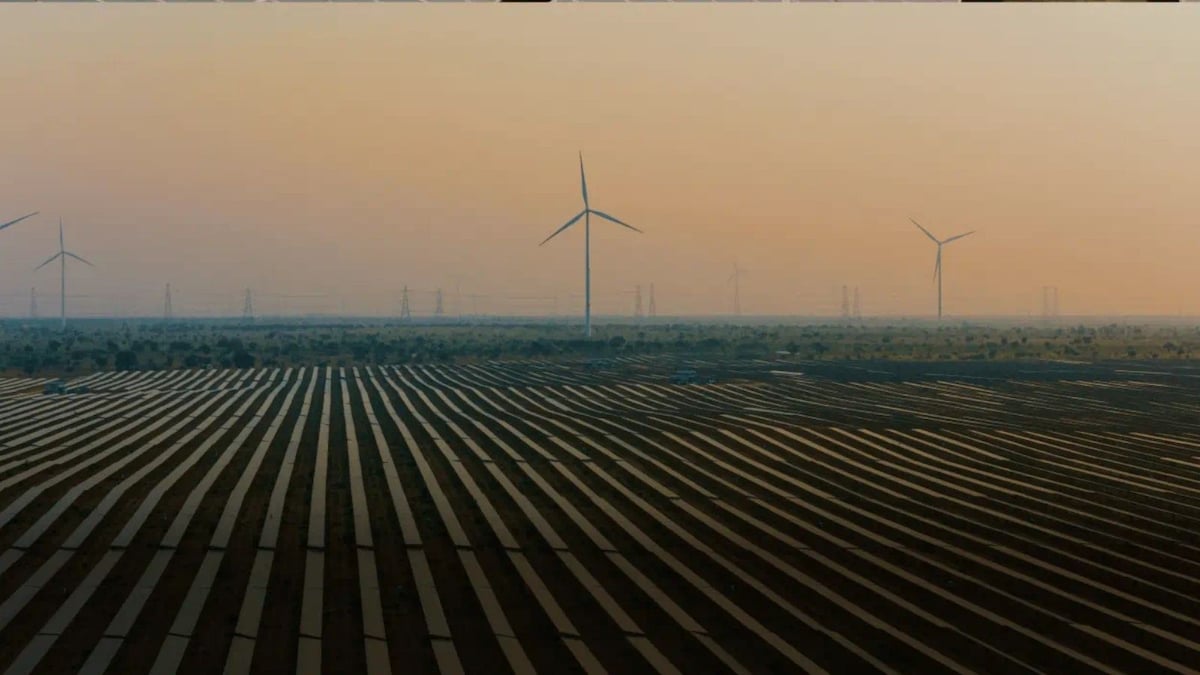
The latest commissioning is part of AGEL’s massive renewable-energy build-out at Khavda in Gujarat’s Kutch district.
The company plans to develop 30 GW of renewable-energy capacity at the site by 2029, combining solar, wind and battery storage.
Spread across 538 square kilometres of barren land, Khavda is being developed as one of the centrepieces of Adani Green’s expansion. The company describes it as the world’s largest renewable-energy plant.
Also read: China hits a historic energy milestone: Solar overtakes coal
AGEL crossed its first 1 GW of operational capacity at Khavda in March 2024. As of May 2026, it had also commissioned 3.37 GWh of battery storage at the site, which the company described as the largest single-location battery deployment outside China.
AGEL says Khavda benefits from solar irradiation of about 2,060 kWh per square metre and wind speeds of around eight metres per second.
The project uses bifacial solar modules, horizontal single-axis trackers and waterless robotic cleaning systems. AGEL has also deployed 5.2 MW wind turbines at the site.
Adani Green targets 50 GW by 2030
Khavda is central to AGEL’s broader goal of reaching 50 GW of operational renewable-energy capacity across India by 2030.
The company added more than 5 GW of capacity in FY26, as it continues to scale up towards that target.
Adani Green Energy shares were trading 3.54% higher at ₹1,257.90 on Tuesday. The stock has gained 24.62% so far in 2026 and about 40% over the past six months.