
The first thing you notice about Dhinidhi Desinghu — apart from her timings in the pool — is her clarity of thought. Few Indian athletes her age articulate as assuredly, fewer still have the performances to back up their words. At 16, Dhinidhi has both, as evidenced by a brace of bronze medals in the 100m and 200m freestyle at the Youth Olympics in Dakar.
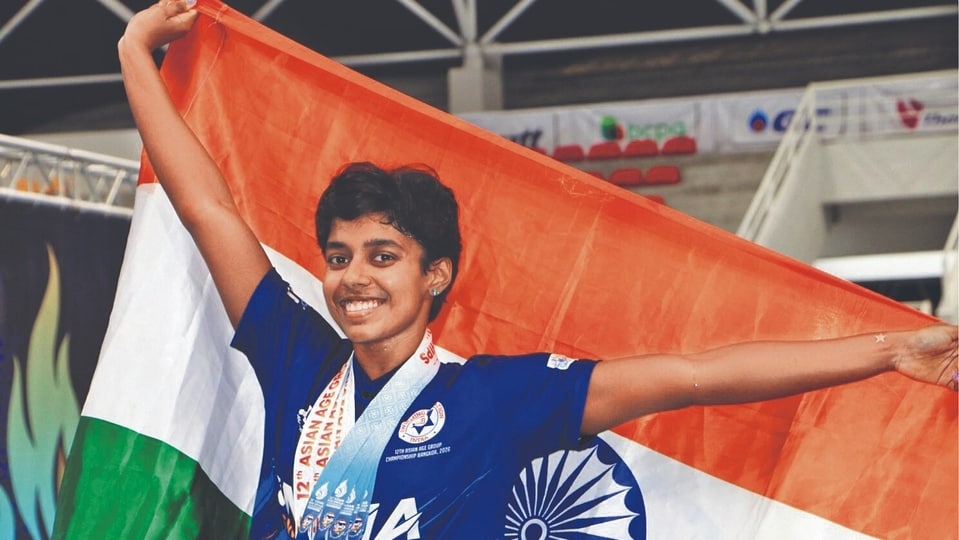
The past two years have been a bit of a whirlwind for the youngster. An Olympics debut at Paris in 2024, a fifth-place finish at the 2025 Asian Youth Games (400m freestyle), gold at Senior Nationals (100m freestyle) with a national record in June, a 200m freestyle national record a month later before finding success in Senegal have established Dhinidhi as one of the brightest rising stars in Indian swimming.
The reality check, however, isn’t too far away. “We are way behind the curve, and not by 1-2 years. We are behind by 30-40 years. The world record times that stood 30-40 years back, that is what we are swimming now,” she said in a media interaction facilitated by SAI on Tuesday.
“Swimming inflation is a thing, and people do improve by a few percentage every year. If a country improves by one percent, Indians would have to improve by 4-5 percent every year to even catch up with the world in a few years. Which, if you think about it, is a very, very long journey. There are some national records that still stand,” she said.
Case in point being the men’s breaststroke records held by Sandeep Sejwal. His 100m and 200m marks date back to 2009, while his 50m record, set in 2018, remains untouched.
“I’m hoping that me and my teammates will be able to raise the bar,” she added. “Especially in women’s swimming. At one point, we never even thought of going to the Olympics or Asian Games or making the finals or coming back with medals. It was always ‘we can’t do it’ kind of attitude. I hope to change that mentality and change that perspective in Indian swimming.”
Dhinidhi’s experience of competing in elite global fields has armed her with the valuable experience as well as sharp, nuanced perspective.
“The thing I take away from athletes around the world is more about how well they swim technically. You can very clearly tell that they know to the T how to swim their race. They know very well that, okay, this is how you swim the first 50m. You don’t overspin your arms. You don’t overtake. You’re supposed to control the race. How they go into warm-ups and make sure they’re ready before the race is something I’d like to learn.”
“I don’t think genetically Indians are at a disadvantage. I feel it comes down to how you prepare for an event and how much you believe. We too are Asians and it’s not like we come from a different planet. We live in the same world. We have two arms. We have two legs.”
Also Read: India’s GM century: The high cost of chasing a chess dream
It’s not that simple, though, and Dhinidhi knows that. “Swimming is a very technical sport. Competitive swimming is not about swinging your arms around and keep kicking. There’re so many fine details which appear too complicated even to me. Swimmers from US or Australia would have learned it at the grassroot level. That’s the stuff we need to learn.”
Having worked on her turns this season, Dhinidhi has trained her sights on improving her starts. In a sport where races can be decided by hundredths of a second, she knows that marginal technical improvements can make a tangible difference.
“I have worked quite a lot on my catch which made a difference. As of now, it’s easier for me to correct my technique but after a certain stage, you are so used to doing certain things that fixing the smallest mistakes gets super difficult. You need to be perfect to win a race.”
Although she has finally become more accepting of her rather unconventional childhood — one that involves tons of sacrifices and countless hours in the pool — Dhinidhi does miss being ‘normal.’ But then comes the appreciation of the life she has chosen.
“I do miss a normal childhood sometimes. But I think sometime last year, I realised how different a life I have. There are kids my age who can eat what they want and do what they want, and I must be one in a million to be able to do something different. How cool is that?”