
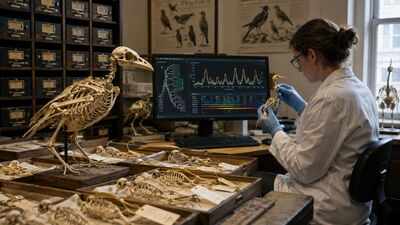
For millions of years, birds have been changing in ways that are difficult to see from the present day. A skeleton in a museum may look like a fixed record of one species, but taken together, thousands of specimens can reveal how bodies changed across vast stretches of time. That is what a team at the University of Michigan set out to investigate in passerines, the enormous bird group that includes songbirds and many familiar species. Using artificial intelligence to measure bird skeletons and a new statistical approach to analyse those measurements, the team reconstructed patterns of body-shape evolution stretching back about 45 million years.The results suggest that evolution did not move at a steady pace. At certain points, it accelerated sharply, and several of those bursts lined up with major changes in Earth’s climate.
How AI is helping scientists track bird evolution
Passerines account for more than half of all living bird species, making them a useful group for examining how evolutionary change unfolds. The difficulty is scale. Comparing the shape of a handful of skeletons can be done by hand, but trying to measure thousands of specimens across hundreds or thousands of species is a very different task.The Michigan team worked with more than 2,000 passerine species and assembled more than 170,000 individual skeletal measurements. Much of the material came from the University of Michigan Museum of Zoology, where generations of specimens have accumulated in collections that were never designed for this kind of large-scale digital analysis.The researchers turned to an artificial intelligence system called Skelevision. Developed by Brian Weeks’ laboratory at the University of Michigan with David Fouhey’s group at New York University, the system was built to extract measurements from photographs of specimens.A specimen is placed against a background grid so the software has a consistent scale to work from. It can then identify and measure a dozen bones across the bird’s skeleton. A scan takes roughly 45 seconds, allowing a collection that would otherwise require enormous amounts of manual work to be processed at a much larger scale.Over seven years, the system was refined through collaboration between the two laboratories. For this study, it was used on more than 15,000 museum specimens.
A new method reveals how bird evolution unfolds in bursts
Jake Berv, the study’s lead author and a postdoctoral fellow at the University of Michigan’s School for Environment and Sustainability, was interested in a longstanding question in evolutionary biology: whether major evolutionary changes tend to happen gradually or arrive in bursts.“This is really important for evolutionary theory because there’s a long history, going back 100 years, that predicts the emergence of new groups, called evolutionary radiations, which is often associated with an explosive burst of diversification. Evolutionary theory predicts that adaptive radiations may account for a large portion of the diversity of life on Earth,”Jake Berv said.The idea of evolutionary radiations has been around for roughly a century. In this view, a lineage can encounter a new ecological opportunity and change rapidly as different species adapt to different ways of living. Once those opportunities become more limited, the pace of change may ease.The fossil record has provided some support for this pattern, although reconstructing evolutionary rates from incomplete fossils is difficult. The Michigan study approached the question from a different direction, using the bodies of living bird species as evidence of changes that accumulated over deep time.Rather than treating each bone as an isolated feature, Berv developed a statistical method called bifrost. It allowed the team to consider the skeleton as an integrated structure, taking into account the way different parts of the body are connected.
How ancient climate shifts influenced the pace of bird evolution
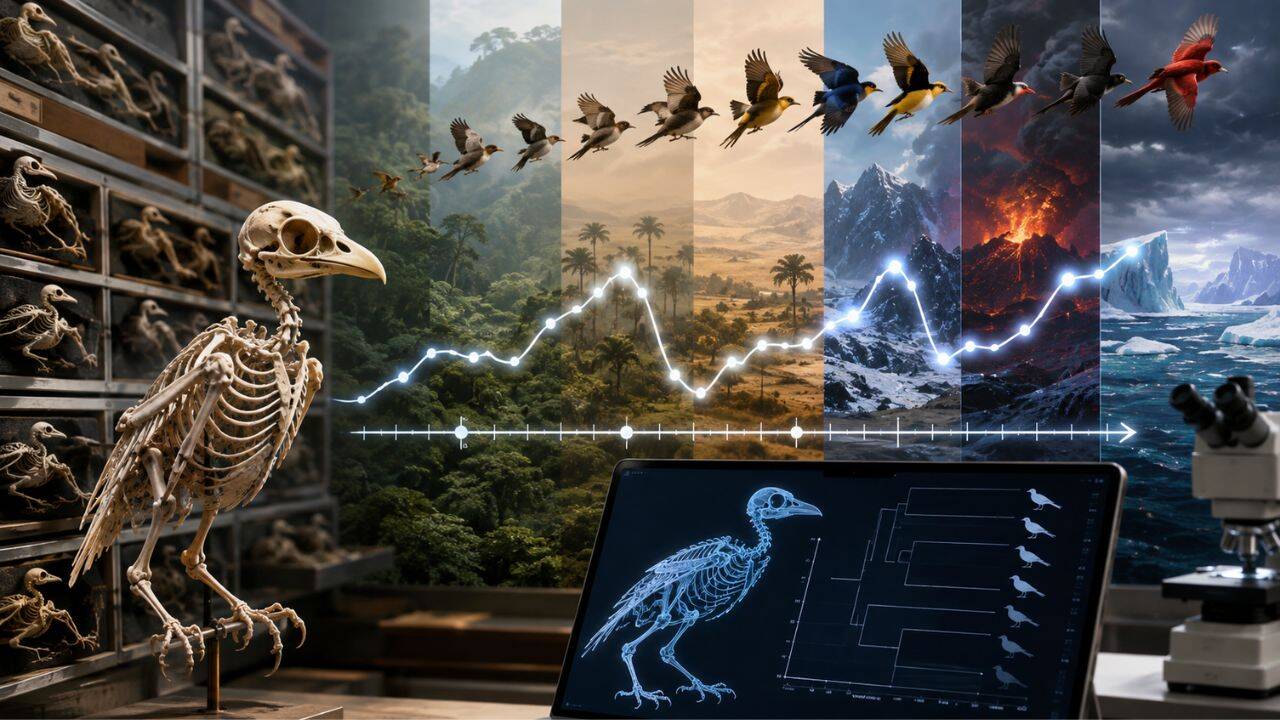
One of the clearest signals emerged around 35 million years ago, close to the transition between the Eocene and Oligocene epochs.This was a period of major climatic change. Global temperatures fell sharply as the warm conditions of the Eocene gave way to the cooler Oligocene. The shift affected ecosystems around the planet, altering habitats and the conditions faced by plants and animals.Against that geological background, the analysis identified a period in which passerine body shapes changed at a much faster rate than they did during many other intervals in their history.The timing does not establish that cooling directly caused the evolutionary burst. Evolution is shaped by several forces at once, and climate can alter ecosystems in complicated ways. But the repeated alignment between environmental shifts and changes in evolutionary rate provides evidence that large-scale changes in the physical environment may help create periods in which lineages explore new forms.Brian Weeks, a senior author of the study, described the pattern as one of relatively rare increases in evolutionary rate surrounded by many smaller declines. In biological terms, that could fit a picture in which birds move into newly available ecological spaces and change rapidly before those opportunities narrow again.The study also identified a cluster of evolutionary slowdowns roughly 15 million years ago. This period coincided with another major geological change, adding another point at which the history of passerine body shapes and Earth’s changing environment appeared to overlap.
Bird evolution varies with latitude and seasonal temperatures
The researchers did not stop with the timeline. They also asked whether geography could tell them something about evolutionary rates. When the skeletal data were examined in relation to where birds live, a second pattern emerged.Passerine communities at higher latitudes and in places where temperatures vary more strongly between seasons tended to contain species with faster rates of morphological evolution. Birds living closer to the equator, where seasonal temperature changes are generally less pronounced, showed slower average rates by comparison.It is a different way of seeing the same question. Instead of asking when evolutionary change accelerated, the team was asking where it appeared to be happening more quickly.The resemblance between the patterns through time and across geography was significant to the researchers because both point towards environmental variation as a possible influence on the evolution of body shape. It also connects the study with the familiar global pattern in which biodiversity itself changes with latitude.
How AI is unlocking decades of museum bird specimens
Natural history museums contain enormous numbers of specimens collected over decades or centuries. Their value is not limited to what scientists knew to look for when each specimen was preserved. New analytical techniques can turn old collections into datasets for questions that could not have been asked when the specimens were gathered.The passerine study would have been difficult to carry out at this scale without those collections. More than 15,000 specimens had to be photographed and measured, with the majority coming from the University of Michigan’s museum holdings.Artificial intelligence changed the amount of work that could be done with them. Instead of a researcher manually measuring every bone, Skelevision could extract standardised measurements from photographs at a much faster pace.
What ancient climate change can tell us now
The study has a modern implication, although its main evidence comes from deep time. Human-driven climate change is occurring on a timescale that is extremely short compared with the evolutionary history examined in the research. Temperatures, rainfall patterns and habitats can shift within decades, while the study is looking at changes accumulated over millions of years.That makes direct comparisons difficult. A bird lineage cannot necessarily respond to a rapidly changing environment in the same way it did during a geological transition that unfolded over a much longer period.