
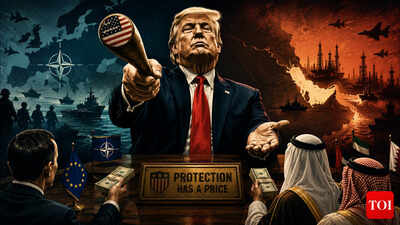
In classic mob films, a gangster eyes a storefront and drawls, “Nice place you got here. Be a shame if something happened to it”.Refuse, and windows shatter, stock goes missing, deliveries dry up.Pay up, and the trouble evaporates.There’s no real contract, just “insurance” whose only guarantee is that the people demanding money won’t be the ones causing damage.Control the environment, control the threat, then turn continued safety into a bill. That’s a protection racket – an offer no one dares to refuse.Real estate moguls know this logic instinctively because they operate at the intersection of property, power and vulnerability. The value of a building is inseparable from who controls the streets around it and who can quietly stall projects if they’re crossed.Security is never neutral; it can be withheld, priced or turned into leverage.US President Donald Trump’s long apprenticeship in New York real estate — immersed in hard‑nosed negotiations, unions, fixers and the constant risk of deals freezing if the wrong players are angered — no doubt gave him a visceral feel for how fear, dependence and cash can be aligned.That is the language he has carried into geopolitics.
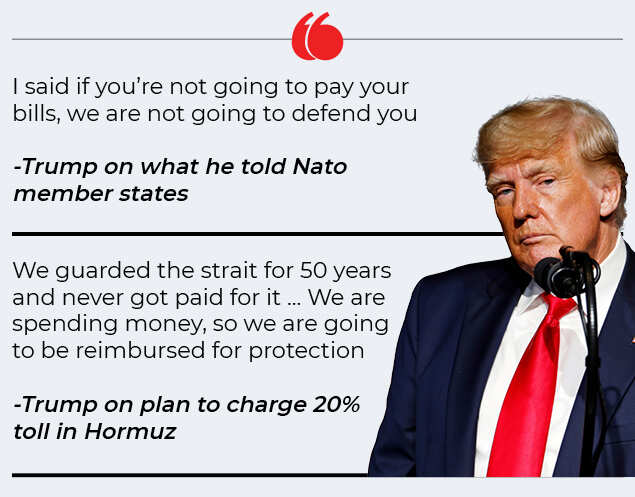
Trump has repeatedly tried to frame security alliances as ‘bad deals’ where US provides protection but is not fairly compensated for its efforts.
When Trump rails that the US “protects” Europe and Nato “for free”, or that America guards Gulf shipping lanes and the Strait of Hormuz without “reimbursement”, he is treating alliances like neighbourhoods and allies like tenants.In Europe, the message to Nato states is blunt: Pay more for your security — by hiking defence budgets and buying US weapons — or don’t expect the same level of protection against an aggressive Russia.In the Middle East, Gulf monarchies are pressed to sign investment and arms deals in exchange for US shield over Hormuz and against Iranian attacks.The logic in both theatres is the same as in those mob scenes: you enjoy safety because someone powerful has decided you will — for now.If you want that to continue, you’d better start paying what they say your protection is worth.
The Hormuz toll
Recently, Trump made another attempt to transpose that logic directly onto one of the world’s most strategic chokepoints, the Strait of Hormuz.Announcing that the US would serve as a “guardian” of the waterway, Trump proposed a 20% toll on all cargo transiting Hormuz to “reimburse” Washington for its long-standing military protection of Gulf shipping lanes.He made explicit what has long been implicit: US military protection is not a public good, it is a billable service.The Hormuz gambit came amid a US‑Iran war that had already disrupted shipping and driven insurers and energy companies to press Washington for stronger convoy protection through the narrow, attack-prone channel. Rather than simply reinforce escorts, Trump proposed that commercial vessels “reimburse” the US at a fixed percentage of cargo — a framing far closer to mob protection money than to alliance burden-sharing.The conceptual move was important.For decades, US naval presence in the Gulf was sold as stabilising, preventing any single power — usually Iran — from weaponising Hormuz against global energy markets.Trump’s “20 percent” line flipped the logic: he threatened to weaponise American protection itself.
Why Gulf rulers balked
Gulf leaders understood the risks immediately. A toll on Hormuz would have shattered the long-standing principle that international straits are open to commerce without unilateral fees, a principle Gulf states rely on to push back against Iran’s own intermittent toll-talk.Saudi Arabia, the UAE, Qatar and others were already deeply anxious about Iranian missile and drone attacks on regional infrastructure; they did not want Washington legitimising the idea that whoever has guns near a chokepoint can charge admission.There was also a political dimension.Many Gulf kingdoms have spent years portraying US protection as a mutually beneficial partnership, not a shakedown.Trump’s language threatened to expose the transactional core of that relationship to their own publics and parliaments.Within hours of his announcement, back-channel pressure from kings and emirs, combined with warnings from his own officials that such tolls would contradict prior US statements about international law, triggered a rapid climbdown.
A protection racket by another name
Trump’s reversal was as revealing as the original proposal.Having been talked out of a formal toll, Trump declared he would instead pursue “trade and investment deals” with Gulf states, substituting the 20% “reimbursement” with capital inflows to the US. Trump framed the reversal as the outcome of “highly productive” conversations with kings and emirs who, he claimed, preferred to “invest tremendously in the US”.Gulf monarchies, always eager to convert surplus oil revenues into Western assets, signalled openness to this shift: paying fees at the strait was politically toxic, but pledging billions for US infrastructure, bonds or corporate investments could be framed domestically as savvy diversification.Functionally, though, the logic barely changed.Washington would keep blockading Iran and securing Hormuz; in return, the states whose exports depended on that security would channel money into the US economy, explicitly marketed by Trump as the financial quid pro quo for continued American protection.The “racket” becomes softer-edged, less obviously coercive, but the underlying leverage is the same: the implicit threat that without US cover, Gulf shipping lanes would be exposed to Iranian disruption, and that alternative protectors (Europe, China, even private security) remain either unwilling or incapable of matching US firepower.
The Nato precedent: Burden-sharing as leverage
Trump’s Middle East gambit did not emerge from a vacuum; it is the extension of a template he has been using in his dealings with Nato.Since his first term, Trump has railed against European allies for what he calls “freeriding” on US defence spending, pointing to charts showing the US outspending European partners by hundreds of billions of dollars.
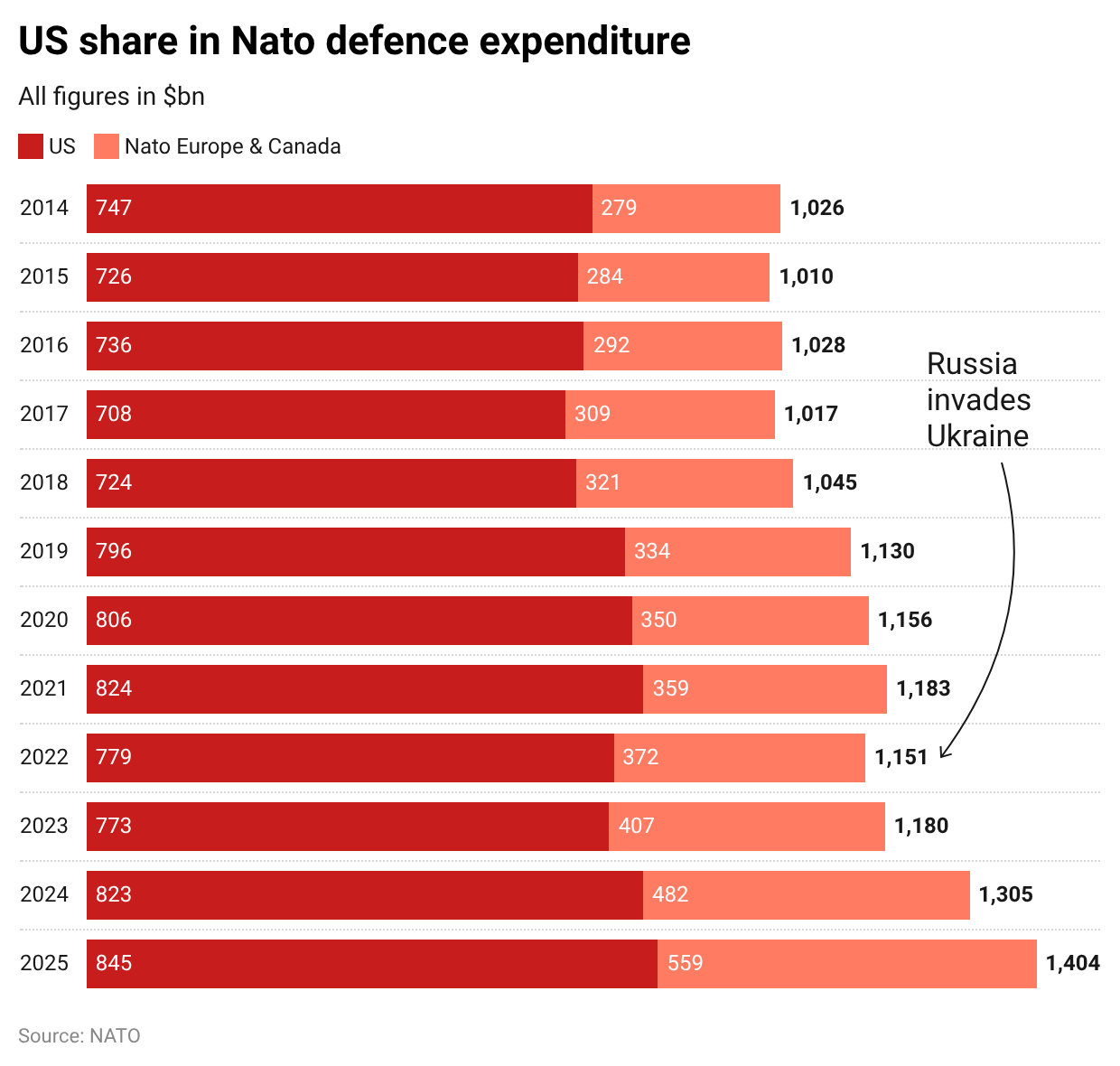
Nato: US outspends European partners by hundreds of billions of dollars.
At a summit in the Hague, Nato states agreed under pressure to a dramatic new target: raising defense expenditure to 5% of GDP by 2035, far above the previous 2% benchmark.Trump then used that pledge as a continuous threat, warning that if allies did not meet his standards, Washington would reduce forces assigned to Nato and scale back its contribution to collective defence.
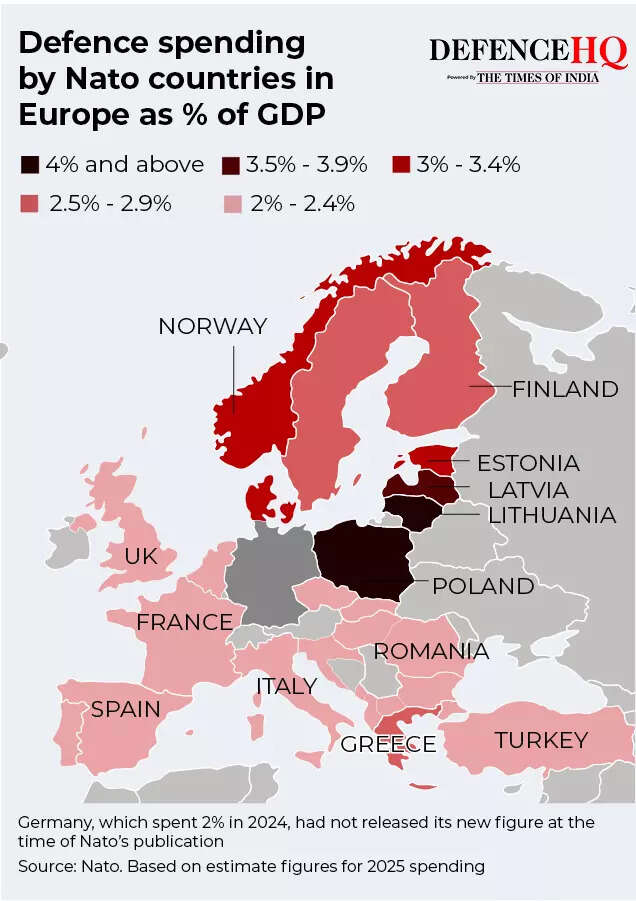
US officials have already informed allies that they will cut some assets from the Nato force model to avoid “unhealthy codependence” on American capabilities — a bureaucratic way of saying Europe must pay more, or risk less cover.Again, the dynamic mirrors a protection racket: the protector loudly complains about bearing costs, then hints that protection will be withdrawn unless the clients step up with cash.
Channeling fear into arms sales
Once allies agreed to spend more, the next step was to steer that money towards American manufacturers.The White House has bragged that since Trump first took office, Nato allies have spent an additional “Trump Trillion” on defence, with more than $1.21 trillion in extra allied spending compared with previous baselines.
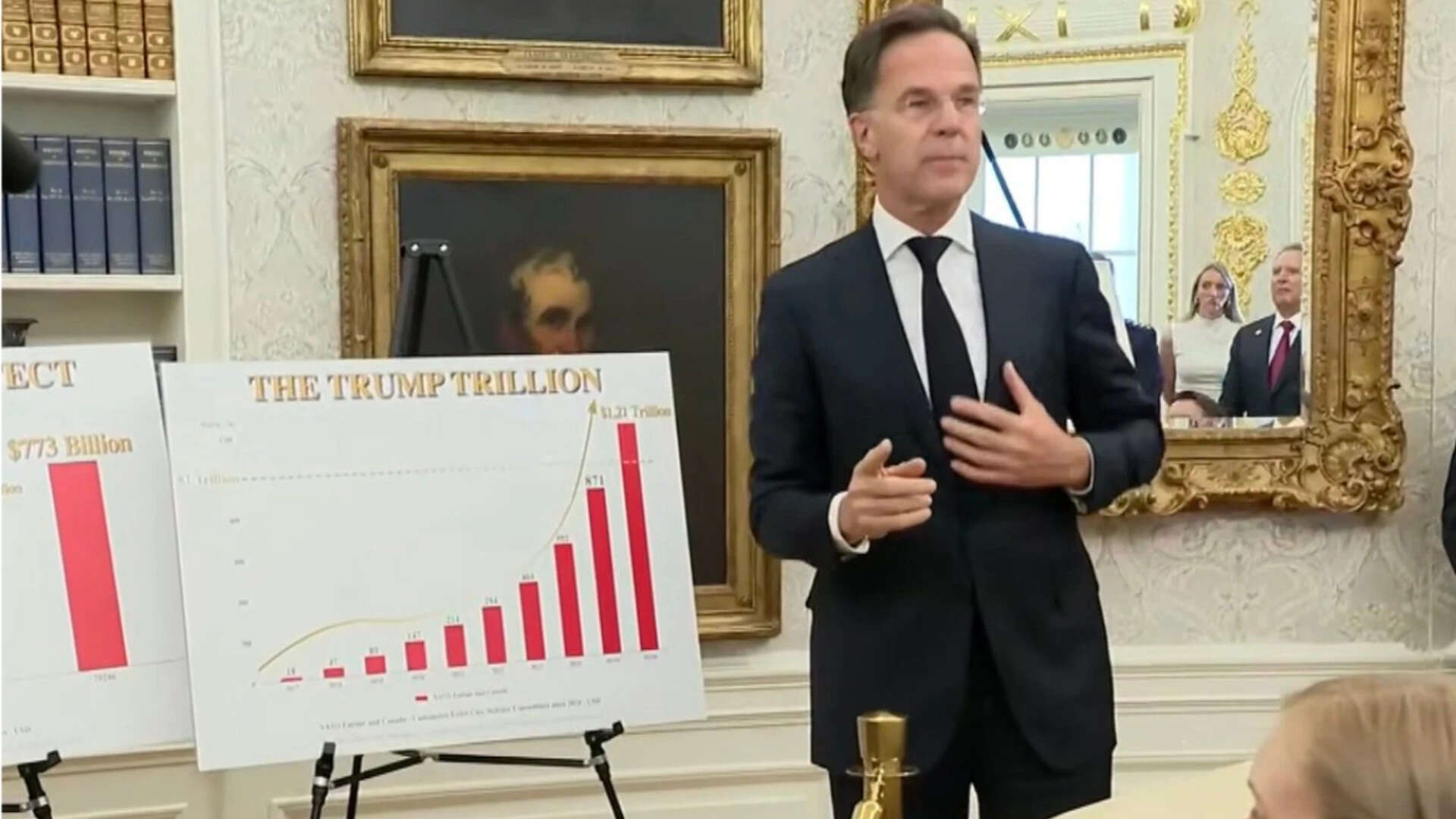
Nato Secretary-General Mark Rutte uses chart labeled the ‘Trump Trillion’ to credit President Trump with driving an extra $1.2 trillion in defence spending by European allies and Canada since 2017.
A 2026 fact sheet boasts that in 2025 alone, Nato allies bought more than $54 billion in US defence equipment, much of it routed through special mechanisms like the Prioritized Ukraine Requirements List that allow European states to buy US packages for transfer to Ukraine.This is where Trump’s approach moves beyond classic burden‑sharing into something closer to a structured tribute system.
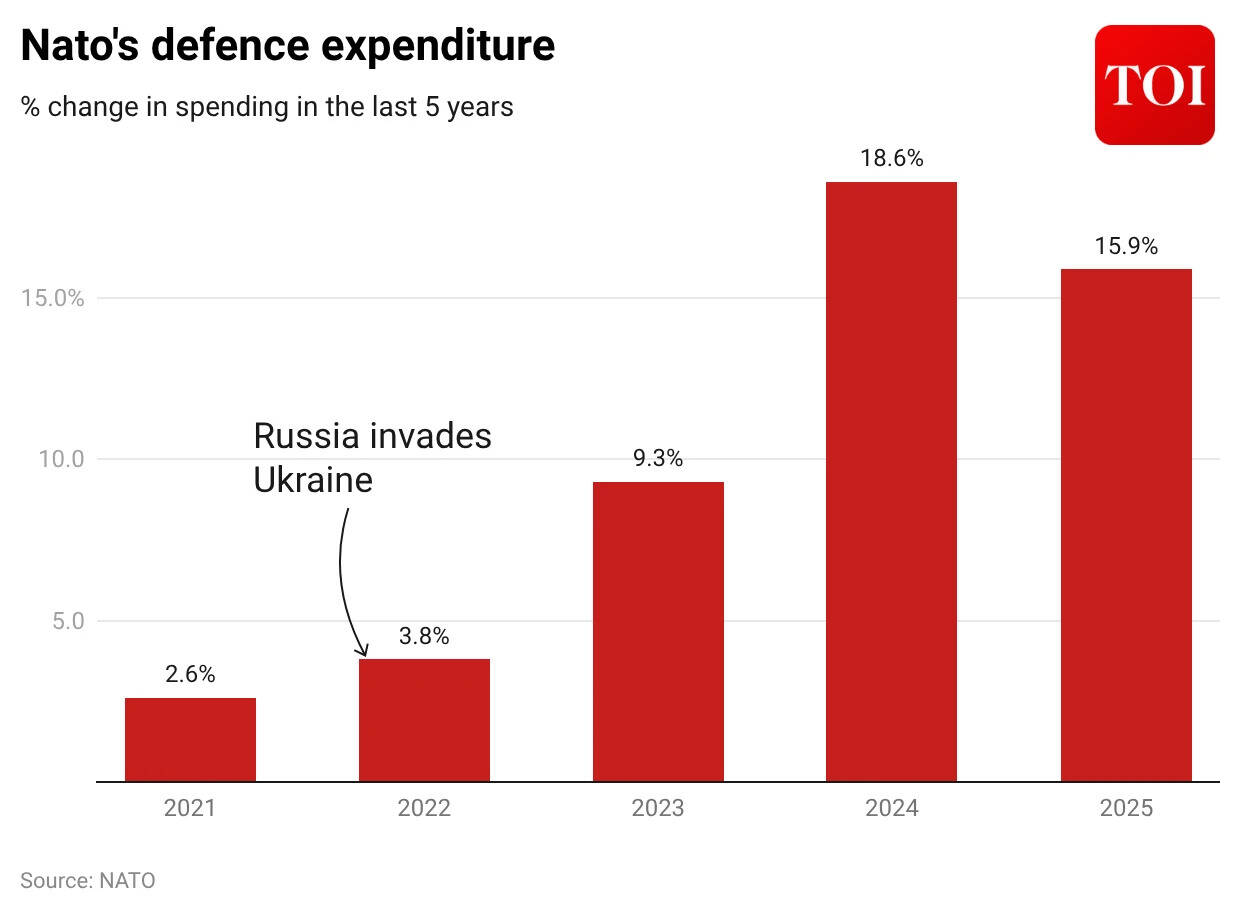
Nato’s European members have drastically increased their defence spending since the Ukraine war started and Trump announced that the alliance must share the burden of defence.
He is not satisfied simply that allies spend more on their own militaries; his “America First Arms Transfer Strategy” is explicitly designed to ensure that increases in European defence budgets translate into contracts for US companies, “reindustrialising America while arming partners”.Allies commit to 5% of GDP on defence; Washington then writes the catalogue, nudging them towards US systems to replace Soviet-era kit and meet interoperability requirements under Nato standards. The Russian threat is the accelerant.Each escalation — from the annexation of territory to attacks in Ukraine — strengthens Trump’s argument that Europeans must arm up, and they must do so quickly.American gear is pitched as the fastest way to plug gaps in air defence, artillery and surveillance; slower European industrial ramp‑ups are cast as unreliable.
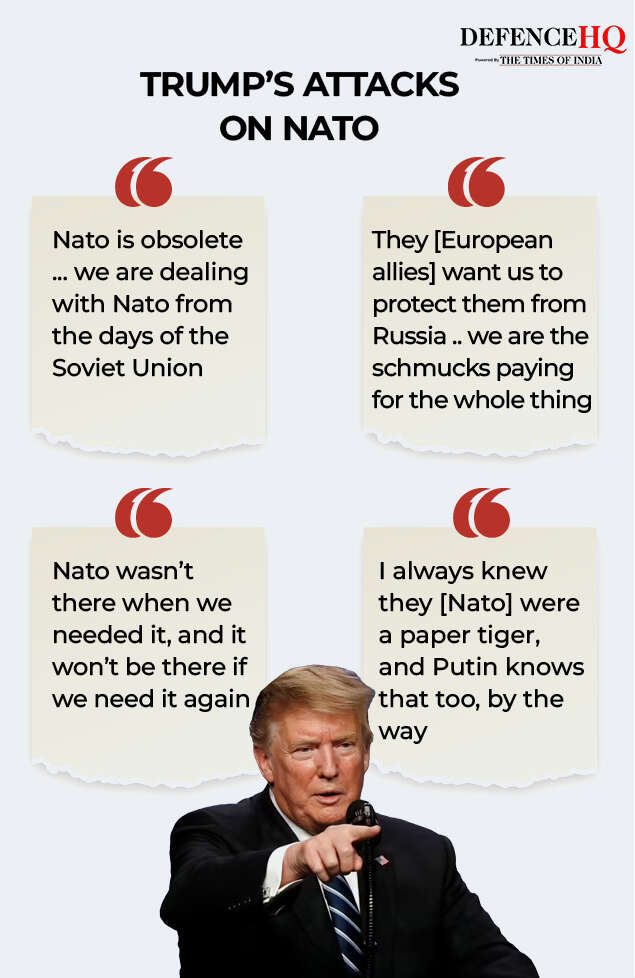
US president Donald Trump has attacked Nato many times.
Fear of Russia, amplified by constant presidential rhetoric about Europe’s vulnerability, becomes the psychological pressure that drives governments and parliaments to sign US procurement deals that may lock them into American supply chains for decades.
What Trump is doing is nothing new
US foreign policy has always had transactional elements, but Trump’s approach is unusual in its bluntness.Previous US presidents used transactional tools — sanctions, aid packages, basing agreements, trade deals — but often wrapped them in multilateral processes and legal frameworks that preserved the image of stable, rules‑based leadership. Most US presidents post‑1945 mixed interests, ideals and alliances, and tended to talk about US security commitments in terms of shared values, collective defence and “leadership of the free world”.Burden‑sharing debates over Nato spending or Gulf basing costs existed under Reagan, Bush, Clinton, Obama and Biden, yet they were usually framed as technical adjustments inside a long‑term strategic partnership.
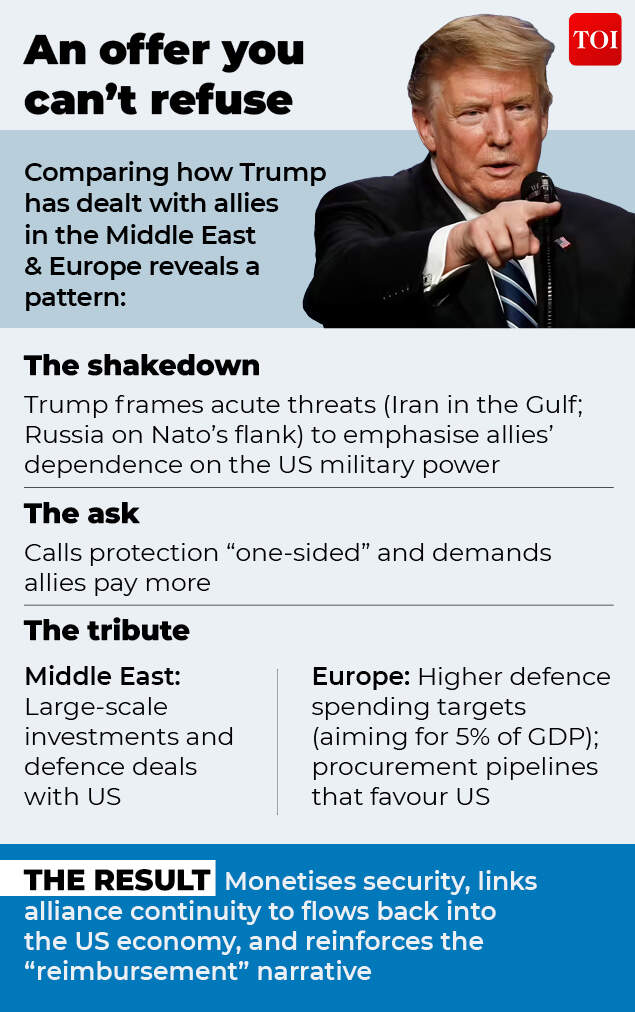
US foreign policy has always had transactional elements, but Trump’s approach is unusual in its bluntness.
Trump has stripped away the veneer.He treats security guarantees as billable, transactional services rather than as part of a broader, partly principled architecture of alliances. He talks like a dealmaker, publicly threatens to pull troops or downgrade commitments, and boasts when “billions of dollars more” flow from allies after his pressure campaigns.He has branded his foreign policy “America First” and repeatedly describes alliances as bad “deals” unless other countries pay what he considers their fair price.
The big picture
What makes Trump’s “racket” significant is that it now has institutional scaffolding: Defence-spending targets, big US-centric investments, and arms-transfer programmes.Even when individual proposals — like the Hormuz toll — are reversed under pressure, they leave behind a precedent: the US president can openly price security.For allies, the calculus is painful but straightforward.They can complain about the tone; they can push back on specific demands; but in the end, they are operating in theatres where US power is still indispensable.In the Middle East, US carrier groups and destroyers, alongside intelligence and surveillance assets, give Washington enormous influence over shipping safety and the Iran threat. In Europe, US bases, nuclear guarantees and high‑end capabilities are what make Nato a credible deterrence against Russia.That dependency is what gives Trump’s approach its racket‑like edge. He is not inventing leverage; he is weaponising it, and tying it directly to economic returns for the United States.In both cases, Trump has repeatedly floated the possibility of reducing military assets or downgrading commitments unless allies meet his spending demands — framing his decision in terms of “fairness” and “reciprocity”, just as a mob boss insists his fee is only fair compensation for the “service” of keeping the neighbourhood safe.In the Middle East, that means Gulf monarchies paying up — if not in tolls, then in investments and arms contracts — for the continuation of a US security umbrella they cannot easily replace.In Europe, it means Nato allies converting fear of Russia into long‑term commitments to buy American weapons and meet US‑defined spending targets, lest they be portrayed as freeloaders and find US protection politically and materially diminished.In both theatres, Trump has transformed the old question — “What is American leadership worth?” — into a new one: “How much will you pay to make sure it doesn’t go away?”