
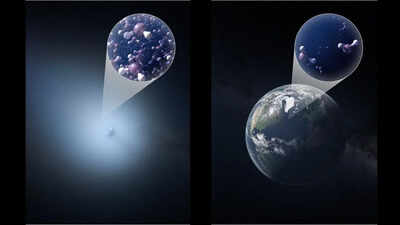
Radioactive specks buried deep inside ancient ocean crust are forcing scientists to rethink what Earth has been quietly passing through in space. These traces are not ordinary geological leftovers. Instead, they appear to be fragments of radioactive stardust material forged in violent cosmic events and scattered across the galaxy. What makes the discovery even more intriguing is the possibility that this stardust is still raining on Earth today, billions of years after the explosions that created it.At the center of the mystery is a question that sounds almost unreal: is Earth still being dusted by remnants of ancient stellar blasts that happened long before the Solar System fully formed?
Ancient ocean crust as a cosmic archive of radioactive stardust
The key evidence comes from ferromanganese crusts, slow-forming mineral layers on the deep ocean floor. These crusts grow at an extremely slow pace, so slow that even a single millimetre can represent vast spans of geological time.As seawater and microscopic particles drift down through the ocean, they become trapped in these layers. Over millions of years, the crust effectively becomes a natural archive, preserving chemical and isotopic traces of what has passed through Earth’s environment.Within this archive, scientists have found isotopes that don’t fit neatly into normal Earth-based processes, including plutonium-244, a radioactive element that strongly suggests an extraterrestrial origin.
Plutonium-244 and the mystery of cosmic origin
According to the study published in Nature Astronomy, titled, ‘The timing of the last r-process event near Earth from interstellar 60Fe, 244Pu and 247Cm deposition on Earth’, Plutonium-244 is not something Earth can easily produce. It requires extremely intense conditions packed with neutrons; conditions found in rare astrophysical explosions.When it appears in ocean crust, it raises a striking possibility: that it was created far away in space and later arrived on Earth as part of radioactive stardust drifting through the galaxy.These elements are believed to form during some of the most violent events in the universe, such as:Rare supernova variations:
- Neutron star collisions (kilonova events)
- Other extreme “r-process” nucleosynthesis events
Once formed, this material is ejected into space, spreading across the Milky Way as microscopic dust.
Why scientists are questioning the supernova explanation
For years, scientists linked traces of radioactive isotopes in Earth’s crust to relatively recent nearby supernova explosions. One key supporting element was iron-60, an isotope commonly associated with supernova debris.However, the plutonium signal does not match the same timeline as iron-60. This mismatch suggests that not all isotopes found in the crust share the same cosmic origin.That has led researchers to consider a more complex picture—one where multiple events over different timescales may have contributed to what is now detected as radioactive stardust raining on Earth.
Why the absence of curium-247 changed everything scientists thought they knew
A critical breakthrough came when scientists searched for curium-247, a radioactive companion expected to appear alongside plutonium-244 if both originated from the same event.Curium-247 has a much shorter half-life (about 16 million years), meaning it should still be detectable if the material arrived on Earth relatively recently.But the result was surprising: Curium was largely absent.This missing piece suggested that the plutonium did not originate from the same supernova events responsible for iron-60. Instead, it points to a more complex and possibly much older cosmic source. Once the isotopes are separated into different origins, the story becomes even more extreme. Without curium to tie it to a recent event, the plutonium signal may stretch back hundreds of millions to nearly a billion years.Scientists now consider the possibility that Earth is moving through a thin background of ancient interstellar dust, left behind by long-past cosmic explosions. Rather than a single event continuously raining debris, the Solar System may occasionally pass through scattered pockets of this material as it orbits the Milky Way.
Is radioactive stardust raining on Earth dangerous
Despite the dramatic framing, current scientific understanding suggests there is no immediate danger to life on Earth from these isotopic traces.The quantities detected are extremely small and spread over vast timescales. They are more valuable as cosmic fingerprints than as environmental threats.What they do offer is something far more profound: a way to trace Earth’s movement through the galaxy and reconstruct ancient astrophysical events that would otherwise be completely invisible.