The first World Cup final did not begin with a tactical argument, a disputed team selection or even a refereeing controversy. It began with a fight over the football itself.
When Uruguay and Argentina met at Montevideo’s Estadio Centenario on July 30, 1930, there was no universally designated World Cup match ball of the kind now unveiled months before every tournament. Different footballs could satisfy the laws of the game while varying considerably in construction, weight distribution, leather quality and feel.
Both finalists arrived carrying a ball they trusted. Neither wanted to play with the other’s.
Argentina preferred the Tiento, a traditional brown leather football usually described as lighter and slightly smaller. Uruguay wanted its own T-Model, an 11-panel ball considered firmer and more robust. With both teams refusing to compromise, Belgian referee John Langenus was forced to make an extraordinary decision.
Both balls would be used. A coin toss determined the order. Argentina won, meaning its Tiento would be used in the first half, with Uruguay’s ball replacing it after the interval.
What followed created one of football’s most irresistible historical narratives.
Uruguay opened the scoring through Pablo Dorado after 12 minutes, but Argentina gradually took control. Carlos Peucelle equalised before Guillermo Stábile, the tournament’s outstanding goalscorer, put the visitors 2-1 ahead.
Argentina, therefore, went into half-time leading with the ball they had chosen. Then the football changed. So did the match.
Uruguay turn the final with their own ball
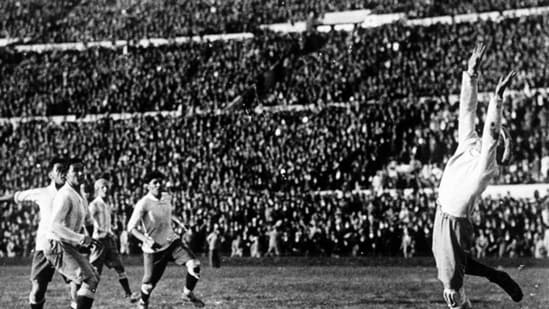
Pedro Cea levelled for Uruguay in the 57th minute. Santos Iriarte’s powerful strike then put the hosts ahead before Héctor Castro completed a 4-2 victory in the closing stages. The pattern was almost too perfect. Argentina had won the opening half 2-1 with its preferred ball. Uruguay won the second 3-0 with its own.
It became easy to conclude that the ball had decided the first World Cup final. The theory is not entirely absurd. Footballs in 1930 were made from hand-cut leather panels stitched around an inflatable bladder. They were closed with thick laces, which could make heading painful and affect the consistency of the surface. Inflation levels varied, leather absorbed moisture, and two legally approved balls could behave very differently.
A softer ball might suit close control and short passing. A firmer or heavier one could encourage direct play, long shooting and physical contests. Players accustomed to one construction could immediately feel uncomfortable with another.
Yet there is no reliable measurement proving exactly how the two final balls differed, nor any scientific evidence showing that one favoured Argentina and the other Uruguay.
Uruguay had, after all, scored the opening goal while using Argentina’s football. Their second-half recovery also had explanations beyond the equipment. The hosts increased the pressure, drove Argentina deeper and fed off a fiercely partisan home crowd. Argentine forward Francisco Varallo was struggling with a knee injury, while substitutions were not available as a routine tactical solution.
The ball may have influenced touch, confidence and rhythm. It cannot reasonably be treated as the sole cause of Uruguay’s comeback.
There is also a deeper uncertainty surrounding the story. While the dispute itself is well documented, some historians question whether the ball was definitely changed at half-time. Langenus later wrote that both countries produced their own football and that a toss was needed to settle the matter. However, the surviving passage from his memoir does not clearly state that one ball was used in each half.
Contemporary newspaper reports apparently provide little explicit reference to a half-time replacement, while some match photographs have been interpreted as showing an Argentine-style 12-panel ball after the interval.
That leaves open another possibility: the coin toss may simply have selected one football for the entire match, with the one-ball-per-half compromise becoming accepted through later retellings.
FIFA continues to recognise the traditional version, and football museums have displayed separate balls said to have been used during each half. Nevertheless, questions over their provenance and the lack of conclusive contemporary documentation prevent the account from being treated as completely beyond dispute.
What is certain is that the 1930 final reflected an era before football became standardised. Uruguay won 4-2, becoming the sport’s first world champions. Argentina returned home believing a final had slipped away. Between them remained two leather footballs, a coin toss and a controversy still being debated nearly a century later.