Arsenal ended a 22-year Premier League wait on Tuesday after Manchester City’s 1-1 draw at Bournemouth confirmed Mikel Arteta’s side as champions with one match still to play.
City needed to win to take the title race into the final weekend after Arsenal’s 1-0 victory over Burnley had moved them to the brink. Bournemouth struck first through Eli Junior Kroupi, and although Erling Haaland equalised in stoppage time, City could not force the winner that would have kept the race alive. The draw left Arsenal four points clear, making the final league match against Crystal Palace a trophy-lift occasion rather than a title decider.
How Arsenal finally turned control into a title
The title is Arsenal’s first since the 2003-04 Invincibles season and their 14th English top-flight crown. It also ends a long sequence of frustration under Arteta, whose side had finished second in each of the previous three Premier League seasons before finally crossing the line this time.
Arsenal’s triumph was not built on a late emotional surge alone. Their title charge had a clear statistical spine. They conceded just 26 league goals, at least six fewer than any other side, and produced one of the strongest defensive seasons in the club’s Premier League history. Only Arsenal’s 1998-99 side, which conceded 17, allowed fewer in a Premier League campaign.
That defensive base became decisive in the run-in. After losing 2-1 away to Manchester City, Arsenal responded with four consecutive league wins without conceding. That sequence mattered because it directly answered the question that had followed Arteta’s team for three years: whether they could absorb pressure when City were still alive behind them. This time, Arsenal did not blink.
Set-pieces also became a major part of Arsenal’s title identity. By early April, they had scored 21 goals from set plays and conceded only eight from those situations, giving them a set-piece goal difference of plus 13. That margin was more than twice as strong as the second-best side at that stage, underlining how much Arteta’s team converted dead-ball detail into league-table separation.
The balance of the side told its own story. This was not Arsenal at their most romantic or free-flowing in the Wenger-era sense. It was a harder, more controlled version: compact without the ball, clinical from restarts, mature in game management, and less vulnerable to the chaos that had damaged previous title pushes.
Also Read: Arsenal’s 22-year drought for Premier League title ends as Manchester City draws with Bournemouth
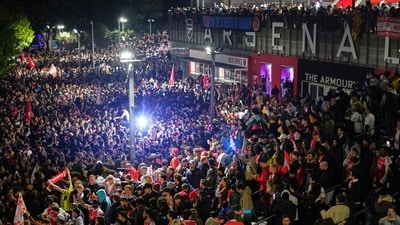
The emotional release was immediate. Arsenal’s players and staff watched City’s match together and celebrated when the final whistle at Bournemouth confirmed the title. Supporters gathered around the Emirates Stadium, while celebrations also broke out at the training ground. Arsene Wenger’s congratulatory message through an Arsenal club video added historical weight to the moment, connecting Arteta’s title winners with the last Arsenal team to finish a league season on top.
Arteta’s role now has a different frame. He arrived in December 2019 with Arsenal outside the true title conversation and has rebuilt the club through discipline, recruitment, structure and repeated pain. The previous three runner-up finishes could have become a scar. Instead, this season turned them into proof of endurance.
Arsenal’s domestic job is complete, but their season still has one more giant door to kick open. They face Paris Saint-Germain in the Champions League final on May 30. A Premier League title already restores Arsenal to the summit of English football. A European crown would turn this campaign into one of the greatest in the club’s history.