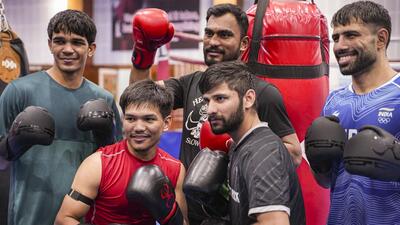
Mumbai: Since the start of the year, coaches in India’s national boxing camp had made it a point to organise at least one fun-filled evening every month. A simple affair, with song and dance being a prominent feature, sometimes even a fancy dress party.
“The last one we had was a beach theme, and I got first prize,” men’s boxing team head coach CA Kuttappa beams with pride as he tells HT. “These are evenings we have to lighten the mood, bring some kind of change to the routine and help everyone bond.”
Recent prizes have included chocolates, a pack of Uno cards and miniature boxing gloves.
Since August though, bigger nights of celebration have been in the works, to toast the strong showing by the boxing contingent at the Glasgow Commonwealth Games. The activity, however, has been put on hold for the time being. Right now, the aim is to build on the CWG momentum in the tougher competition that the Asian Games in Aichi-Nagoya from Sept 19-Oct 4 will be.
The women boxers returned from Glasgow with five gold medals and a silver. And there was an upswing in performance from a young men’s team that won two gold and silver medals each. This a year after the Indian men failed to even secure a podium spot at the World Championships for the first time in 12 years.
While the women’s team has continued to thrive, the men had struggled. Until the Glasgow upturn in performances. “The boys did exceptionally well, and to be honest, I never thought we would get such results,” said the Dronacharya awardee.
Kuttappa was re-appointed head coach of the men’s team in January for his third stint as national coach. Soon after, in collaboration with women’s team coach Santiago Nieva, he started to make a few changes in the way the boxers trained.
“What would generally happen is the players would come in for training, spar, and then leave. And that’s it. I told all the coaches to watch the sparring sessions, and then analyse the videos of those sessions,” Kuttappa said.
“Then we would bring the boys and give them point-wise explanations of what went well, what needed to change. But importantly, we would talk more about the positive stuff, and then make them work on correcting the errors.”
A major part of the feedback was to change the focus of each bout. Instead of winning, the target was more performance-oriented – making sure the punches were accurate and the blocks were perfect.
“If I tell the boys they have to win, then they will start to fear losing. Instead, we have a step-by-step process. The main thing is they need to put up a fight so that even if they lose, people will say it was a solid performance. You do the simple things right and the results will follow.”
At the Commonwealth Games, Sachin Siwach (60kg) and Ankush Panghal (80kg) won gold after pulling off hard-fought wins in their finals. Jadumani Singh (55 kg) and Narender Beral (+90kg) took silver. The quartet, with Sumit Kundu (70kg) and Kapil Pokhariya (90kg), will form the men’s boxing contingent at the Asian Games.
Similarly, each of the five women’s pugilists at the Asian Games also competed at the Commonwealth Games. With that in mind, Kuttappa and Nieva ensured camaraderie was forged in the Indian boxing contingent.
“Everyone trains together, and at the CWG, the boys were cheering for the girls’ matches and the girls were supporting during the boys’ bouts,” Kuttappa said. “There is good team bonding. We are a family, and we’re all together.”
After the Glasgow performances, there’s optimism about the chances of a resurgent men’s team in Japan.
“Once we come back,” Kuttappa added, “we hope to have a double reason to celebrate.”
Indian boxers though have won only eight gold medals in the Asian Games, heavyweight Hawa Singh having won two of them in 1966 and 1970.