
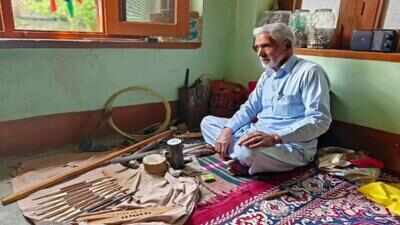
Talk about Pashmina and we are transported to Kashmir’s beautiful valleys where it is said that every handwoven shawl begins with delicate fibres and skilled hands. But behind every shawl made of Pashmina is a small wooden instrument that rarely receives attention. It is the main ‘unsung hero’ behind every beautiful textile. Known locally as the Mukh, this shuttle carries threads back and forth across the loom. This is what makes the weaving process possible.Now at the back of it is 75-year-old Abdul Majeed Zargar. He is craftsman from Amda Kadal Jogiwan in Srinagar, who is believed to be the last person in Kashmir who continues to make these wooden shuttles all by hand. Now the man is teaching his son how to build a mukh in the hope that the knowledge will survive beyond his lifetime.Meet the last maker of MukhZargar learned it when he was a young man looking for a livelihood. He experimented with silver-making before moving on to knife-making but neither worked out for him. He eventually decided to learn how to make Mukhs.However, mastering the craft took nearly a year. His early attempts were far from perfect, and he struggled to produce shuttles that met the expectations of experienced weavers.He decided to take his handmade pieces to different workshops in search of buyers. Initially people rejected them but an encounter with a sazvari (a trader dealing in weaving tools) in Khayam changed his life.The trader introduced him to experienced craftsmen who examined his work. Although they identified several flaws, they bought three pairs of his shuttles for Rs 40.Zargar later discovered that the pieces had never actually been used. When he asked why they had purchased defective products, the craftsmen explained that they wanted to encourage him rather than let him give up.“If we had not bought them, you would have lost hope,” they told him, as recalled in his conversation with Kashmir Life.The craftsmen also recommended him to other weavers and traders, helping him find customers who needed new shuttles or repairs.Keeping Pashmina weaving alive
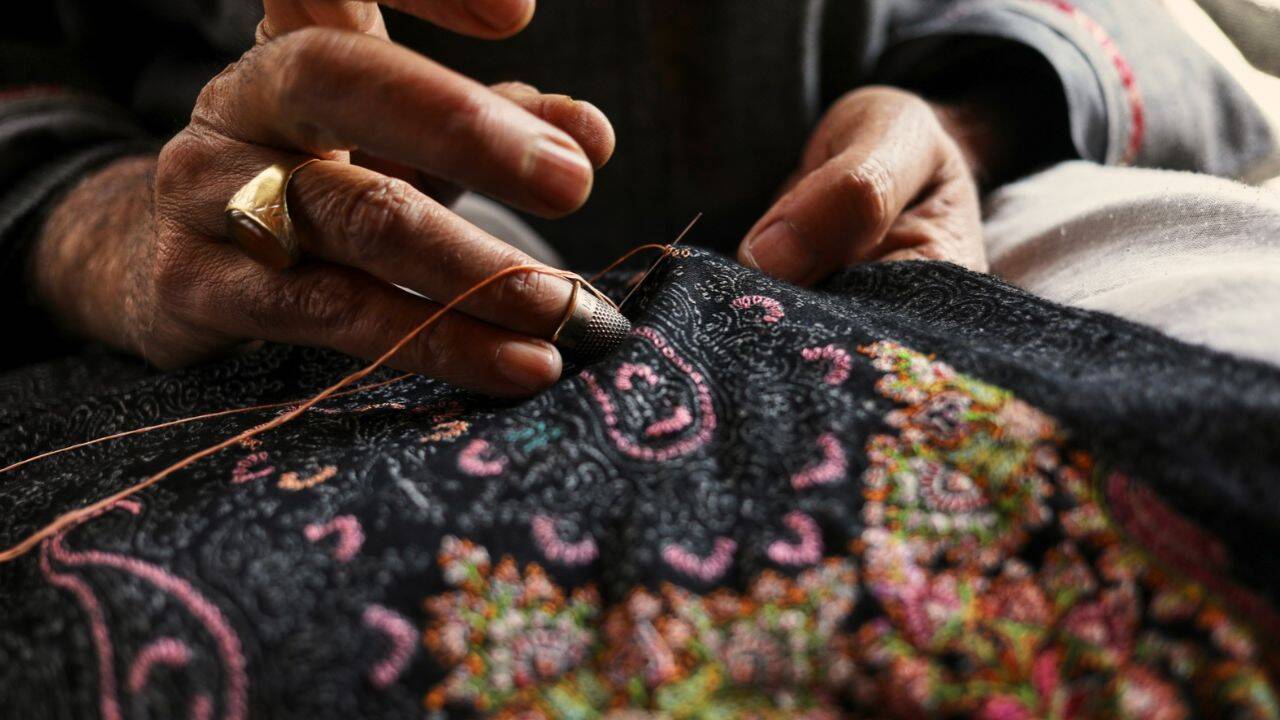
Kashmiri Shawl in making (Canva)
A Mukh might look like an ordinary wooden object, but it’s very important in traditional weaving. It is essentially a shuttle or throw shuttle that carries the weft yarn through the warp threads, moving from one side of the loom to the other. This repeated movement gradually forms the fabric.Kashmir Pashmina a registered GI productThe Government of India’s compendium of handicrafts and handlooms covered under Geographical Indications also documents Kashmir Pashmina as a registered GI product, with its registration dating to September 12, 2008.For Zargar, therefore, the Mukh is much more than a wooden implement.Over the years, he has also introduced improvements to the traditional design. Earlier, the metal components used in Mukhs were made of iron, which could rust with time. He replaced these parts with brass, making the shuttles more durable and resistant to corrosion.According to a May 2025 report by Kashmir News Observer (KNO), he has made thousands of these shuttle boats and supplied them to artisans across Kashmir.A craft that’s disappearingDespite spending nearly five decades perfecting his skills, Zargar is increasingly worried about the future of his occupation.In its May 2025 report, KNO noted that Zargar had attempted to teach others but struggled to find interested apprentices. Many young people, he explained, preferred computer-based jobs or employment in cities. He has also expressed disappointment over the limited institutional understanding of the importance of such tools.Teaching his son to keep the art aliveNow Zargar is making sure that his son knows it. The biggest concern is not simply that his livelihood may disappear, but that a specialised skill accumulated over decades could vanish with him.After unsuccessful attempts to train other people, he has now turned to his own family. He is teaching his son the process of making Mukhs, hoping that the next generation will continue the work.It is a painstaking skill that requires patience, precision and an understanding of what weavers need from the shuttle. Zargar’s work represents an occupation which is disappearing now. His wooden shuttles may never receive the attention given to an embroidered Pashmina shawl, but without them, traditional handloom weaving would lose an essential instrument.