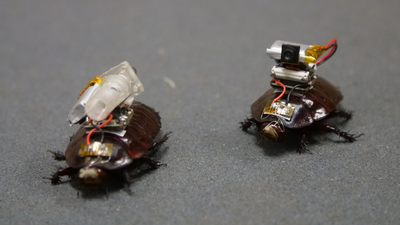
Small robots and drones have come far from their original aims of creation. From hospitality service to spiritual guidance and even disaster response, they are being deployed in numerous fields. Recently, numerous locations across the world have suffered through major disasters, including earthquakes, and victims are still being searched for in rescue operations that have lasted for weeks.Now, new research shows how bugs, with their ability to crawl through even narrower gaps in rubble, could be used as the next generation of first responders. A research team from the University of Queensland (UQ) and the University of New South Wales (UNSW) have developed the ‘Paraborg ‘ to not only help with searching for victims but also administering first aid. “Cyborg insects have been designed for ‘search and explore’ missions for the past couple of decades,” Tan Vo Doan, a bio-robotics researcher at UQ, said in a press release. “We wanted to take the next step.”
A cockroach inspired by one
The team relied on a giant burrowing cockroach that inhabits northern Queensland to develop the Paraborg, which they documented in a recent paper published in Advanced Science. The armoured cockroach is up to 87mm (3.5 inches) in length and weighs up to 40 grams (1.4 ounces).Taking advantage of this large size, the research team developed two types of Paraborgs with different functions: one equipped with a camera to film the condition of disaster victims, and another with an automatic injection mechanism to administer medication.A cockroach can carry up to 1.5 times its body weight. In practice, the bug, equipped with the injection mechanism, saw its total height increase by about 15mm and its weight by about 17 grams, which the study found did not significantly impair its normal movements.To create the cyborg cockroaches, the team anaesthetised them when the electrodes and microchips were attached, and they lived as normal cockroaches once the equipment was removed. By applying electrical stimuli to electrodes embedded in the cockroach’s antennae and cerci, a pair of protruding sensory organs at the rear of the abdomen, researchers were able to remotely control the bug’s direction of travel and walking speed.They were able to steer the roach by stimulating each antenna independently, while stimulating both cerci controlled the pace. The scientists administered different frequencies between 10 and 40 hertz after finding that anything over 50 hertz became ineffective over time.The injection mechanism is a small device that deploys a syringe using a spring system. This triggers a process that breaks the seal between a chamber containing citric acid and another containing baking soda. The resulting chemical reaction, similar to what you might’ve done as a kid to make a volcano with baking soda and vinegar, creates enough carbon dioxide to push the plunger on the syringe and administer medication.For the study, the research team remotely controlled a cockroach to travel from its starting point through three checkpoints and administer an injection to a simulated target.
Shocking results
The results showed that the success rate for injections made at close range – within 150mm of the target- topped out at approximately 95%. The success rate for the entire sequence of tasks – from departure to completion of the injection- was 72%. The researchers also successfully demonstrated teamwork, where one cockroach uses a camera to locate a simulated target while another serves as the injector.Although the research team has previously developed cyborg beetles capable of climbing walls, they note that larger cockroaches are better suited for carrying specialised rescue and medical equipment.While the results of the new research are promising, the experiment didn’t replicate the complex environmental conditions found at actual disaster sites, such as debris, uneven terrain and shifting landscapes. Vo Doan expressed hope that, if resources can be secured to speed up research and field testing, a rescue team of cyborg insects could be deployed at actual disaster sites within five to 10 years.“Rather than building one robot to do everything, we can harness the natural strengths of different insects and equip them for different missions,” Vo-Doan said.