
New Delhi: The 2016 Rio Games witnessed a hegemonic shift in men’s badminton. The Riocentro was packed, ready to witness the legendary Lin Dan, arguably the greatest ever shuttler, claim a third successive Olympic medal. Having lost the semis to his long-time nemesis Lee Chong Wei, the Chinese superstar was vying for bronze.
But unexpectedly, the result went in favour of a lanky 22-year-old Viktor Axelsen at the other end, who silenced the arena, vociferously cheering for the five-time world champion. It was a passing of the baton, a changing of the guard as the youngster went on to dominate the sport for the next decade before surprising everyone by announcing his retirement on Wednesday.
“Today is not an easy day for me. Due to my recurrent back issues, I am no longer able to compete and train at the highest level,” the 32-year-old Dane posted on social media. “Accepting this situation has been incredibly difficult. But I have now reached a point where my body won’t allow me to continue.”
The former world No.1 had been struggling with back issues for the last couple of seasons, undergoing multiple surgeries. But in the end, after years of physical turmoil, his body had given up.
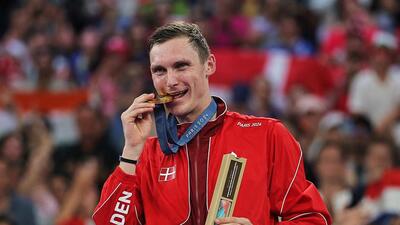
But not before Axelsen charted a legacy that stands out from other champions, scripting several records and giving badminton aficionados lasting memories. He was truly Lin Dan’s successor, winning two consecutive Olympic gold medals in Tokyo 2021 and Paris 2024, becoming only the third singles player to do so after Zhang Ning (women’s in 2004 and 2008) and Lin Dan himself (2008 and 2012).
Axelsen also went on to clinch two World Championships (2017, 2022) and All England titles (2020, 2022) apart from holding the No.1 position for 183 weeks, the third-longest reign after Lee Chong Wei (398) and Lin Dan (211).
But more than anything, it was his on-court dominance that stood out, leaving a lasting impact on the sport. At 6’4” tall, Axelsen’s reach, steepness of smash, court coverage suffocated his opponents.
But what set him apart was his professionalism and discipline which led him to attain such a level that the court seemed to shrink for his opponents and expand for him. Every lift from the opposition felt like a death for the bird while every defensive block he made felt like an intentional setup for the next kill.
But the real tribute to Axelsen was how he evolved, taking the traditional European power game and fusing it with an obsessive Asian-style technical precision.
The rebel
Axelsen not just challenged himself but also the traditional structures of sport, which are usually rigid, more often than not disrupting the existing order. To prioritise and enhance his game, he shifted his training base from Denmark to Dubai in 2021 — his most significant act of rebellion.
By leaving the national centre in Brondby, he moved out of the Danish system to reduce travel time to Asia — the centre of global badminton — and to also tend to his asthma and rhinitis allergy. But the real reason behind the move was the fact that he wanted total control over his environment.
The two-time Olympic champion received major flak in his home nation but Axelsen stood his ground, breaking the federation monopoly. He arranged his own funding, coaching, support staff, and invited top players from all over the world (including India’s Lakshya Sen and Ayush Shetty) to train with him in his own ecosystem. This ‘open borders’ training approach was unheard of until then in international badminton.
Simultaneously, he was also a great advocate for players’ rights, publicly calling out the Badminton World Federation (BWF) many-a-time for the gruelling calendar which led to injuries, prize money delays and fines (remember 2023 and the $5,000 fine?) and generally spoke against issues other shuttlers were scared to speak about.
In a massive breakaway from the western world, Axelsen also learnt Mandarin which allowed him to communicate directly with his massive fanbase in Asia, building a personal brand. His ability to communicate with different cultures (he has a huge fanbase in India too) was never seen before.
These characteristics displayed Axelsen’s lone wolf mentality, both on-and-off-court. In Dubai, he often was his own coach, proving that a player could reach the absolute pinnacle trusting himself. He became a lone wolf because he didn’t want tradition to get in the way of excellence. He bet on himself and delivered the results — a blueprint for others to follow.