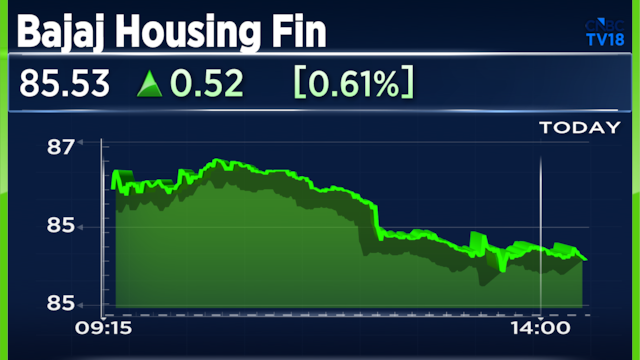
The price target implies an upside potential of 8% from Wednesday’s closing levels.
Jefferies expects Bajaj Housing Finance to deliver a 23% compound annual growth rate (CAGR) in assets under management (AUM) over financial year 2026-2029, ahead of most prime housing finance companies. However, the brokerage expects pressure on spreads to persist in the near-term, while the stock’s premium valuation limits the upside potential.
Growth outlook remains strong
Jefferies said Bajaj Housing Finance’s growth should be supported by the company’s micro-market-focused sourcing strategy, strong developer relationships and a network of more than 9,800 approved project finance projects.
Bajaj Housing Finance, India’s second-largest housing finance company, had an AUM of ₹1.5 lakh crore as of June 2026. It focuses primarily on the mass-affluent segment, with an average home-loan ticket size of ₹49 lakh.
Jefferies expects the company’s earnings per share (EPS) to grow at around 20% CAGR over FY26-29, with return on assets (ROA) reaching around 2% and return on equity (ROE) 13.6% by financial year 2029. It forecasts net profit to rise from ₹2,570 crore in FY26 to ₹4,430 crore by financial year 2029.
The brokerage also noted that Bajaj Housing Finance plans to increase its non-prime loan mix to 20% from 12%, which could support yields. Its Sambhav business, focused on emerging and affordable segments, is also expected to scale, with management targeting a ₹600 crore-plus monthly run-rate by the end of financial year 2027, compared with ₹450 crore – ₹470 crore in June 2026.
Premium valuations cap upside
Despite the strong growth outlook, Jefferies said Bajaj Housing Finance trades at a premium to most housing finance peers. The stock trades at around 2.6 times March 2027 estimated book value and 24 times March 2027 estimated earnings, compared with lower valuations for most listed housing finance companies.Jefferies price target of ₹92, is based on a 2.4-times price-to-book valuation on September 2028 estimates. The brokerage sees downside risks from asset-quality pressures in the loans-against-property and developer-finance portfolios, along with lower growth and greater net interest margin pressure.
Spreads: A key concern for Bajaj Housing
Jefferies expects pressure on spreads to continue, although it believes they are nearing a bottom. Bajaj Housing Finance’s spreads have already declined 23 basis points since September 2025, largely due to lower yields following rate cuts and the company’s 35% fixed-liability base.The brokerage expects another 6-10 basis points of pressure as new home-loan yields remain below portfolio yields amid intense competition. However, it expects spreads to stabilise over the next few quarters and improve if the interest-rate cycle turns.
Asset quality: Bajaj Housing Fin’s key strength
Jefferies highlighted Bajaj Housing Finance’s asset quality as best-in-class, with gross Stage 3 loans at 0.29% and Stage 2 loans at 0.32% as of June 2026, among the lowest across housing finance peers.
The company’s home-loan book stood at ₹80,900 crore, accounting for 54% of AUM, while lease rental discounting contributed 23.1%, developer financing 11.4% and loans against property 10.3%. Home-loan customers are predominantly salaried, at 83%, while around 78% have a credit score of 750 or above.
According to Bloomberg analysts’ data, 18 analysts track Bajaj Housing Finance, with seven having a ‘Buy’ rating, six ‘Hold’, and four ‘Sell’, while one source is not rated. The 12-month consensus target price is ₹94.76, implying a 10.8% return potential from the last price of ₹85.51.
Shares of Bajaj Housing Finance ended 0.8% higher on Wednesday at ₹85.66. The stock is still down 11% so far this year and is trading just above its IPO price of ₹70. The stock is now significantly below its post-listing high of ₹188.
Also read: Best earnings season in years, but Jefferies says Indian markets remain expensive