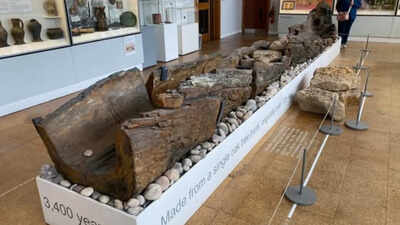
A new exhibition opening at the University of Nottingham Museum is bringing together decades of archaeological work along the River Trent, one of Britain’s most extensively studied river valleys. Prehistoric Lives in the Trent Valley, curated by researchers from York Archaeology, draws on artefacts, pollen samples, animal remains and layers of sediment recovered from sites across the valley, built up through years of fieldwork tracking how prehistoric communities settled, adapted and left their mark on a landscape that was constantly reshaped by the river itself. Among the finds featured is a Bronze Age log boat pulled from a quarry near Shardlow in Derbyshire, one of the clearest physical traces of how people used the Trent thousands of years before written records existed.
How gravel quarrying uncovered Bronze Age boats beneath England’s floodplain
Much of the valley’s prehistoric evidence has come not from planned digs but from ongoing commercial gravel quarrying, which has exposed ancient river deposits during construction work. According to Derbyshire County Council’s Historic Environment Record, the official county archive of archaeological sites, a Bronze Age log boat was recorded at Shardlow Quarry near Weston-upon-Trent, found bedded into silt at the base of an old buried river channel. The vessel measured roughly 8 metres long with a beam of about 1 metre, and its upper edges suggested the boat had survived largely intact, with only two breaks near the bow and stern.An earlier log boat had already been discovered at the same quarry in 1998, carved from a single hollowed-out oak tree and dated to roughly 3,400 years ago, placing it firmly within the Bronze Age. According to a peer-reviewed study of the site published in the journal Catena, archaeologists and geoarchaeologists have monitored extraction at Shardlow quarry on a weekly basis since the late 1990s, a rare example of sustained, long-term site monitoring that has revealed multiple log boats, timber structures, ancient peat deposits and buried river channels preserved beneath the modern floodplain.
Why the Trent Valley has produced so much prehistoric evidence
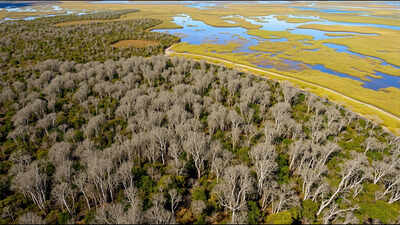
The reason so much has survived beneath the Trent Valley comes down to the river’s own geological history. Repeated flooding and channel shifting over thousands of years buried organic material, wooden structures and artefacts under layers of silt, sand and gravel, protecting them from the kind of decay that destroys similar material in drier, more disturbed environments. According to Historic England, the country’s official heritage body, log boats like the one found at Shardlow represent some of the earliest evidence of water transport in prehistoric Britain, offering rare physical proof of how communities moved people and goods along rivers long before roads existed in any organised form.This pattern of preservation extends beyond boats alone. Excavations across the valley have also uncovered Iron Age settlement remains, including a roundhouse identified at Hoveringham in Nottinghamshire, adding evidence of permanent habitation to the picture built up from earlier prehistoric finds of boats, tools and metalwork recovered from the river’s ancient channels.
How the new exhibition brings this research together
According to the University of Nottingham’s Lakeside Arts, which is hosting the exhibition, Prehistoric Lives in the Trent Valley opened on July 24, 2026, and will run until January 10, 2027, with free admission. The exhibition was curated by Dr David Knight, honorary research fellow at the University of Nottingham and head of research at York Archaeology, alongside Dr Kristina Krawiec, head of geoarchaeology, and Dr Steve Malone, senior researcher, both also of York Archaeology.Rather than presenting artefacts in isolation, the exhibition combines physical finds with environmental evidence such as pollen and sediment records, reflecting how researchers have approached the valley’s archaeology for decades. Dr Knight said the exhibition offered an opportunity to display a range of archaeological finds that had not previously been shown publicly, giving visitors deeper insight into the valley’s paleoenvironmental and archaeological history.
Why combining artefacts with environmental evidence matters
Studying pollen grains, animal bones and sediment layers alongside physical artefacts allows researchers to reconstruct not just what people made and used, but the changing landscape they lived in. This kind of environmental evidence can reveal shifts in vegetation, flooding patterns and land use over time, helping archaeologists understand why communities settled where they did and how the river’s own behaviour shaped human activity across thousands of years.Dr Clare Pickersgill, keeper of the University of Nottingham Museum, said the exhibition offered insight into the Trent Valley and its inhabitants across this extended period, alongside a related Festival of Archaeology event where visitors could learn more about the science behind the discoveries. A further exhibition talk, featuring Dr Knight and Dr Malone discussing how the River Trent has changed over time, is scheduled for November 12, 2026, at the museum’s Djanogly Theatre.
What ongoing quarry work continues to reveal
Because much of this archaeological material continues to be uncovered through active gravel extraction rather than planned excavation alone, researchers say the valley remains a live site of discovery even today. The decades-long monitoring arrangement at Shardlow, sustained through cooperation between archaeologists and quarry operators, has already produced far more material than a single excavation season could achieve, and researchers expect further finds as extraction continues in other parts of the valley.For visitors to the exhibition, the through line connecting a Bronze Age log boat, an Iron Age roundhouse and thousands of years of sediment is the river itself, a constantly shifting waterway that both shaped the lives of the people who settled along it and, through burial and preservation, ended up recording much of that history for archaeologists to eventually uncover.